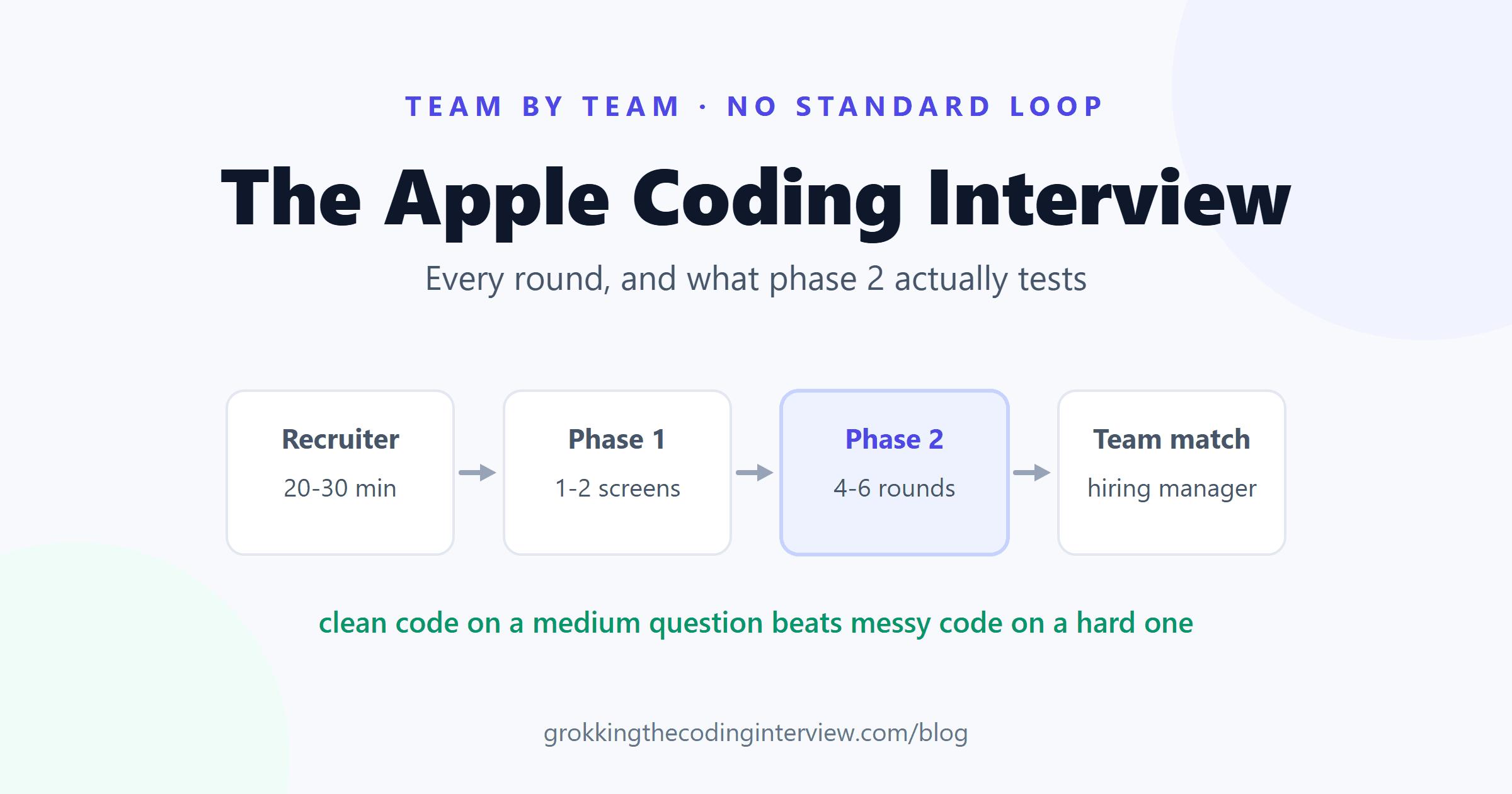
TL;DR: Apple hires team by team, so there is no single standard loop. Most candidates go through a recruiter call, one or two technical phone screens, then an onsite phase of four to six rounds. That onsite phase is what recruiters call phase 2. It tests clean, working code more than clever algorithms. Expect at least one round where you debug or improve existing code instead of writing new code from a blank file.
Apple is the least standardized interview among the large tech companies. Google and Meta run one central process. Apple lets each team build its own.
This matters more than any list of questions. Two candidates can interview at Apple in the same month and go through loops that share almost nothing. The team you apply to decides the rounds, the difficulty, and the follow-up questions.
This article walks through the phases most candidates see. It explains what phase 2 grades, and shows the one habit that separates Apple from the other big loops.
The phases, start to finish
Recruiters at Apple often describe the process in phases. Here is the shape most software engineering candidates report.
| Phase | What happens | Length | What it decides |
|---|---|---|---|
| Recruiter call | Background, team fit, logistics | 20 to 30 min | Whether you continue |
| Phase 1 | One or two technical phone screens | 45 to 60 min each | Whether you reach the onsite |
| Phase 2 | The onsite loop, four to six rounds | Half a day to a full day | The hire decision |
| Team match | Discussion with the hiring manager | Varies | Which team you join |
The number of rounds moves with the level. A junior role may have four. A senior role may have six or more, with a design round added.
Phase 1: the technical phone screens
The first screen is usually one engineer and one coding question, run on a shared editor. Most teams use CoderPad. You will be asked about your resume first, then given a data structures and algorithms question.
The difficulty here is moderate. Think of a medium problem on a common pattern: two pointers, a hash map, a tree traversal, or a sliding window. The screen is a filter, not the real test.
One detail catches people out. Apple screeners often ask you to run the code. Many candidates practice writing code that looks right and never practice making it compile. Write in an editor with no autocomplete for a few weeks before this round.
Phase 2: what the onsite actually tests
Phase 2 is the onsite loop. It is usually four to six rounds in one day, each about 45 minutes to an hour, with different engineers.
A typical mix looks like this:
- Two coding rounds. Standard algorithm questions, with follow-ups.
- One round on code quality. Debugging, refactoring, or extending code you did not write.
- One domain or language round. Deep questions about the language you chose, or about the team's area.
- One or two behavioral rounds. Past projects, conflict, and how you work.
- A design round for senior candidates. System design, or object oriented design for some teams.
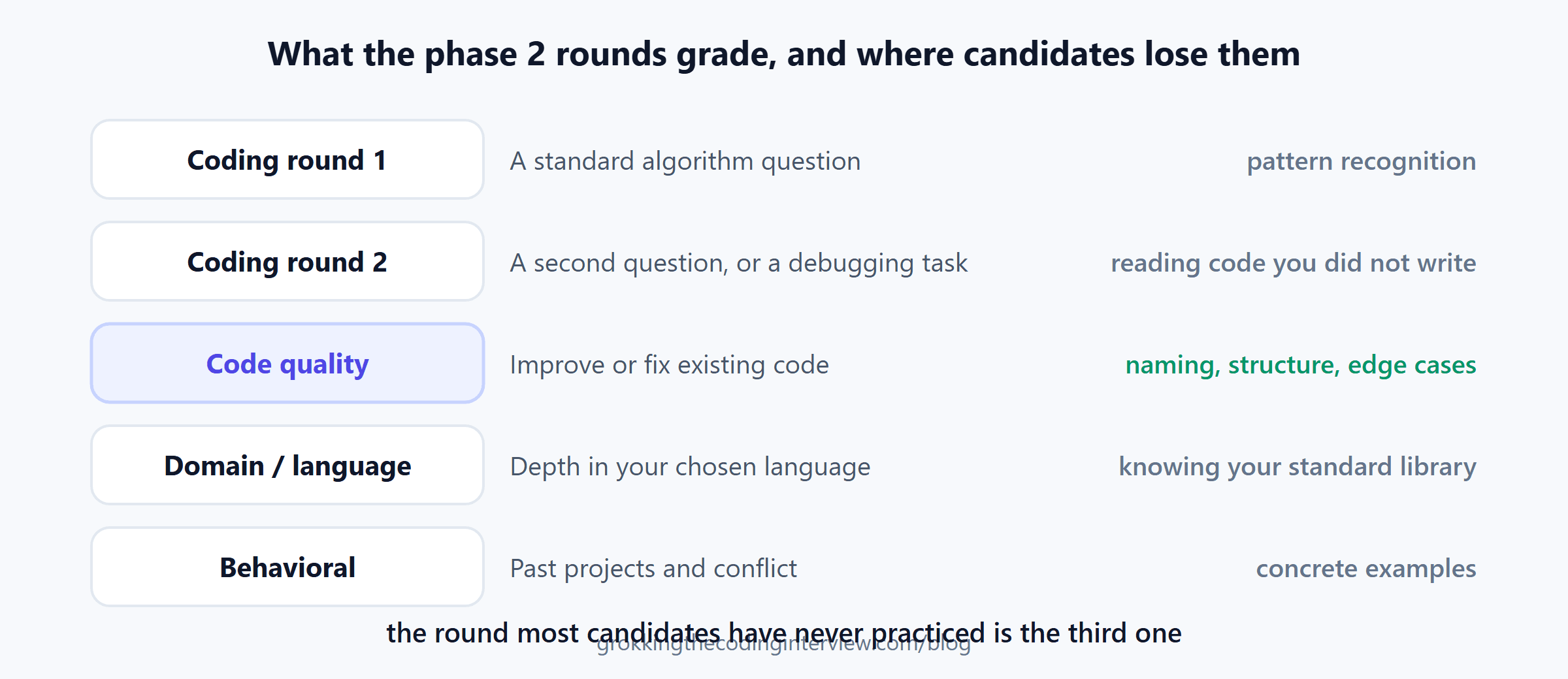
The coding rounds look familiar if you have prepared for any large company. The third one is where Apple differs.
The code quality round
Some Apple teams hand you working code that is badly written and ask you to improve it. Others hand you broken code and ask you to find the bug. Either way, you are not starting from an empty file.
This round rewards a different skill than LeetCode practice builds. You need to read unfamiliar code quickly, form a theory about what it does, and test that theory. Then you make a small, safe change and explain why it is safe.
Practice this directly. Solving problems on a blank file does not train it. Take an old solution you wrote months ago. Read it cold and explain it out loud. Then make it handle one new case.
The habit that decides Apple loops
At Apple, how the code reads counts for more than at most companies. Interviewers there weigh naming, structure, and edge case handling heavily. A correct solution written carelessly can still fail the round.
This is a real difference, not a small one. At Google, an elegant solution to a hard question carries the round. At Apple, a clean solution to a medium question often scores better than a messy solution to a hard one.
Three things to do in every Apple coding round:
- Name things properly.
leftandright, notiandj.seenCounts, notmap. - Handle the empty case out loud. Say what happens on an empty input before you are asked.
- Write one small helper when a block of logic gets long. Interviewers notice this.
Say your reasoning while you work. The interviewer is grading how you think, and silence hides all of it. Our guide on how to talk through a coding problem covers the exact phrasing to use at each step.
Which patterns show up
Apple asks standard interview patterns. There is no secret Apple-only family of questions.
The ones that appear most often in candidate reports:
- Arrays and strings: two pointers, sliding window, prefix sum
- Hash maps: counting, grouping, lookup in one pass
- Trees: depth first search, level order traversal
- Graphs: breadth first search on a grid, matrix traversal
- Heaps: top K elements
- Dynamic programming: less often, and usually the simpler families
If you know the tell for each of these, you can name the family within a minute of reading the question. That is the skill Apple rounds reward, because the remaining time goes into writing the code well.
Grokking the Coding Interview teaches all 41 patterns this way. You learn the tell that identifies each family, the template that solves it, and the variations interviewers use to disguise it.
Language choice at Apple
Most Apple teams let you pick your language. Some teams do not.
Teams working on iOS and macOS may expect Swift or Objective-C. Teams in services and infrastructure are usually open. Ask the recruiter before phase 2, and ask specifically: "Is there a language this team expects for the coding rounds?"
If you have a choice, pick the language you write fastest and most correctly. Our comparison of Python, Java, C++, and Go for coding interviews covers the trade-offs, including where each one costs you time.
How Apple compares with the other large loops
| Apple | Meta | Amazon | ||
|---|---|---|---|---|
| Process | Team by team | Central and standard | Central and standard | Central and standard |
| Algorithm difficulty | Medium, some hard | Hard | Medium to hard | Medium |
| Code quality weight | High | Medium | Medium | Medium |
| Speed pressure | Lower | Medium | High, two questions per round | Medium |
| Behavioral weight | Medium | Medium | Medium | High, the leadership principles |
The practical result: Apple gives you more time per question and expects more polish in return. Meta gives you less time and expects speed. Prepare differently for each.
For the other loops, see our guides to the Amazon coding interview, the Google coding interview, and the Meta coding interview.
A four week plan for an Apple loop
If you have a phase 2 scheduled, spend your time like this.
Week 1 and 2: pattern coverage. Work through the core families listed above, grouped by pattern rather than at random. Solve about ten problems per pattern.
Week 3: code quality. Solve fewer problems. For each one, write the solution, then rewrite it to read better. Time both versions. Then take three old solutions and debug them cold.
Week 4: full rounds. Run timed mock rounds with a person, out loud, in CoderPad. Say every step. Handle edge cases before being asked.
Do not spend the final week on hard dynamic programming. Apple asks it rarely, and the round you are most likely to fail is the code quality one.
Frequently asked questions
What is phase 2 at Apple? Phase 2 is the onsite loop, the stage after the technical phone screens. It is usually four to six rounds in one day, mixing coding, code quality, domain knowledge, and behavioral questions. It is the stage where the hire decision is made.
How many rounds does the Apple interview have? Most candidates see six to eight interactions in total: a recruiter call, one or two phone screens, and four to six onsite rounds. The exact count depends on the team and the level, because Apple teams design their own loops.
Is the Apple coding interview harder than Google's? The algorithm questions are usually easier than Google's. The bar for code quality is higher. Candidates who grind hard problems but write messy code often find Apple harder, and candidates who write clean code find it easier.
Does Apple ask system design questions? Yes, for mid-level and senior roles. Some teams ask object oriented design instead, especially teams working on applications. Ask your recruiter which one your loop includes, because the preparation is different.
Can I choose my programming language at Apple? Usually yes. Teams working directly on iOS or macOS may expect Swift or Objective-C. Confirm with your recruiter before the onsite, since it changes how you practice.
Does Apple ask LeetCode questions directly? Apple asks questions in the same families as LeetCode problems, but interviewers usually rewrite them. Learn the patterns rather than memorizing specific problems, because a memorized solution falls apart when the wording changes.
Related reading
- Coding Interview Patterns: The Complete List
- How to Talk Through a Coding Problem
- The Amazon Coding Interview
- The Google Coding Interview
- The Meta Coding Interview
Related guides
- Google's AI-Assisted Coding Interview: How It Differs from Meta's
- Meta's AI-Assisted Coding Interview: What Changed and How to Prepare
- How Many LeetCode Problems: The Numbers by Target Company, Per Day, and In Total
- Start Here: The Coding Interview Guide Library
Prepare with the pattern method: Grokking the Coding Interview: Patterns for Coding Questions covers all 41 patterns (30 common + 11 advanced) with the tell, the template, and the variations for each, plus more than 300 hand-picked problems in Python, Java, JavaScript, C++, C#, and Go. It costs $79 once, with lifetime access.