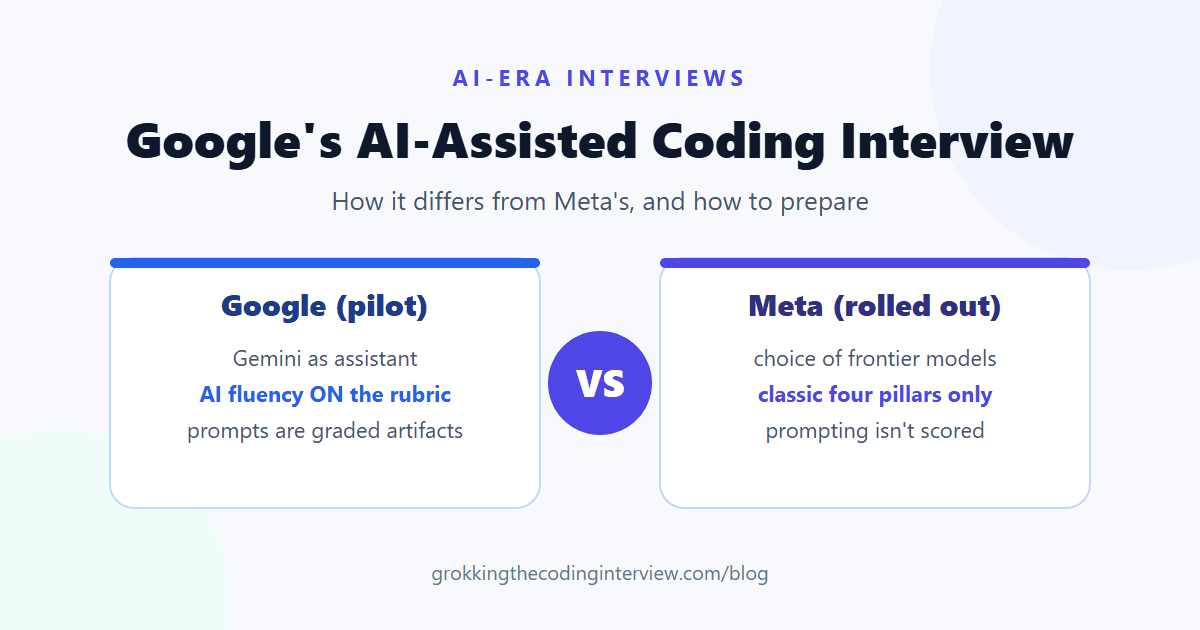
TL;DR: Google is piloting a "code comprehension" interview: 60 minutes in a three-panel environment with a multi-file codebase and Gemini as your chat assistant, progressing through bug fixing, implementation, and optimization. The headline difference from Meta's AI-enabled round: Google puts AI fluency explicitly on the rubric (prompt quality, output validation, debugging AI suggestions), while Meta grades the same four classic pillars and treats the AI as furniture. The pilot targets junior and mid-level US roles, classic algorithm rounds aren't going anywhere during the 12-to-18-month rollout, and the deep preparation is identical for both companies: pattern-backed judgment. What changes is what you make visible while you work.
When two companies that define industry hiring norms both put an AI assistant inside the coding interview within a year of each other, that's not a coincidence, it's a direction. We covered Meta's version in detail; this post covers Google's pilot, and more usefully, the differences, because if you're interviewing at both (most candidates targeting one target the other), the deltas are what change your preparation.
What Google is piloting
The facts as of this writing, with the usual caveat that pilots evolve and your recruiter email is the final word:
- A "code comprehension" round. You're dropped into an existing multi-file codebase and asked to read, debug, and optimize real code, progressing through roughly three phases: fix a bug, implement a feature, then optimize or scale. If that sounds familiar, it's structurally the same shape as Meta's round.
- Gemini in the third panel. The environment is the now-standard three-panel layout: file explorer, editor, AI chat. The assistant has project context and answers in chat; it does not edit your files. You type what ships.
- 60 minutes, one candidate, one interviewer observing how you work, not just whether you finish.
- Scope: the pilot targets junior and mid-level software engineering roles on select US teams, with expansion planned over 12 to 18 months if it goes well. Classic algorithm rounds remain in loops throughout, so, as with Meta, nobody is excused from fundamentals.
The real difference: what's on the rubric
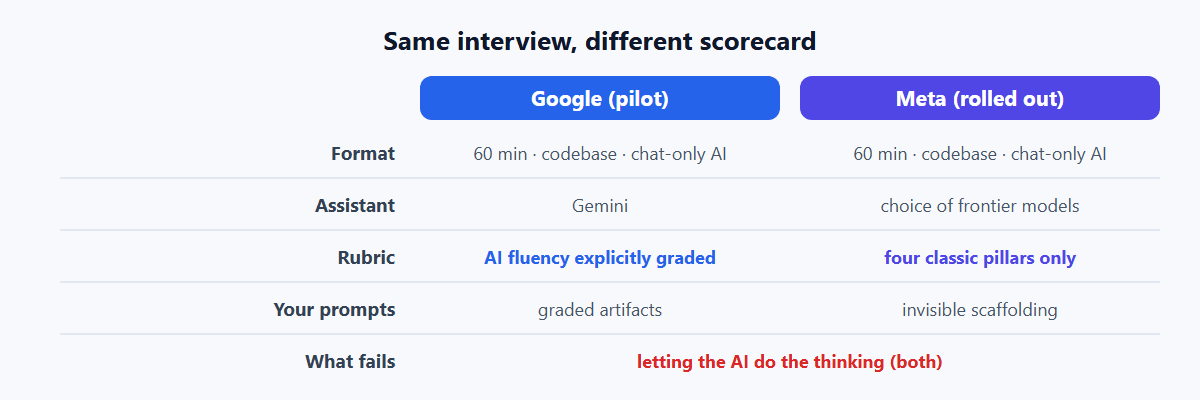
Structurally, the two rounds are near-twins. The philosophical split is in the grading, and it changes how you should behave in the room:
- Meta: the AI round is scored on the same four pillars as the classic round: problem solving, code quality, verification, communication. Prompt engineering is deliberately absent. The AI is a tool; the rubric pretends it isn't there and grades what you produced and how you reasoned.
- Google: interviewers explicitly evaluate AI fluency: can you write clear, specific prompts that get useful results; do you review generated code critically instead of copy-paste-and-hope; and when the AI gives you something close-but-wrong, can you find and fix the miss?
Put bluntly: at Meta, your prompts are invisible scaffolding; at Google, your prompts are graded artifacts. The same lazy prompt ("here's the whole problem, solve it") hurts you at both companies, but for different reasons: at Meta because the resulting workflow shows no problem solving of yours, at Google because the prompt itself is evidence of unclear thinking.
What stays the same (and why it's the important part)
Strip the rubric labels and both companies are converging on the same question: when the AI can type, what's left is judgment, and judgment is pattern fluency wearing work clothes. Both rounds hand you unfamiliar code and a capable assistant, then watch whether you:
- decompose the problem yourself instead of delegating the thinking,
- recognize whether a proposed approach is right (you can't validate a solution against a pattern you don't recognize),
- catch the confidently-wrong output before it lands in the codebase, and
- explain your decisions while making them.
That's why the deep preparation is shared: the pattern base, timed practice, and the code-reading and verification drills from the Meta guide transfer wholesale. Your loop at either company also still contains classic no-AI rounds, where that same base is tested with no assistant at all.
One foundation, every format. Grokking the Coding Interview builds the pattern fluency both the classic rounds and the AI rounds run on: all 42 patterns (32 common + 10 advanced), 300+ sequenced problems, six languages, for a one-time $79.
Preparing for Google specifically: three additions
If Meta prep is your baseline, add these three drills for Google's rubric:
1. Practice prompts as specifications. Since prompt quality is graded, treat every prompt like a mini design doc: state the goal, the constraints, the input/output shape, and what you don't want ("no external libraries", "keep it O(n log n)", "match the existing style in parser.py"). Drill this by taking tasks you've already solved and writing the one-paragraph spec that would let a junior engineer (or a model) nail it first try. Vague in, vague out, and at Google, vague in is itself the downgrade.
2. Drill the "close but wrong" scenario deliberately. Google's rubric names debugging AI suggestions as a skill. Practice it directly: ask an assistant for a solution, then before running it, predict where it's most likely wrong (off-by-one at boundaries, the touching-intervals operator, a value-vs-identity comparison, a hidden O(n²)). Then verify your prediction. Ten reps of this builds the exact reflex the round measures.
3. Narrate your validation, not just your plan. At Meta, narrating your reasoning is one pillar among four. At Google's pilot, the validation behavior itself is a scored line, so make it audible: "before I take this, I'm checking the empty-input case and the complexity, because generated code tends to miss both." You're not just checking the work; you're demonstrating that checking is your habit.
What this means beyond these two companies
Google's pilot timeline (12 to 18 months to broad rollout) and Meta's already-standard round bracket the industry's trajectory: within a couple of years, an AI-in-the-loop round will be a normal fixture of engineering interviews, the way take-homes and system design rounds became normal. The companies differ on whether to grade the AI interaction explicitly, but they agree completely on what fails: candidates who let the assistant do the thinking. Prepare once for the shape (patterns, reading, verification, narration) and the vendor-specific details become footnotes you skim the week of your onsite.
The takeaway
Google's pilot and Meta's round are the same interview with different scorecards. Google grades the interaction (prompts, validation, debugging); Meta grades straight through it (the four classic pillars). Both still run classic algorithm rounds beside the AI round, and both reward the same foundation: pattern-backed judgment, made visible out loud. If you're preparing for either, prepare for both; the delta is three drills, not a different curriculum.
Build the shared foundation: Grokking the Coding Interview covers all 42 patterns with 300+ problems ($79, lifetime access). Loop coming up fast? Grokking 75 is the 6-week essential track.
FAQs
Is every Google coding interview AI-assisted now? No. It's a pilot for junior and mid-level roles on select US teams, running alongside classic algorithm rounds, with expansion planned over 12 to 18 months if it succeeds. Most Google loops today are still traditional, so check with your recruiter and prepare for the classic format as your baseline.
Which AI does Google provide in the interview? Gemini, integrated into the interview environment's chat panel with context on the project files. Like Meta's setup, it advises in chat only and cannot edit files; every change to the codebase is typed or pasted by you.
Does Google grade prompt engineering? In the pilot, yes: AI fluency, including prompt quality, output validation, and debugging AI suggestions, is explicitly evaluated. This is the sharpest contrast with Meta, whose rubric sticks to the four classic pillars and doesn't score prompting at all.
Can I refuse to use the AI and just code it myself? Technically you can under-use it, but in a round designed to observe how you work with an assistant, ignoring it reads as either unfamiliarity or inflexibility, both bad signals. The strong move is deliberate, bounded use: you decompose, it drafts, you verify.
Do I still need to grind algorithm problems for Google? Yes, on two fronts: classic rounds remain in every loop, and the AI round's validation skill runs on the same pattern recognition. What's changed is the ceiling on memorization: reciting a memorized solution impresses no one when the AI can produce it in seconds. Recognition and judgment are the durable skills.