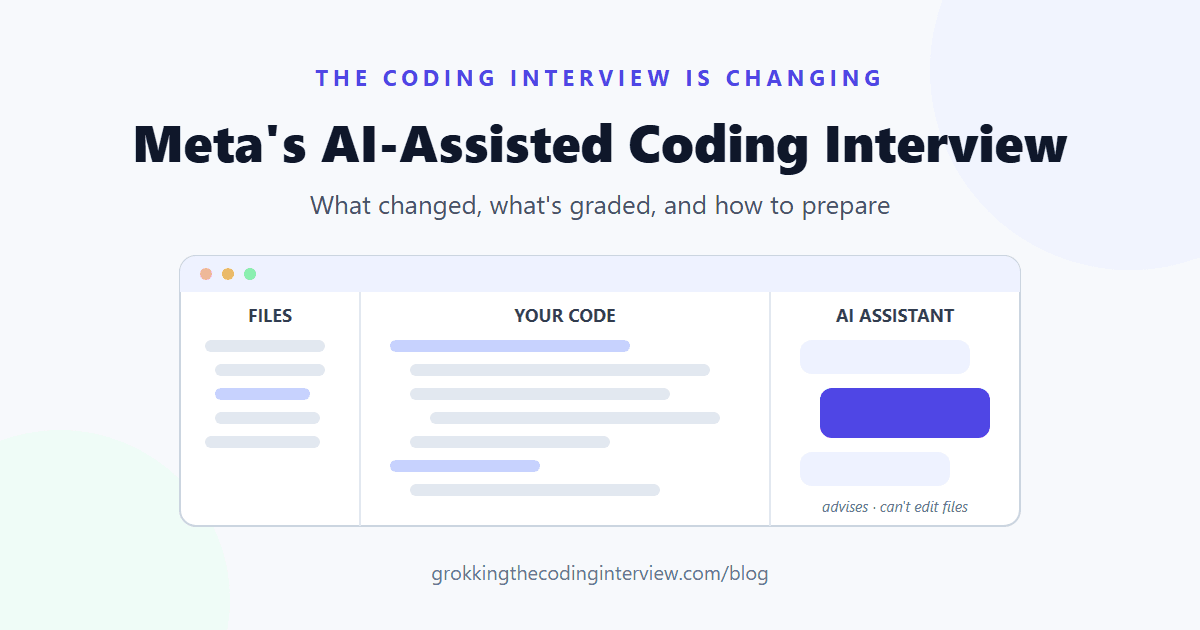
TL;DR: Meta now runs one of its onsite coding rounds with an AI assistant built into the editor: 60 minutes, a real multi-file codebase instead of a blank editor, and tasks that escalate from "fix this bug" to "make it scale." The AI can chat but cannot touch your files, and Meta's grading rubric is the same four pillars as always (problem solving, code quality, verification, communication). Prompt engineering is not one of them. The other coding round in the loop is still the classic no-AI algorithm interview, so pattern fluency hasn't become optional; it's now tested twice, once directly and once through your ability to judge what the AI hands you.
When I ran interview loops at Meta, the format had been frozen for a decade: blank editor, algorithmic problem, 40 minutes, no help. That era is ending. Meta began rolling out an AI-enabled coding round in late 2025, and it's now a standard part of many onsite loops. Most of the commentary treats this as either the death of LeetCode or a gimmick. Having sat on the evaluating side of that rubric, I think it's neither, and the candidates who understand what's actually being graded have a large, exploitable edge right now. Here's the format, the rubric, and a preparation plan for both rounds.
What actually changed
- One round changed, one didn't. The AI-enabled interview replaces one of the two coding rounds in the onsite loop. The other remains a classic algorithm interview: blank editor, no AI, patterns and complexity, same as ever. Anyone telling you to stop practicing fundamentals is reading half the memo.
- You work in a codebase, not a blank editor. The AI round drops you into a multi-file project with existing classes, data models, and logic you've never seen. A traditional round produces 30 to 50 lines from scratch; this one has you navigating hundreds of existing lines to fix a bug, add a feature, and then scale the result. Reading unfamiliar code quickly is now a graded skill.
- The AI is an advisor, not a driver. The assistant lives in a chat panel with context on the project files, but it cannot edit them. Every line that lands in the codebase, you typed or pasted, and you own it. Candidates get a choice of current frontier models, so "the model was bad" is not an excuse the rubric recognizes.
- The tasks escalate. Expect roughly three phases: understand and fix, extend with a feature, then discuss or implement scaling. Meta cares more about your reasoning in the phases you complete than about finishing everything.
What Meta actually grades (and the trap hiding in it)
Meta evaluates the AI round on the same four pillars as the classic round: problem solving, code quality, verification, and communication. Notice what's missing: prompt engineering. The AI is furniture, like the syntax highlighter. Notice also what got promoted: verification, which used to mean "test your own code," now means "test code you didn't write, produced by a system that is confidently wrong at a measurable rate."
That's the trap. The losing strategy in this round is what you might call prompting your way out: paste the task into the chat, accept the output, run it, hope. Interviewers watch for exactly this, because it makes the pillar scores collapse: no visible problem solving (the AI did it), no verification (you didn't check it), no communication (you went silent while reading the chat). The winning strategy is almost boring: you lead, the AI types. Decompose the problem yourself, hand the AI well-defined subtasks, read every line it returns, test before you integrate, and narrate the whole time.

Why patterns matter more here, not less
Here's the part most takes miss, and it's the reason this blog's pattern-first thesis gets stronger in the AI era, not weaker.
When the AI proposes a solution, your job is to judge it in seconds: Is this approach right? Is that nested loop hiding an O(n²) on the hot path where a sliding window does it in O(n)? Is this cycle check correct, or is it the buggy version that compares values instead of nodes? You cannot validate output against a pattern you don't recognize. Judgment is exactly what pattern fluency is: knowing the tells, the templates, and the boundaries well enough to spot when generated code violates them. The candidates who pass the AI round aren't better prompters; they know what correct looks like before the AI answers.
And the classic round is still sitting in your loop, blank editor and all, where the recognition skill is tested with no assistant in sight.
Both rounds reward the same foundation. Grokking the Coding Interview teaches all 42 patterns (32 common + 10 advanced) with 300+ problems, which is the fluency the classic round tests directly and the AI round tests through your judgment, for a one-time $79.
How to prepare: five drills
- Keep your pattern base current. Half your loop is still the classic round, and your AI-round judgment runs on the same fluency. Timelines and milestones are in our prep-timeline guide; nothing about them changed.
- Practice code reading, on a clock. Weekly: open an unfamiliar mid-sized repo, give yourself 10 minutes to map it (entry points, data flow, where the state lives), then say the summary out loud. The AI round starts with exactly this motion, and almost nobody drills it.
- Pair with an AI under interview rules. Solve real tasks with an assistant, but impose the constraints: the AI never sees the whole problem, only subtasks you define; nothing gets integrated until you've read and tested it; you narrate decisions as you go. This builds the "you lead, it types" rhythm the rubric rewards.
- Drill verification as a reflex. Before accepting any AI-generated function, do three things fast: state what it should do on an edge case, trace or test that case, and check the complexity against the approach you intended. If you make this a habit, "verification" stops being a rubric line and becomes your visible advantage.
- Rehearse the narration. Two mock sessions where you practice thinking aloud while reading and evaluating generated code. Silence during AI use reads as absence of thought, and it's the most common downgrade in this round.
Is this just Meta?
No. Google is piloting an AI-assisted round where interviewers explicitly evaluate AI fluency: how clearly you specify what you want, whether you validate output critically, and how you debug suggestions that are close but wrong. Other companies are watching both experiments. The direction is one-way: interviews are converging on how engineers actually work now, which is with an AI in the loop and judgment as the scarce skill. Prepare for that shape once and it transfers everywhere; the details above are current as of this writing, so treat any loop-specific specifics in your recruiter email as the final word.
The takeaway
Meta didn't lower the bar; it moved the bar to where the job actually is. One round still checks that you can think in patterns with no help. The new round checks whether you can steer: decompose problems, direct an AI at subtasks, verify everything it produces, and explain your decisions while doing it. Both rounds run on the same foundation, recognition, and that's trainable the same way it always was. The candidates in trouble aren't the ones who never used AI; they're the ones who let it think for them.
Build the foundation both rounds test: Grokking the Coding Interview covers all 42 patterns with 300+ sequenced problems ($79, lifetime access). Interview soon? Grokking 75 compresses the essentials into a 6-week plan.
FAQs
Can you really use AI in Meta's coding interview now? In one designated round, yes: an assistant is built into the interview environment with project context, and using it is expected. The other coding round in the loop remains AI-free. Bringing your own outside AI tools to any round is still not allowed.
Is prompt engineering part of the evaluation? Not at Meta: the rubric is the same four pillars as the classic round (problem solving, code quality, verification, communication). Google's pilot does discuss AI fluency more explicitly, including prompt clarity. Either way, prompting skill without judgment scores poorly everywhere.
Do I still need to practice LeetCode-style problems? Yes, twice over: the classic no-AI round still exists in the loop, and the AI round tests the same fluency through validation, since you can't judge generated code against patterns you don't recognize. What you can skip is memorizing exotic solutions; recognition beats recall in both rounds.
What does the AI in the interview actually do? It's a chat assistant with visibility into the project files. It answers questions, explains code, and drafts snippets, but it cannot edit files. You type or paste everything yourself, which is the point: every line in the final state is one you chose to own.
Will other companies adopt AI-assisted interviews? The trajectory says yes: Google is already piloting its own version, and the industry historically converges on FAANG interview formats within a few years. Preparing for judgment-plus-patterns rather than for one company's tooling is the durable bet.