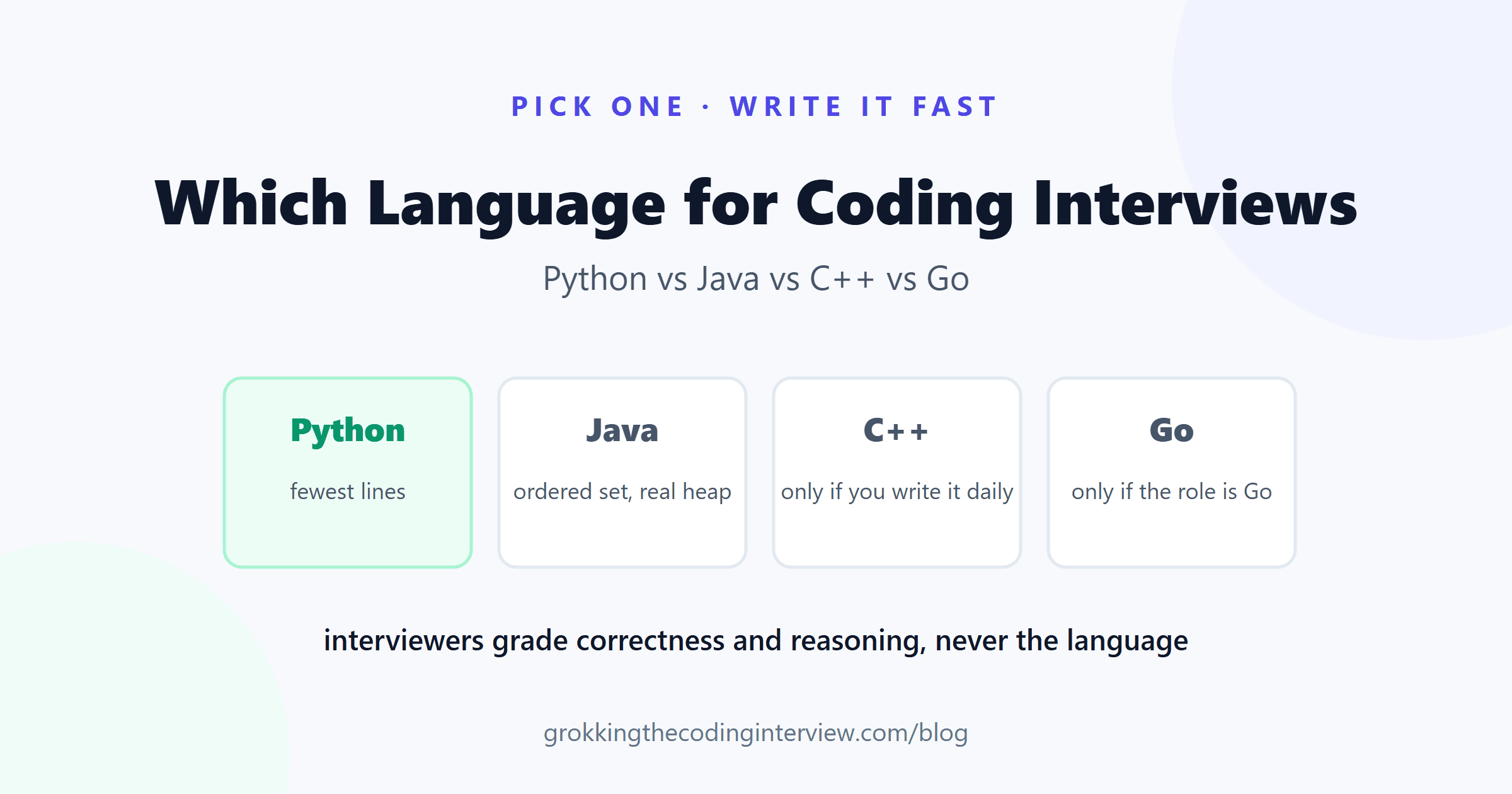
TL;DR: Use the language you write fastest and most correctly under pressure. For most candidates that is Python, because it needs the fewest lines and has the data structures you need built in. Java is a strong second and is expected in some backend loops. Use C++ only if you already write it daily. Use Go only if the role is a Go role. No large company rejects a candidate for choosing Python.
Interviewers do not grade the language. They grade whether the solution is correct, whether the complexity is right, and whether you can explain your thinking.
So the choice is about one thing: which language lets you produce correct code fastest while talking at the same time. Every other consideration is smaller than it looks.
This article compares the four common choices on that basis. It shows where each one costs you time, and covers the cases where the role decides for you.
The short answer, by situation
| Your situation | Use |
|---|---|
| No strong preference, general software role | Python |
| Backend role, you already write Java | Java |
| You write C++ daily, or the role is systems and embedded | C++ |
| The role is a Go role and the team expects it | Go |
| iOS or macOS team at Apple | Swift, ask the recruiter first |
| Android role | Kotlin or Java |
If you are unsure after reading that table, the answer is Python.
Why Python wins for most candidates
Python needs fewer lines than the alternatives to say the same thing. In a 45 minute round with one question, that difference is real.
Three specific advantages matter in an interview:
The syntax stays out of the way. No type declarations, no boilerplate class wrapper, no semicolons. You spend your attention on the algorithm.
The standard library covers most patterns. collections.deque for queues, heapq for heaps, collections.Counter for counting, functools.cache for memoization, bisect for binary search on a sorted list. Most patterns have a one line setup.
Slicing and tuples reduce bugs. Swapping two values is one line. Returning two values needs no wrapper object. Fewer moving parts means fewer mistakes while a person watches you type.
The trade-off people worry about is speed. In an interview it does not matter. Interviewers grade the complexity you reason about, not the wall clock time of your submission. On a timed online assessment with tight limits it can matter, and that is the one case where C++ or Java has a real edge.
Where each language costs you time
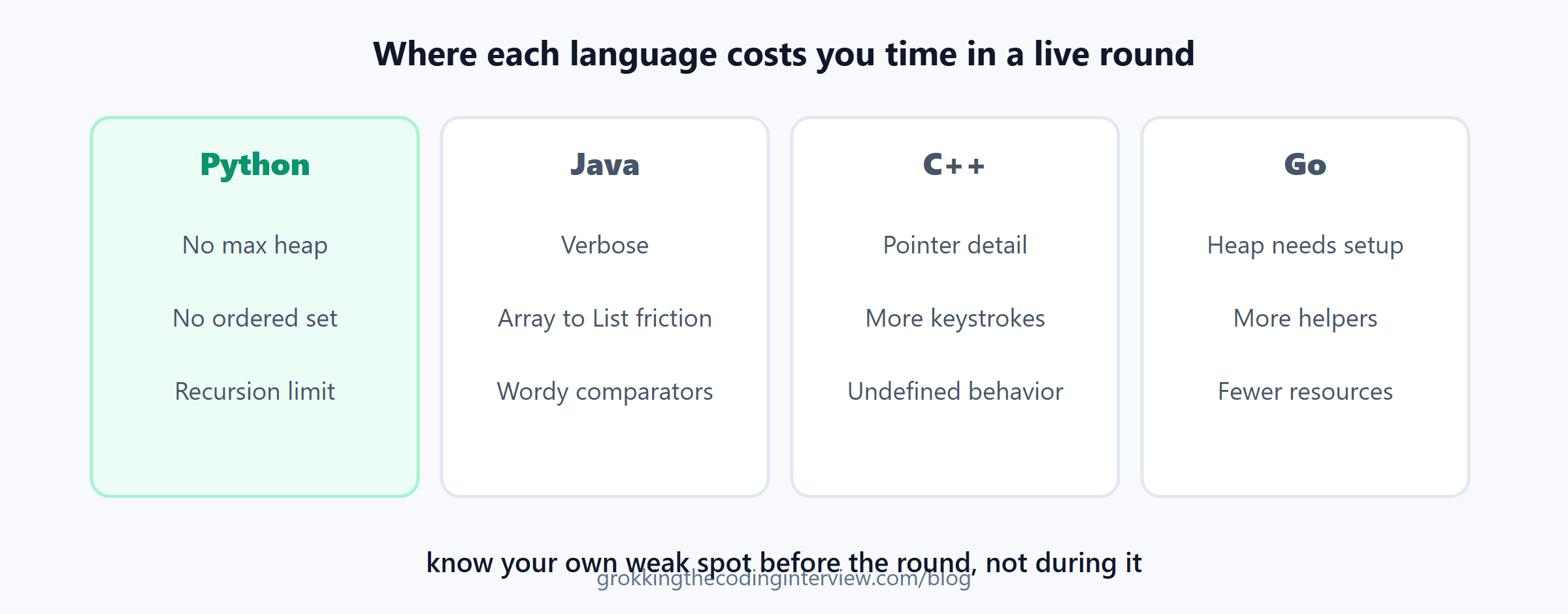
Every choice has a specific weak spot. Knowing yours ahead of time is worth more than the general comparison.
Python
- No built-in max heap.
heapqis a min heap. You push negated values and remember to negate on the way out. This is the single most common Python interview bug. - No built-in balanced tree or ordered set. If a question needs sorted order plus fast insert and delete, you need
sortedcontainers, which may not be available. Say the approach out loud and note the missing structure. - Recursion limit. Deep recursion raises an error at around a thousand frames. Mention it and describe the iterative version.
- Mutable default arguments. A classic trap that shows up in backtracking code.
Java
- Verbose. More typing per idea, which costs minutes you do not have.
- Arrays and collections do not mix cleanly. Converting between
int[]andList<Integer>wastes time and causes autoboxing mistakes. - Comparators are wordy. Custom sorting takes more code than in Python.
What Java does well: PriorityQueue gives you a real heap in either direction, TreeMap and TreeSet give you the ordered structure Python lacks, and ArrayDeque covers stacks and queues. For questions needing an ordered set, Java is genuinely easier.
C++
- Manual detail. Pointers, references, and iterator syntax all take attention that could go to the algorithm.
- Longer to write. The same solution takes more keystrokes than Python.
- Easy to introduce undefined behavior under time pressure, which is hard to debug live.
What C++ does well: the standard template library is excellent. priority_queue, set, map, and unordered_map cover nearly every pattern, and set gives you the ordered structure directly. If you already write C++ daily, there is no reason to switch.
Go
- No generics habit in most interview code, so you write more type-specific helpers.
- No built-in heap that reads simply. The
container/heappackage needs an interface implementation, which is several lines of setup before you solve anything. - Fewer practice resources. Most curated problem lists have solutions in Python, Java, and C++ first.
What Go does well: it is simple, it reads clearly, and concurrency questions are easier to express. If the team is a Go team, use it.
The comparison table
| Python | Java | C++ | Go | |
|---|---|---|---|---|
| Lines needed | Fewest | More | More | Moderate |
| Heap | Min only, negate for max | Both directions | Both directions | Needs interface setup |
| Ordered set or balanced tree | Not in the standard library | TreeMap, TreeSet | set, map | Not in the standard library |
| Counting and grouping | Counter, defaultdict | HashMap plus merge | unordered_map | map |
| Memoization | functools.cache | Manual map | Manual map | Manual map |
| Runtime speed | Slowest | Fast | Fastest | Fast |
| Risk of a syntax slip | Low | Medium | Higher | Low |
| Best for | Most candidates | Backend loops | Systems roles | Go roles |
Should you switch languages before an interview?
Usually no.
Switching costs more than people expect. You lose fluency in the small things: how you write a nested loop without thinking, which method name returns what, how you iterate a map. Those small things are exactly what fails under pressure.
A rough rule. Switch only if your interview is more than eight weeks away, and only if you will solve at least 80 problems in the new language first. Anything less and you will be slower on the day than you are now.
The one exception is a candidate whose current language is unusual for interviews, for example a language with no interviewer familiarity and no practice resources. In that case switching to Python early is worth the cost.
Does the language change how you prepare?
The patterns do not change. The idioms that express them do.
A sliding window is a sliding window in all four languages. What changes is whether you write defaultdict(int) or HashMap plus getOrDefault, and whether your heap needs negation. Learn the pattern once, then learn its one line setup in your language.
We keep template sets for the two most common interview languages. Every pattern in Python is built around deque, heapq, and functools.cache. Every pattern in Java is built around ArrayDeque, PriorityQueue, and TreeMap.
Grokking the Coding Interview gives every solution in Python, Java, JavaScript, C++, C#, and Go. The pattern stays constant while you read it in whichever language you will use on the day.
What to do in the round itself
Say your language at the start, and say why in one short sentence. "I will use Python, since the built-in collections keep this short." That takes three seconds and settles it.
If the interviewer asks you to use something else, ask whether the team requires it. Some teams do. If they do and you are not fluent, say so directly rather than struggling through it silently.
Two more practical habits:
- Practice without autocomplete. Most interview editors have none. Code that only compiles with editor help is a real risk.
- Know your standard library cold. The exact method names, not approximately. Looking them up is not always possible in the round.
Frequently asked questions
What is the best language for coding interviews? Python for most candidates, because it needs the fewest lines and has the data structures interviews use built in. The better rule is to use whichever language you write fastest and most correctly, since interviewers grade correctness and reasoning rather than the language.
Will using Python hurt me at a FAANG interview? No. All the large companies accept Python, and many interviewers prefer it because the solution is shorter to read. The only situation where it costs you is a timed online assessment with very tight runtime limits.
Is C++ better than Python for interviews? Only if you already write C++ daily. It runs faster and its standard library is excellent, but it takes more keystrokes and offers more ways to make a mistake under pressure. Speed of writing matters more in an interview than speed of execution.
Should I use Java or Python for coding interviews? Python if you have no preference. Java if you already write it, especially for backend roles. It is also simpler for questions needing an ordered set or a max heap, where its standard library does more for you.
Can I switch languages between rounds? Yes, and it is fine. Some candidates use Python for algorithm rounds and Java for object oriented design rounds. Say which you are using at the start of each round.
Does the language matter for the online assessment? Slightly more than in a live round. Some assessments have tight time limits that penalize Python on very large inputs. If you know the assessment is strict, an efficient solution matters more than the language, but C++ or Java gives you extra headroom.
Related reading
- The DSA Patterns Cheat Sheet: All 41 on One Page
- Coding Interview Patterns in Python
- Coding Interview Patterns in Java
- The 10 Coding Interview Templates on One Page
- How to Talk Through a Coding Problem
Related guides
- Coding Interview Patterns: The Complete List of All 42 (LeetCode Cheat Sheet)
- The Only 75 LeetCode Problems You Need (Grokking 75)
- How Many LeetCode Problems: The Numbers by Target Company, Per Day, and In Total
- Start Here: The Coding Interview Guide Library
One course, six languages: Grokking the Coding Interview: Patterns for Coding Questions teaches all 41 patterns with every solution in Python, Java, JavaScript, C++, C#, and Go, so you can learn the pattern once and read it in the language you will use. It costs $79 once, with lifetime access.