TL;DR: Java costs you keystrokes in an interview and gives you nothing back on the score sheet, so the whole game is buying those keystrokes back. You do that with muscle-memory skeletons and the right JDK type for each pattern:
ArrayDequefor BFS and monotonic stacks,PriorityQueuefor top-K and k-way merge,HashMap.getOrDefaultfor frequency windows,TreeMapfor ordered range queries. This guide gives you a compact Java template per pattern, a map from every pattern family to its JDK tool, and the five Java-specific traps I have actually watched sink candidates. Every problem in Grokking the Coding Interview ships full Java solutions alongside five other languages, so you can learn the patterns natively in Java from the first chapter.
I have interviewed hundreds of candidates, and Java candidates lose a specific, measurable thing: time. Where a Python candidate writes eight lines, you write twenty-five. Nobody scores you down for that. But those minutes come out of the part of the interview that actually decides the outcome, which is recognizing the pattern and handling the follow-ups.
The good news is that this is a solvable problem, and the solution is not "switch to Python." It is to stop composing Java from scratch in the room. Every pattern below has a skeleton that should come out of your fingers without thought, and a JDK type that does the hard part for you. Get those two things automatic and the verbosity tax drops to near zero.
This is the same pattern method, written for the language you already think in.
What Java actually costs you, and what it gives back
The cost is real but bounded. Type declarations, no tuple literals, no list slicing, no destructuring assignment, manual memoization. Across a 40-minute interview that is maybe two to four minutes of pure typing overhead. That matters at the margin, and it is why the skeletons below are worth memorizing rather than deriving.
What you get back is worth naming. Static types catch a whole class of bug before you run anything, which means fewer of those humiliating live-debugging spirals. The type signature itself documents your intent to the interviewer. And the JDK collections are explicit about their complexity in a way Python's conveniences are not, so complexity narration comes naturally.
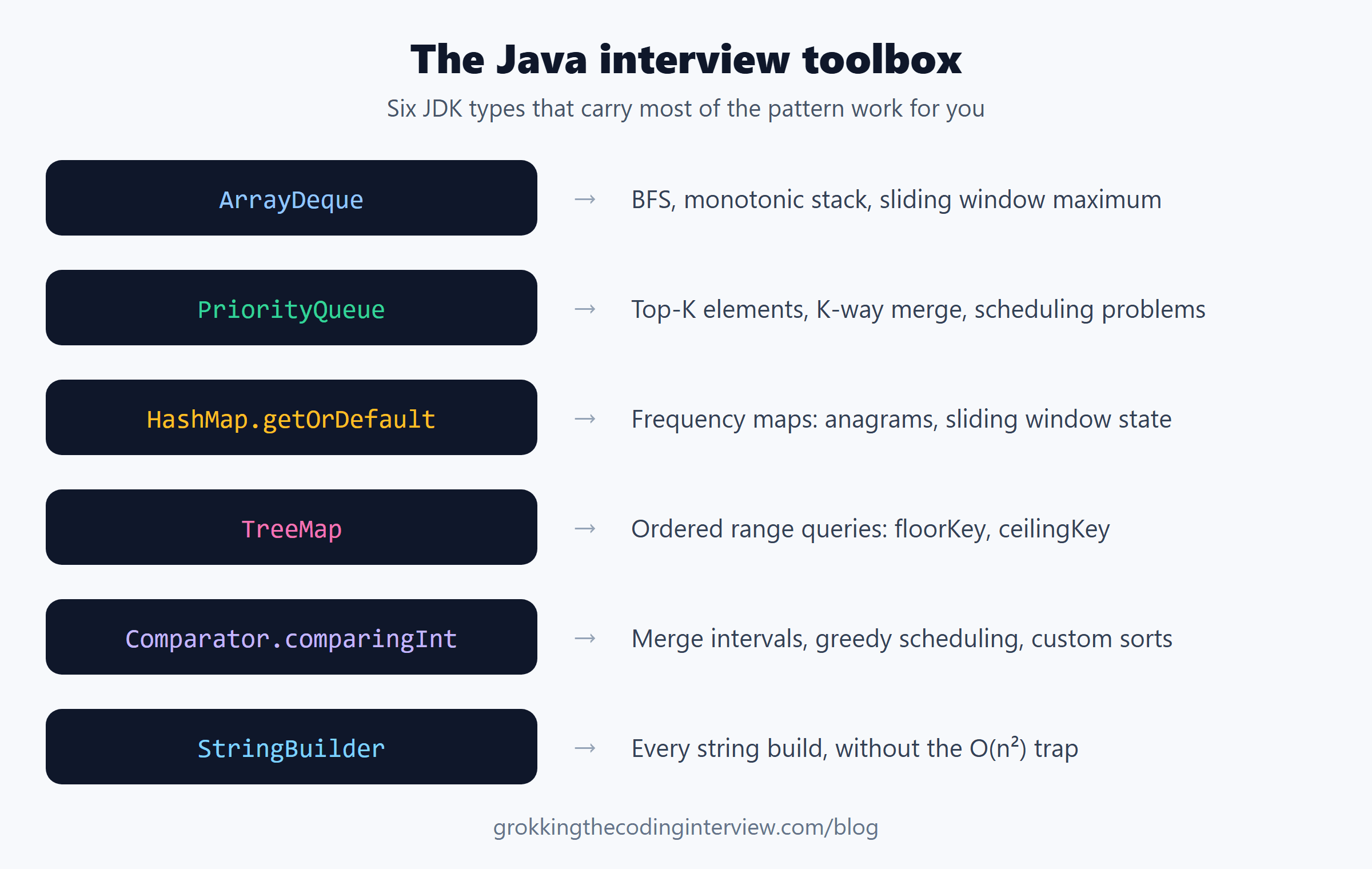
The JDK is a pattern toolkit. Almost every interview pattern leans on one of these, and all are fair game at every major company:
| Tool | What it gives you | Patterns it powers |
|---|---|---|
ArrayDeque | O(1) push/pop at both ends | BFS, monotonic stack, sliding window maximum |
PriorityQueue | A ready-made binary heap | Top-K elements, K-way merge, scheduling |
HashMap.getOrDefault / merge | One-line frequency maps | Sliding window, anagrams, top-K |
TreeMap / TreeSet | Sorted keys with floorKey, ceilingKey | Range queries, interval lookup, ordered windows |
Arrays.sort + Comparator.comparingInt | Sorting by any field | Merge intervals, scheduling, greedy |
StringBuilder | O(1) amortized append | Every string-building problem |
One habit that pays immediately: use Deque rather than the legacy Stack class. Stack extends Vector, so every operation is synchronized and slower, and interviewers who know the JDK notice. Deque<Integer> stack = new ArrayDeque<>(); is the modern answer for both stacks and queues.
The templates
These are deliberately minimal: the skeleton you adapt, not a solution you memorize. Each links to its full deep dive where we have one.
Two Pointers
Converging pointers on sorted data. Full walkthrough in the two pointers deep dive.
int[] pairWithTarget(int[] nums, int target) {     // sorted input
    int left = 0, right = nums.length - 1;
    while (left < right) {
        int sum = nums[left] + nums[right];
        if (sum == target) return new int[]{left, right};
        if (sum < target) left++;
        else right--;
    }
    return new int[]{-1, -1};
}
Sliding Window (variable size)
Grow the right edge, shrink the left while invalid. Full treatment in the sliding window deep dive.
int longestNoRepeat(String s) {
    Set<Character> seen = new HashSet<>();
    int left = 0, best = 0;
    for (int right = 0; right < s.length(); right++) {
        char ch = s.charAt(right);
        while (seen.contains(ch)) {
            seen.remove(s.charAt(left++));
        }
        seen.add(ch);
        best = Math.max(best, right - left + 1);
    }
    return best;
}
For the counting variant, window.merge(ch, 1, Integer::sum) and window.getOrDefault(ch, 0) keep the frequency bookkeeping to one line each.
Fast and Slow Pointers
Cycle detection without extra memory. Deep dive here.
boolean hasCycle(ListNode head) {
    ListNode slow = head, fast = head;
    while (fast != null && fast.next != null) {
        slow = slow.next;
        fast = fast.next.next;
        if (slow == fast) return true;             // reference equality is correct here
    }
    return false;
}
Merge Intervals
Sort, then merge or emit. Deep dive here.
int[][] merge(int[][] intervals) {
    Arrays.sort(intervals, Comparator.comparingInt(a -> a[0]));
    List<int[]> out = new ArrayList<>();
    for (int[] cur : intervals) {
        int[] last = out.isEmpty() ? null : out.get(out.size() - 1);
        if (last != null && cur[0] <= last[1]) {   // overlap: extend
            last[1] = Math.max(last[1], cur[1]);
        } else {
            out.add(new int[]{cur[0], cur[1]});    // copy, never alias the input
        }
    }
    return out.toArray(new int[0][]);
}
That copy on the last line is not pedantry. If you add intervals[i] directly and then mutate last[1], you have silently modified the caller's input, and an interviewer who spots it will ask about it.
Binary Search
The while (left <= right) form generalizes to every "search a sorted space" problem, including binary-search-on-the-answer.
int binarySearch(int[] nums, int target) {
    int left = 0, right = nums.length - 1;
    while (left <= right) {
        int mid = left + (right - left) / 2;       // not (left + right) / 2
        if (nums[mid] == target) return mid;
        if (nums[mid] < target) left = mid + 1;
        else right = mid - 1;
    }
    return -1;
}
Write that mid line the safe way every single time, even on a ten-element array. It is free, and saying "I use this form so it can't overflow on large inputs" is one of the cheapest seniority signals available in a coding round.
BFS (trees and graphs)
ArrayDeque is the whole trick: poll is O(1), so level-order traversal stays O(n).
List<List<Integer>> levelOrder(TreeNode root) {
    List<List<Integer>> out = new ArrayList<>();
    if (root == null) return out;
    Deque<TreeNode> q = new ArrayDeque<>();
    q.add(root);
    while (!q.isEmpty()) {
        int size = q.size();                       // exactly one level
        List<Integer> level = new ArrayList<>();
        for (int i = 0; i < size; i++) {
            TreeNode node = q.poll();
            level.add(node.val);
            if (node.left != null) q.add(node.left);
            if (node.right != null) q.add(node.right);
        }
        out.add(level);
    }
    return out;
}
Capturing q.size() into size before the inner loop is the line people forget. Without it the queue grows while you iterate and the levels smear together.
DFS and Backtracking
Choose, recurse, un-choose. The skeleton behind subsets, permutations, and combination sums.
List<List<Integer>> subsets(int[] nums) {
    List<List<Integer>> out = new ArrayList<>();
    backtrack(nums, 0, new ArrayList<>(), out);
    return out;
}

void backtrack(int[] nums, int start, List<Integer> path, List<List<Integer>> out) {
    out.add(new ArrayList<>(path));                // copy: path keeps mutating
    for (int i = start; i < nums.length; i++) {
        path.add(nums[i]);                         // choose
        backtrack(nums, i + 1, path, out);         // explore
        path.remove(path.size() - 1);              // un-choose, by index
    }
}
Two Java details hide in there. new ArrayList<>(path) is mandatory, because adding path itself stores a reference that you are about to mutate. And path.remove(path.size() - 1) removes by index, which is what you want; see trap 3 below for when that same call bites you.
Top-K Elements
Keep a min-heap of size k; the root is the weakest thing still in the club. Why that works is in the Top-K deep dive.
int[] kLargest(int[] nums, int k) {
    PriorityQueue<Integer> heap = new PriorityQueue<>();   // min-heap by default
    for (int x : nums) {
        heap.add(x);
        if (heap.size() > k) heap.poll();                  // evict the weakest
    }
    int[] out = new int[heap.size()];
    int i = 0;
    for (int x : heap) out[i++] = x;
    return out;
}
PriorityQueue is a min-heap by default, which is exactly what the k-largest problem wants. For k-smallest, flip it with new PriorityQueue<>(Comparator.reverseOrder()). Worth saying out loud: iterating a PriorityQueue does not give you sorted order, only the head is guaranteed. If the question wants sorted output, drain it with poll().
Monotonic Stack
Next-greater-element and its many disguises. Deep dive here.
int[] nextGreater(int[] nums) {
    int[] out = new int[nums.length];
    Arrays.fill(out, -1);
    Deque<Integer> stack = new ArrayDeque<>();     // indexes, values decreasing
    for (int i = 0; i < nums.length; i++) {
        while (!stack.isEmpty() && nums[stack.peek()] < nums[i]) {
            out[stack.pop()] = nums[i];
        }
        stack.push(i);
    }
    return out;
}
Dynamic Programming (top-down)
This is where Java charges you the most, because there is no one-line memoization decorator. For integer state, an array beats a map on both speed and clarity. The six DP families are mapped in our DP patterns guide.
long[] memo;

long fib(int n) {
    memo = new long[n + 1];
    Arrays.fill(memo, -1);
    return helper(n);
}

long helper(int n) {
    if (n < 2) return n;
    if (memo[n] != -1) return memo[n];             // the whole memoization idiom
    return memo[n] = helper(n - 1) + helper(n - 2);
}
That return memo[n] = ... assignment-as-expression is the compact Java equivalent of Python's @cache, and it generalizes: for 2D state use long[][] with Arrays.fill on each row, and sentinel -1 for "not computed." Reach for HashMap only when the state space is sparse or the key is not an integer.
The rest of the map
The other pattern families, and the JDK tool each one leans on:
| Pattern | Java tool / idiom |
|---|---|
| In-place linked list reversal | Three-pointer loop: next = cur.next; cur.next = prev; prev = cur; cur = next; |
| Cyclic sort | Manual swap through a temp int |
| K-way merge | PriorityQueue<int[]> holding {value, listIndex, elementIndex} |
| Topological sort | ArrayDeque queue plus an int[] indegree |
| Union-Find | int[] parent with path compression in five lines |
| Tries | TrieNode[] children = new TrieNode[26] |
| Bitwise XOR | ^, or Arrays.stream(nums).reduce(0, (a, b) -> a ^ b) |
| Prefix sums | int[] prefix built in a single pass |
| Intervals and scheduling | Arrays.sort(a, Comparator.comparingInt(x -> x[1])) on end time |
| Sliding window maximum | ArrayDeque<Integer> of indexes, kept monotonically decreasing |
If you can name the pattern, the JDK almost always has the load-bearing data structure ready. That is the entire argument for pairing the pattern map with this language.
Five Java traps that cost real candidates
1. (left + right) / 2 overflow. For large left and right the sum wraps negative and your binary search reads a negative index. This exact bug lived in the JDK's own Arrays.binarySearch for nearly a decade before anyone noticed. Always write left + (right - left) / 2.
2. == on boxed Integer. Java caches boxed integers from -128 to 127, so Integer a = 100, b = 100; a == b is true, while the same code with 1000 is false. Small test cases pass, the real input fails. Use .equals() or compare unboxed int values. This one is genuinely nasty because it looks correct and behaves correctly on exactly the inputs you try by hand.
3. list.remove(int) versus list.remove(Object). On a List<Integer>, list.remove(1) removes the element at index 1, not the value 1. To remove the value you need list.remove(Integer.valueOf(1)). The backtracking template above depends on the index behavior, so know which one you are invoking.
4. String concatenation in a loop. s += ch allocates a fresh string every pass, turning an O(n) build into O(n²). Use StringBuilder and call toString() once at the end. Interviewers at scale-focused companies watch for this specifically.
5. Arrays.sort on primitives has an adversarial worst case. On int[] it is dual-pivot quicksort, which is O(n²) against a crafted input; on object arrays it is Timsort, which is O(n log n) guaranteed. It almost never matters in an interview, but if you are asked about worst-case sorting guarantees, knowing the difference is the answer that separates you.
Should you switch to Python?
Only sometimes, and probably not right now.
The honest comparison: Python buys you roughly two to four minutes per problem in typing time, and the interview subset of Python is genuinely small enough to learn in a couple of weeks. If your interviews are more than a month or two out and you have no strong Java attachment, learning it is a reasonable investment.
Inside a month, stay with Java. Fluency under pressure beats brevity every time, and the failure mode of a half-learned interview language is far worse than the cost of extra typing. You will freeze on a syntax detail and lose more than the four minutes you were trying to save.
Either way the patterns transfer completely unchanged. That is the point of learning patterns rather than solutions, and it is why the course ships every problem in both languages side by side.
Will interviewers accept Java?
At every major tech company: yes, unconditionally. Java is one of the two most common languages we see in interviews, and it is the house language at Amazon and across most of the enterprise world. Nobody has ever been scored down for choosing it.
Two practical notes. First, you generally do not need to write a full class wrapper, imports, or a main method unless the interviewer asks for a runnable program; write the method, and say "I will assume the standard imports." Second, if you are on a shared editor with no compiler, announce that you are writing compilable-but-unrun Java and would like a moment at the end to trace a test case by hand. Both of those reclaim time that Java's ceremony would otherwise eat.
The takeaway
Pattern recognition decides coding interviews, and in Java the constraint is time, not capability. Learn the tells from the complete pattern guide, get these skeletons into your fingers so you are recalling rather than composing, reach for the right JDK type instead of hand-rolling it, and respect the five traps. Do that and the language stops being a tax.
Learn every pattern natively in Java: Grokking the Coding Interview teaches all 42 patterns (32 common + 10 advanced) across 300+ problems, each with complete Java solutions and in-browser playgrounds to run them, for a one-time $79. Short on time? Grokking 75 drills the essential 75, also in Java.
FAQs
Is there a Java version of Grokking the Coding Interview? You do not need a separate edition. Every problem in the course includes complete Java solutions alongside Python, C++, JavaScript, Go, and C#, with in-browser playgrounds to run each one. Pick Java once and the whole course reads in Java.
Is Java good enough for FAANG coding interviews? Yes, and at Amazon it is arguably the default. All major companies let you interview in the language of your choice, and interviewers grade problem-solving, communication, and complexity analysis rather than language choice. The only real cost is typing time, which memorized skeletons largely erase.
Am I allowed to use PriorityQueue, TreeMap, and Collections.sort in an interview?
Yes. Standard-library types are expected, not cheating. The rule of thumb is that you can use anything you can explain: know that PriorityQueue operations are O(log n), TreeMap lookups are O(log n), and Collections.sort is O(n log n) Timsort, and be ready to sketch how a heap works if asked. What is off-limits is a library call that is the whole question.
Is Java too verbose for coding interviews? It is more verbose, and that costs roughly two to four minutes per problem. That gap closes almost entirely once the pattern skeletons are automatic, because the typing that remains is mechanical rather than inventive. Verbosity is a preparation problem, not a language problem.
Should I use int[] or List<Integer> in interviews?
Prefer primitive arrays when the size is known and the problem is numeric: they avoid boxing, avoid the == trap, and are faster. Use List<Integer> when the result size is unknown and you need to append. Converting at the end with list.stream().mapToInt(Integer::intValue).toArray() is a one-liner worth having memorized.
What Java version should I assume?
Anything from Java 8 onward is safe, and interviewers rarely care. Lambdas, streams, and Comparator.comparingInt are all Java 8 and universally accepted. Newer conveniences like var and records are fine at most companies, but do not build a solution around a feature the interviewer might not recognize.