TL;DR: Python is the highest-leverage language for coding interviews: less syntax between your idea and working code, and a standard library (
heapq,collections,bisect,functools) that implements half the patterns for you. This guide gives you compact Python templates for the most-asked patterns, a map from every pattern family to its Python tool, and the handful of Python-specific traps that actually cost people offers. Every problem in Grokking the Coding Interview ships full Python solutions (alongside five other languages), so you can learn the patterns natively in Python from day one.
I have interviewed hundreds of candidates, and I can tell you something most prep guides won't: the language you choose changes the interview. Not because interviewers score Python higher (they don't), but because a Python candidate types eight lines while a Java candidate types twenty-five, and those minutes get spent on the part that actually decides the outcome: recognizing the pattern and handling the follow-ups.
This is the pattern method, in the language best suited to it.
Why Python wins interviews
The syntax gets out of the way. Swapping two values is a, b = b, a. Reversing a string is s[::-1]. A frequency count is one Counter call. In a 40-minute interview where you might write code for 20 of them, shaving keystrokes off every operation is not a gimmick, it is more time for thinking.
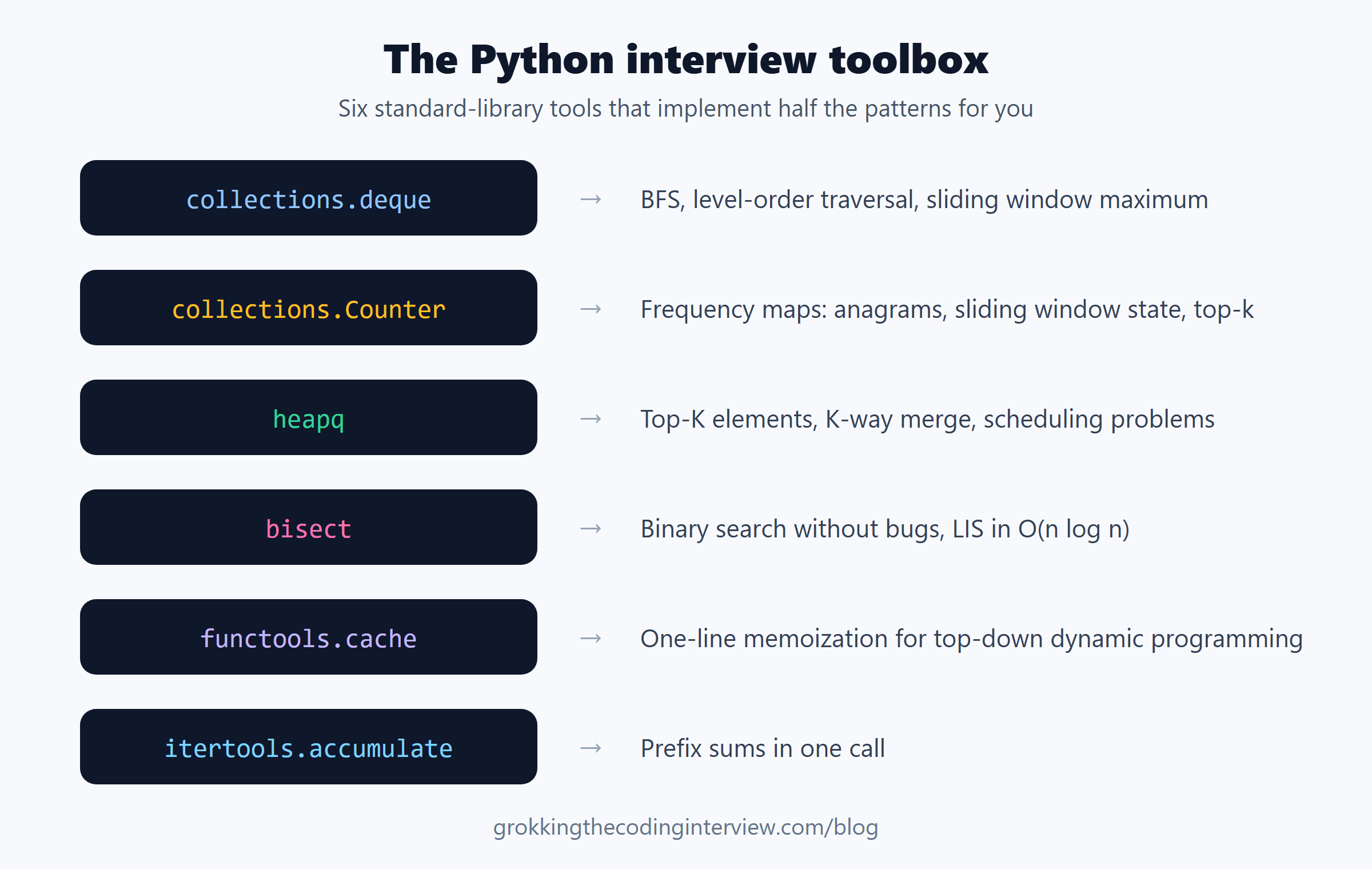
The standard library is a pattern toolkit. A large fraction of interview patterns lean on exactly four modules, and every one is fair game in interviews at every major company:
| Tool | What it gives you | Patterns it powers |
|---|---|---|
collections.deque | O(1) pops from both ends | BFS, sliding window maximum |
collections.Counter / defaultdict | Instant frequency maps | Sliding window, anagrams, top-k |
heapq | A ready-made min-heap | Top-K elements, K-way merge, scheduling |
bisect | Binary search, already debugged | Sorted-array problems, LIS in O(n log n) |
functools.cache | One-line memoization | Every top-down DP pattern |
One honest caveat. Python's convenience can hide costs, and good interviewers probe for that. x in my_list is O(n) while x in my_set is O(1); list.pop(0) is O(n) while deque.popleft() is O(1); slicing copies. Use the built-ins, but be ready to state the complexity of each one you touch. That combination, convenient and accounted for, reads as seniority.
The templates
These are deliberately minimal: the skeleton you adapt, not a solution you memorize. Each links to its full deep dive where we have one.
Two Pointers
Converging pointers on sorted data. Full walkthrough in the two pointers deep dive.
def pair_with_target(nums, target):        # sorted input
    left, right = 0, len(nums) - 1
    while left < right:
        s = nums[left] + nums[right]
        if s == target:
            return [left, right]
        if s < target:
            left += 1
        else:
            right -= 1
    return [-1, -1]
Sliding Window (variable size)
Grow the right edge, shrink the left while invalid. Full treatment in the sliding window deep dive.
def longest_no_repeat(s):
    seen, left, best = set(), 0, 0
    for right, ch in enumerate(s):
        while ch in seen:
            seen.remove(s[left])
            left += 1
        seen.add(ch)
        best = max(best, right - left + 1)
    return best
Fast and Slow Pointers
Cycle detection without extra memory. Deep dive here.
def has_cycle(head):
    slow = fast = head
    while fast and fast.next:
        slow, fast = slow.next, fast.next.next
        if slow is fast:
            return True
    return False
Merge Intervals
Sort, then merge or emit. Deep dive here.
def merge(intervals):
    intervals.sort()
    out = [intervals[0]]
    for start, end in intervals[1:]:
        if start <= out[-1][1]:            # overlap: extend
            out[-1][1] = max(out[-1][1], end)
        else:
            out.append([start, end])
    return out
Binary Search
The while left <= right form generalizes to every "search a sorted space" problem, including binary-search-on-the-answer.
def binary_search(nums, target):
    left, right = 0, len(nums) - 1
    while left <= right:
        mid = (left + right) // 2
        if nums[mid] == target:
            return mid
        if nums[mid] < target:
            left = mid + 1
        else:
            right = mid - 1
    return -1
When the array is static and you just need a position, say the word bisect and use it: bisect.bisect_left(nums, target) is a debugged binary search you don't have to rewrite under pressure.
BFS (trees and graphs)
deque is the whole trick: popleft is O(1), so level-order traversal stays O(n).
from collections import deque

def level_order(root):
    if not root:
        return []
    out, q = [], deque([root])
    while q:
        level = []
        for _ in range(len(q)):            # exactly one level
            node = q.popleft()
            level.append(node.val)
            if node.left:
                q.append(node.left)
            if node.right:
                q.append(node.right)
        out.append(level)
    return out
DFS and Backtracking
Choose, recurse, un-choose. The skeleton behind subsets, permutations, and combination sums.
def subsets(nums):
    out = []
    def backtrack(start, path):
        out.append(path[:])                # copy: path keeps mutating
        for i in range(start, len(nums)):
            path.append(nums[i])           # choose
            backtrack(i + 1, path)         # explore
            path.pop()                     # un-choose
    backtrack(0, [])
    return out
Top-K Elements
Keep a min-heap of size k; the root is the weakest thing still in the club. Why that works is in the Top-K deep dive.
import heapq

def k_largest(nums, k):
    heap = nums[:k]
    heapq.heapify(heap)
    for x in nums[k:]:
        if x > heap[0]:
            heapq.heapreplace(heap, x)
    return heap
For one-liners, heapq.nlargest(k, nums) and heapq.nsmallest(k, nums) exist; use them when the k-sized heap itself isn't the point of the question.
Monotonic Stack
Next-greater-element and its many disguises. Deep dive here.
def next_greater(nums):
    out = [-1] * len(nums)
    stack = []                             # indexes, values decreasing
    for i, x in enumerate(nums):
        while stack and nums[stack[-1]] < x:
            out[stack.pop()] = x
        stack.append(i)
    return out
Dynamic Programming (top-down)
@cache turns a brute-force recursion into a memoized solution in one line. The six DP families are mapped in our DP patterns guide.
from functools import cache

@cache
def fib(n):
    return n if n < 2 else fib(n - 1) + fib(n - 2)
That decorator is the fastest route from "I see the recurrence" to "it runs" that any interview language offers.
The rest of the map
The other pattern families, and the Python tool each one leans on:
| Pattern | Python tool / idiom |
|---|---|
| In-place linked list reversal | Triple assignment: prev, cur.next, cur = cur, prev, cur.next |
| Cyclic sort | while swap: nums[i], nums[j] = nums[j], nums[i] |
| K-way merge | heapq with (value, source, index) tuples |
| Topological sort | deque + in-degree defaultdict(int) |
| Union-Find | Plain list as parent array, path compression in 5 lines |
| Tries | Nested dict, or defaultdict(TrieNode) |
| Bitwise XOR | ^ and functools.reduce(operator.xor, nums) |
| Prefix sums | itertools.accumulate(nums) |
| Intervals / scheduling | sort(key=lambda x: x[1]) on end time |
| Sliding window maximum | deque of indexes, monotonic decreasing |
If you can name the pattern, Python usually has the load-bearing data structure ready. That is the entire argument for pairing the pattern map with this language.
Five Python traps that cost real candidates
1. list.pop(0) in a loop. It shifts the whole list, turning O(n) BFS into O(n²). Use deque.popleft(). Interviewers at scale-obsessed companies specifically watch for this.
2. String concatenation in a loop. s += ch copies the string every pass. Collect into a list and ''.join(parts) at the end.
3. Mutable default arguments. def f(path=[]) shares one list across all calls. Use path=None then path = path or []. This bug in a backtracking solution is agonizing to debug live.
4. Recursion depth. Python's default limit is around 1,000 frames. A DFS on a 10,000-node degenerate tree will crash. Mention sys.setrecursionlimit, or better, offer the iterative version with an explicit stack; knowing when to switch is the senior signal.
5. Floor division with negatives. -7 // 2 is -4 in Python (it floors, not truncates), and % follows suit. Any problem doing arithmetic partitioning around zero deserves a two-second comment about it.
Will interviewers accept Python?
At every major tech company: yes, unconditionally. Meta, Google, Amazon, Microsoft, and effectively all startups let you interview in the language of your choice, and Python is now the most common interview language we see. The exceptions are role-specific: embedded, systems, and some high-frequency-trading roles want C++ fluency demonstrated. Unless your target role is one of those, the right question is not "is Python allowed" but "why would I give away typing time for free?"
One nuance worth knowing: interviewers do expect you to understand what your conveniences cost. If you use sorted(), know it is O(n log n) Timsort. If you use in on a list, expect the follow-up. Python doesn't lower the bar; it moves the test from syntax recall to comprehension, which is where you want the test to be.
The takeaway
Pattern recognition decides coding interviews, and Python is the language that lets you spend the most interview time on it. Learn the tells from the complete pattern guide, keep these templates in your fingers, respect the five traps, and narrate complexity as you go. The stack is short and the payoff compounds with every round.
Learn every pattern natively in Python: Grokking the Coding Interview teaches all 42 patterns (32 common + 10 advanced) across 300+ problems, each with full Python solutions and in-browser playgrounds to run them, for a one-time $79. Short on time? Grokking 75 drills the essential 75, also in Python.
FAQs
Is Python good enough for FAANG coding interviews? Yes. All the major companies accept it, and it is among the most common languages candidates use. Interviewers grade problem-solving, communication, and complexity analysis, not language choice. The only caveat is role-specific: systems and embedded positions may require C or C++.
Is there a Python version of Grokking the Coding Interview? You don't need a separate edition: every problem in the course includes complete Python solutions alongside Java, C++, JavaScript, Go, and C#, with playgrounds to run each one in the browser. Pick Python once and the whole course reads in Python.
Am I allowed to use things like heapq, Counter, and sorted() in an interview?
Yes, standard-library tools are expected, not cheating. The rule of thumb: you can use anything you can explain. Know that sorted is O(n log n), heapq operations are O(log n), and Counter construction is O(n), and be ready to sketch how a heap works if asked. What's off-limits is a library call that is the entire question, like calling a cycle-detection package on a cycle-detection problem.
Is Python too slow for coding interviews? No. Interview judgments are about algorithmic complexity, not constant factors, and an O(n log n) Python solution beats an O(n²) C++ solution every time. Online assessments with strict time limits occasionally punish Python's constants, but the fix is the better algorithm, which is what the patterns give you.
Should I switch to Python just for interviews if I work in Java or C#? If your interviews are more than a month away, it's often worth it: the interview subset of Python (lists, dicts, sets, the four modules above) is learnable in a week or two, and the typing-speed dividend pays in every round after. Inside a month, stay with the language you think in; fluency under pressure beats brevity. Either way the patterns transfer unchanged, and the course gives you the same problems in both languages side by side.