
TL;DR: Interviewers can only grade what they can observe, and increasingly they're required to write it down. Silent-and-right loses points everywhere; narrated-and-right wins them; narrated-everything (rambling) loses them back. The skill is a five-beat talk track: restate and clarify, state the brute force in one sentence, name the pattern and its tell, narrate decisions while coding (never syntax), and test out loud. Plus one rule that removes most anxiety: silence is fine if you announce it. "Give me 30 seconds, I'm comparing two approaches" reads as thinking; unexplained quiet reads as absence. Scripts, the silence budget, and four drills below.
Every guide on this site keeps bumping into the same wall: Meta scores communication as one of four pillars, Amazon reads your narration through Leadership Principles, Google's hiring committee only ever meets you through what your interviewer wrote down, and the AI-assisted rounds downgrade silent chat-reading hardest of all. So this is the missing guide: not whether to talk (settled) but what to say, when, and how to stop saying too much, from someone who spent years on the listening side of it.
Why narration is graded (the mechanics nobody explains)
Your interviewer leaves the room with two things: a score and written evidence for it. At Google that's a formal packet a committee decides from; at Meta and Amazon it's debrief notes defended in a room of other interviewers. Either way, "the candidate seemed smart" is not writable evidence; "the candidate identified the monotonic-feasibility structure and chose binary search on the answer, stating O(n log maxW)" is. When you narrate well, you are literally drafting your interviewer's notes for them. When you think silently and produce correct code, you force them to reverse-engineer your reasoning, and reverse-engineered credit is always partial credit.
There's a second mechanism: narration lets interviewers steer. If you're quietly heading down a doomed path, they can't redirect without interrupting; if you're narrating, a raised eyebrow at the right sentence saves you ten minutes. Silent candidates get less help, not because interviewers are punitive, but because there's no surface to help against.
The five-beat talk track
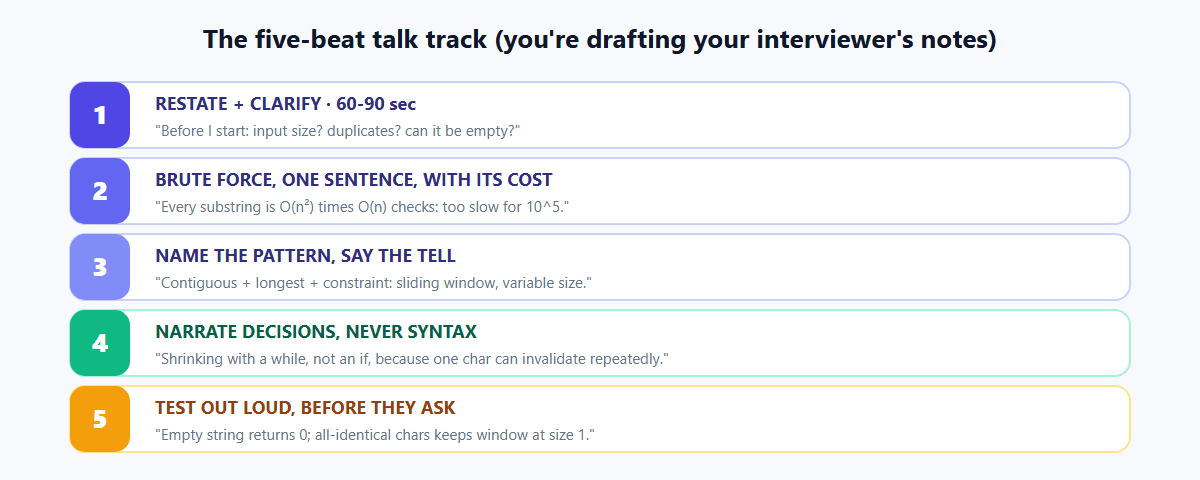
Beat 1: restate and clarify (60-90 seconds). Compress the problem into your own words, then run your clarifying checklist: sizes, ranges, duplicates, sortedness, ties, invalid input.
"So I'm looking for the longest contiguous substring under a distinctness constraint. Before I start: how large can the input be? Can it be empty? ASCII or unicode?"
This beat catches misreads while they're free, and at Google, where prompts under-specify on purpose, it's directly scored.
Beat 2: the brute force, in one sentence, with its cost. Not coded, stated: it proves you see the baseline and gives your later choice a contrast.
"Brute force is checking every substring, which is O(n²) windows times O(n) validation. Too slow for 10⁵, so I want something linear-ish."
Beat 3: name the pattern, and say the tell. This is the highest-value sentence in the interview, and most candidates skip it because it feels like showing your homework. Show the homework.
"Contiguous plus longest plus a constraint: that's the sliding window tell. Variable-size window, expand right, shrink while invalid, frequency map as state."
One sentence converts you from "someone who found an answer" to "someone with a diagnostic method", and it's precisely what the write-up needs.
Beat 4: narrate decisions while coding, never syntax. The rambling failure lives here, so here's the rule: narrate at the level of choices, not lines. Say things that have alternatives.
Say: "I'll use a dict for counts so removal stays O(1)." · "Shrinking with a while, not an if, because one new char can invalidate repeatedly." Don't say: "Now I'm writing a for loop... i equals zero... incrementing..."
If a stretch of code has no decisions in it, it's fine to type quietly for 20 seconds; beat 4 is not a livestream.
Beat 5: test out loud, before they ask. Walk one normal case and the edges from beat 1, tracing actual values.
"Empty string: loop doesn't run, returns 0, good. All-identical characters: window shrinks each step, stays size 1, good."
Volunteering this beat, rather than being prompted into it, is the single easiest way to earn the "verification" line in your write-up, and it's a formally scored pillar in the AI-era rounds.
The silence budget
You get thinking silences; you don't get unexplained ones. The rule I coach: any silence over ~30 seconds gets a label.
"Let me think for a moment: I'm deciding between a heap and sorting upfront."
Labeled silence reads as depth. The label does two jobs: it keeps the interviewer's model of you running while you think, and it forces you to know what you're thinking about, which collapses a surprising amount of fog. If the silence ends without resolution, narrate the fork itself ("I'll start with the heap version since it handles the streaming follow-up better"), because articulated trade-offs score whether or not the first branch was right.

Rambling: the failure on the other side
Rambling isn't "talking a lot"; it's talking without information. The three forms interviewers see daily:
- Syntax narration (the livestream): fixed by the decisions-not-lines rule.
- Anxiety chatter: apologizing, self-grading ("this is probably wrong..."), narrating feelings. Every such sentence spends packet space on doubt. Replace with silence labels; they're what the anxious sentence was trying to be.
- The unkillable tangent: three approaches described at length before any commitment. Cap beat 2 and 3 at three sentences total, commit, and let follow-ups reopen alternatives; "I'd also consider X, but I'll start here because Y" closes a tangent in one breath.
Four drills that install it
- Record one timed problem and count. Count unexplained silences over 30 seconds and information-free sentences. Most people need exactly one horrified listen; it's the fastest-acting drill on this list.
- Tell-first solving. For one week, you may not touch the keyboard on any practice problem until you've said beats 1-3 aloud. This welds narration to the diagnosis habit so they fire together under pressure.
- Decision commentary passes. Re-solve an old problem narrating only decisions: if you can't find a decision to narrate for 30 seconds, you've found a stretch where quiet typing is correct. Calibration, both directions.
- Narration-scored mocks. In your Week 3-4 mocks, ask your partner to score only communication for one session: silences labeled? pattern named? tests voiced? It's one mock, and it moves the needle more than three ordinary ones.
The takeaway
Narration is drafting your own evidence: five beats (restate, baseline, pattern, decisions, tests), one budget (label any silence past 30 seconds), one calibration (decisions, never syntax). It costs perhaps two minutes across a 40-minute interview and changes what's writable about you, which, in a world of packets, debriefs, and AI-round rubrics, is very nearly the whole game. The candidates who feel this is unnatural are right; it's a rehearsed skill, which is exactly why the ones who rehearse it stand out.
Pair the talk track with the pattern fluency it narrates: Grokking the Coding Interview teaches all 42 patterns (32 common + 10 advanced) with the tells and templates the five beats are built from, for a one-time $79. Interview soon? Grokking 75 plus a week of tell-first solving covers the essentials.
FAQs
Won't talking slow down my coding? Beats 1-3 cost about two minutes and routinely save more by catching misreads and doomed approaches early, and beat 4 permits quiet typing through decision-free stretches. Candidates who feel slowed by narration are usually doing syntax narration, which is the version to delete, not the method.
I'm interviewing in my second language. Does imperfect English hurt me? Far less than silence does. Interviewers grade the presence and order of the beats (clarified, baselined, named, tested), not fluency of delivery, and short declarative sentences carry the method perfectly. Every script in this guide works in eight-word sentences.
What if the interviewer stays completely silent? Keep the track running; silent interviewers are usually just note-taking (you're making that easy), and some loops mandate minimal intervention. The beats aren't a conversation bid, they're evidence-generation, and they work identically on a stone-faced audience.
How does narration change in the AI-assisted rounds? It intensifies: reading AI output silently is the most common downgrade in Meta's AI round, and Google's pilot scores audible validation directly. The additions are small: narrate your prompts' intent ("I'm asking only for the parser stub, I'll integrate it myself") and your verification of what comes back.
How much of my evaluation is communication, really? Formally, one pillar of several; effectively, it's a multiplier on the rest, because every other pillar is scored through what you made observable. The same solution, narrated versus silent, routinely lands one rating band apart, and in packet-driven processes like Google's, the written trail is the interview.