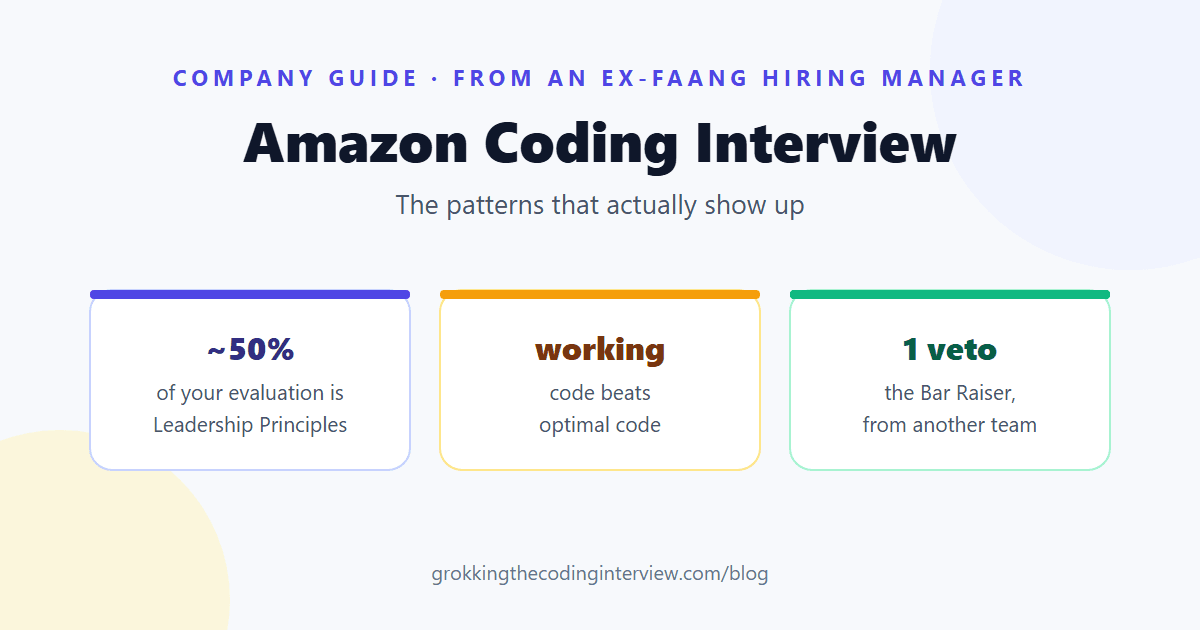
TL;DR: Amazon's pipeline is the most structured in FAANG: an online assessment (two coding problems plus a work-simulation and Leadership Principles survey), a phone screen, then a virtual loop of four to five 55-minute rounds where a Bar Raiser holds veto power and Leadership Principles show up in every round, including the coding ones (roughly half your evaluation is LP fit). The coding bar itself favors working code over optimal code: correct-then-optimize beats elegant-but-buggy. The pattern pool is a narrow, repeating band: sliding window, two pointers, hashing, tree and graph BFS/DFS, heaps/Top-K, with moderate DP. Prepare the patterns, prepare eight LP stories, and practice narrating both at once.
After Meta (covered here), Amazon is the second stop in our company guide series, and the two companies fail candidates in opposite ways. Meta's killer is the clock. Amazon's killer is the assumption that coding rounds are only about coding: candidates deliver clean solutions, skip the "tell me about a time..." questions bolted to the same 55 minutes, and lose the offer on Leadership Principles they didn't know were being scored. Here's the full pipeline, the patterns the pool actually draws from (from publicly reported interview data plus my years of FAANG interviewing), and the prep plan that covers both halves of the evaluation.
The pipeline at a glance
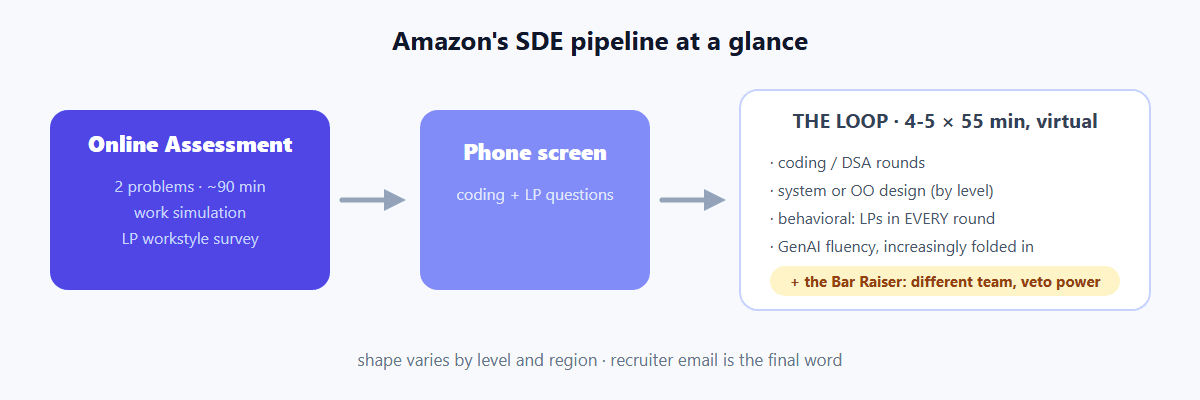
- Online Assessment (OA): ~90 minutes for two LeetCode-style problems (medium, occasionally hard), then a work-simulation section (scenario judgment) and a workstyle survey keyed to Leadership Principles. For SDE II and above, recent OAs add a short system-design sketch. The OA is auto-scored plus reviewed; treat the non-coding sections as real, because they are.
- Phone screen: one round, coding plus LP questions.
- The loop: four to five 55-minute virtual rounds: coding/DSA, system design or object-oriented design (level-dependent), behavioral, and increasingly a GenAI-fluency component folded in. Every round budgets time for LP questions.
- The Bar Raiser: a trained senior interviewer from a different team, with veto power, whose whole job is asking "does this hire raise the bar?" They lean hardest on Leadership Principles, and they're why "I crushed the coding" candidates still get rejected.
Format details vary by level, team, and region; your recruiter's email is the final word. The shape above is the common case as of this writing.
What makes Amazon's coding bar distinct
Working code beats optimal code. Unlike Google, where optimality is the bar, Amazon interviewers consistently reward a correct brute-force-then-improve arc over a swing at the optimal solution that arrives buggy. Say your brute force out loud, ship it mentally, then optimize. This ordering is scored, not just tolerated.
Leadership Principles live inside coding rounds. Expect 10 to 15 minutes of behavioral questions in the same session as your coding problem, and expect your coding behavior itself to be read through LP lenses: asking clarifying questions is Customer Obsession and Dive Deep; stating trade-offs is Ownership; disagreeing with a hint gracefully is Backbone. Roughly half the total evaluation is LP fit, which no amount of LeetCode covers.
The pool is narrow and stable. Amazon's questions are variations on a compact, repeating band of patterns, more predictable than Meta's rotation. That's good news: coverage is very achievable, and pattern-first prep maps almost one-to-one onto what's asked.
The pattern tiers at Amazon
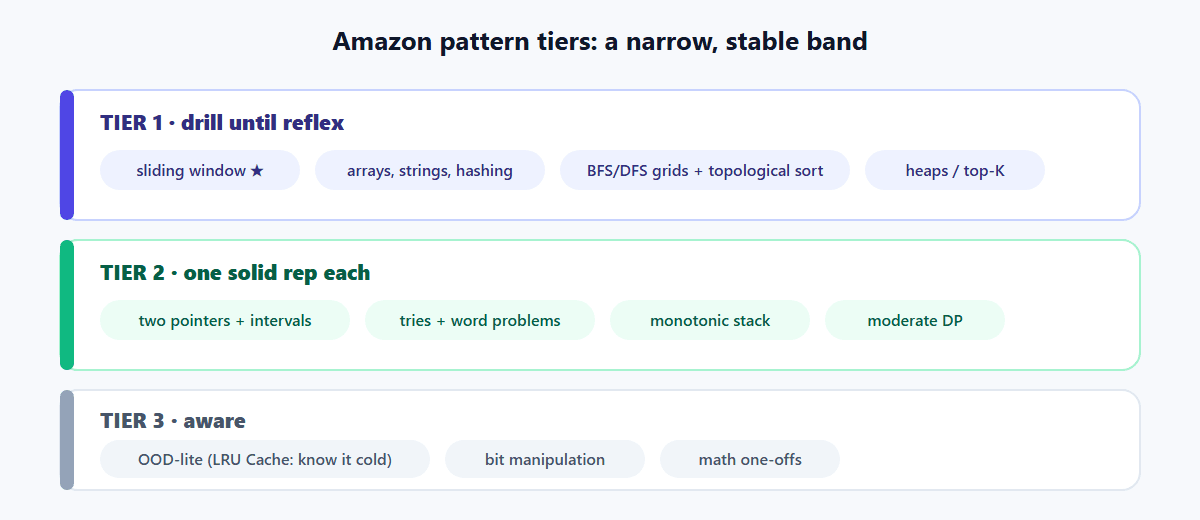
Tier 1, drill until reflex:
- Sliding window: Amazon's signature pattern; longest-substring variants are near-ritual in OAs and screens.
- Arrays, strings, and hashing: Two Sum families, Subarray Sum Equals K, anagram groups.
- Tree and graph BFS/DFS: Number of Islands and Rotting Oranges are famously Amazon; add Word Ladder, Course Schedule (topological sort), and shortest-path-on-grid forms.
- Heaps / Top-K: K Closest Points to Origin is an Amazon screen staple; Kth Largest, Top K Frequent, Merge k Sorted Lists all recur.
Tier 2, one solid rep each:
- Two pointers and merge intervals (Meeting Rooms variants, ranges with product costumes: delivery windows, locker bookings).
- Tries and word problems: Word Search II, autocomplete-shaped designs.
- Monotonic stack: rising steadily here as everywhere.
- Moderate DP: Coin Change, House Robber, unique paths; Amazon's DP runs shallower than Google's but appears more often than Meta's.
Tier 3, aware:
- OOD/design-lite questions (parking lot, LRU Cache, which straddles the line: know LRU cold, it's an Amazon classic), bit manipulation, math one-offs.
Train the tiers in order: Grokking the Coding Interview covers all 42 patterns (32 common + 10 advanced) with 300+ sequenced problems, and Amazon's Tier 1 maps directly onto its opening chapters, for a one-time $79.
The LP half: eight stories, indexed twice
You don't need all 16 Leadership Principles memorized; you need eight strong stories from your own work, each mapped to 2 to 3 LPs, told in STAR shape (situation, task, action, result) with numbers in the result. Index them twice: by LP ("which story shows Ownership?") and by theme ("conflict", "failure", "deadline"), because questions arrive phrased both ways. Practice the 90-second version of each; Bar Raisers cut rambling stories off and score the fragment.
And the detail most candidates miss: rehearse switching modes mid-round. The awkward gear-shift from "tell me about a disagreement with your manager" straight into a graph problem is an Amazon-specific skill; simulate it in your mocks or the shift will cost you the first five minutes of the coding half.
A 4-week Amazon-specific plan (for someone already pattern-fluent)
- Week 1: Tier 1 blocks (sliding window, hashing, BFS/DFS) + draft your eight LP stories.
- Week 2: heaps/Top-K, intervals, two pointers + rehearse stories to 90 seconds each; OA practice set under real timing.
- Week 3: Tier 2 sweep + two mixed sessions in Amazon format: one LP question, then one coding problem, same sitting, narrating throughout.
- Week 4: two full mocks with the mode-switch built in, failure-list review, LRU Cache and Number of Islands one more time each (superstition, but earned superstition).
Not yet pattern-fluent? Put the 6-week foundation in front of this, and calibrate your total runway with the timeline guide.
The takeaway
Amazon is the most learnable loop in FAANG: a narrow, stable pattern band, a coding bar that rewards the honest correct-then-optimize arc, and a completely knowable second axis (Leadership Principles) that candidates lose only when they don't realize it's being graded everywhere. Prepare both halves with equal seriousness, practice them in the same sitting, and respect the Bar Raiser's veto by treating every round as a behavioral round. The coding foundation is the same one every company tests; the LP muscle is Amazon's own, and it's the difference between "strong coder, no offer" and "raised the bar."
Build the coding half: Grokking the Coding Interview for the full 42-pattern curriculum ($79, lifetime), or Grokking 75 if your loop is weeks away.
FAQs
How hard is the Amazon online assessment? The two coding problems are typically LeetCode mediums (occasionally a hard), heavy on sliding window, hashing, and BFS/DFS. What surprises candidates isn't difficulty but the format: the work-simulation and Leadership Principles survey sections are scored inputs, not formalities, and rushing them after burning 85 minutes on code is a common self-inflicted rejection.
Do Leadership Principles really matter in the coding rounds? Yes, structurally: LP questions are asked inside coding rounds, roughly half the overall evaluation is LP fit, and the Bar Raiser (who holds veto power) leans on them hardest. A clean coding performance with weak, story-free LP answers loses to a decent coding performance with strong ones, and I've watched exactly that trade happen.
Is the Amazon coding interview easier than Meta's or Google's? The problems trend slightly easier and the pool is more predictable, but the evaluation is broader: Meta grades speed, Google grades optimality, Amazon grades correctness plus the person. "Easier questions, more axes" is the honest summary; candidates who prepare only the coding axis routinely fail it.
How many LeetCode problems do I need for Amazon? Around 100 to 150 pattern-organized problems covers Amazon's narrow band comfortably, weighted toward sliding window, hashing, BFS/DFS, and heaps; the general framework is here. Past that point, LP stories and mode-switching mocks return more per hour than additional problems.
Does Amazon let you use AI in interviews? Not in a dedicated AI-assisted round the way Meta now does; as of this writing Amazon has instead been folding GenAI-fluency discussion into existing rounds, and its OA remains strictly monitored solo work. Expect this to keep evolving industry-wide, and treat your recruiter's instructions as final.