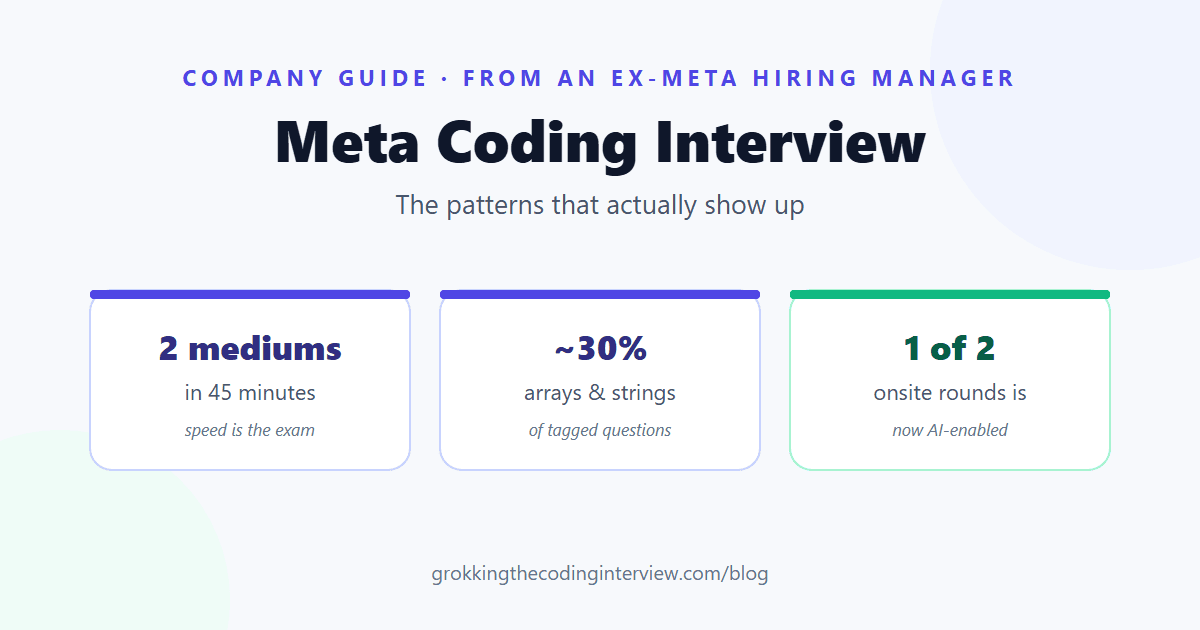
TL;DR: Meta's coding bar is less about difficulty and more about speed with communication: the classic rounds run two medium problems in about 45 minutes, which means roughly 20 minutes per problem while talking. The question pool rotates constantly, but it rotates within a stable set of patterns: arrays and strings dominate (about 30% of publicly tagged questions), with two pointers, tree and graph BFS/DFS, intervals, hash-map/prefix-sum tricks, heaps, and stacks (including monotonic) carrying most of the rest. One onsite coding round is now AI-enabled; the other is still the classic blank-editor format. Prepare tier by tier, then drill timed pairs, then mock.
I ran interview loops at Meta, and here's the thing candidates most often get wrong about the company: they prepare for hard and get beaten by fast. Meta's coding questions are mostly fair mediums, LeetCode-style with slight modifications, drawn from a rotating pool. What fails candidates is the clock: two problems per round, about 45 minutes, with your reasoning narrated as you go. This guide covers the loop's shape, the patterns the pool actually draws from (based on publicly reported and tagged interview data plus my own years in those rooms), and how to prepare for the bar that's actually being set.
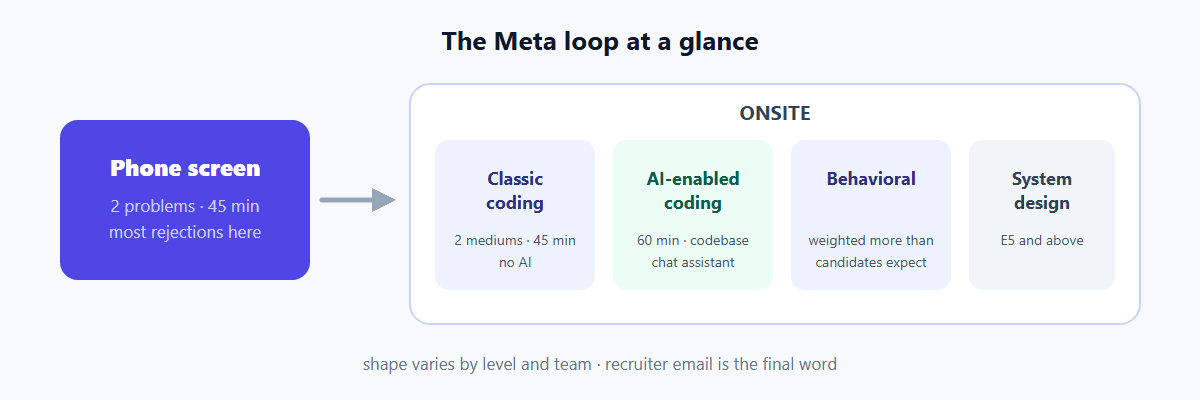
The loop at a glance
- Phone screen: one 45-minute round, typically two problems in CoderPad, no compiler help. This is the speed bar's first appearance, and most rejections happen here.
- Onsite, coding: two rounds. One remains the classic format (blank editor, two mediums, ~45 minutes). The other is now the AI-enabled round: 60 minutes in a multi-file codebase with a chat assistant, graded on the same four pillars; we covered it in full here.
- Onsite, behavioral: one round, and Meta weighs it more than most candidates expect.
- Onsite, system design: for E5 and above; a separate preparation entirely.
Details vary by level and team, and recruiter email is always the final word; the shape above is the common case as of this writing.
What makes Meta's coding bar distinct
The clock is the exam. Two mediums in 45 minutes means each problem gets about 20 minutes: understand, narrate an approach, code it clean, test it, done. There is no time to derive a pattern from first principles; there's only time to recognize it. That's why Meta, more than almost anywhere, rewards pattern-first preparation: recognition is the only thing fast enough.
Slight modifications, deliberately. Meta's pool takes known problems and twists a constraint, which punishes memorized solutions and rewards owned templates. If you've learned each pattern's variations (not just its canonical problem), the twists are small edits.
Communication is scored while you move. Silent-but-correct scores worse than narrated-and-correct. The talk track to practice: restate the problem, state the brute force in one sentence, name the pattern and why, code while narrating decisions, test out loud.
The pattern tiers at Meta
Based on publicly tagged question data and what I saw in loops, organized by how you should invest:
Tier 1, drill until reflex (the bulk of what's asked):
- Arrays and strings (~30% of tagged questions): in-place manipulation, two pointers everywhere; Valid Palindrome II and Valid Word Abbreviation are perennial screens.
- Tree and graph BFS/DFS: Binary Tree Vertical Order Traversal, Diameter of Binary Tree, Range Sum of BST, Lowest Common Ancestor, Shortest Path in a Binary Matrix, Rotting-Oranges-style grid BFS.
- Intervals: Merge Intervals and Interval List Intersections show up constantly, usually with a product costume (meetings, ad slots).
- Hash map + prefix sum: Subarray Sum Equals K and its family; the "count subarrays with property X" question shape.
Tier 2, one solid rep each:
- Heaps / Top-K: Kth Largest Element, Top K Frequent Elements, Merge k Sorted Lists.
- Stacks, including monotonic: Simplify Path, Basic Calculator II, Minimum Remove to Make Valid Parentheses, and the Meta favorite Buildings With an Ocean View, which is the monotonic stack pattern in disguise.
- Sliding window: less frequent than at Amazon, still regular.
- Binary search and math-adjacent: Random Pick with Weight (prefix sums + binary search), Pow(x, n).
Tier 3, aware but don't over-invest:
- Dynamic programming: appears, but Meta leans on it noticeably less than Google; don't let DP anxiety eat your Tier 1 time.
- Backtracking and light design questions (Moving Average from Data Stream, Dot Product of Two Sparse Vectors).
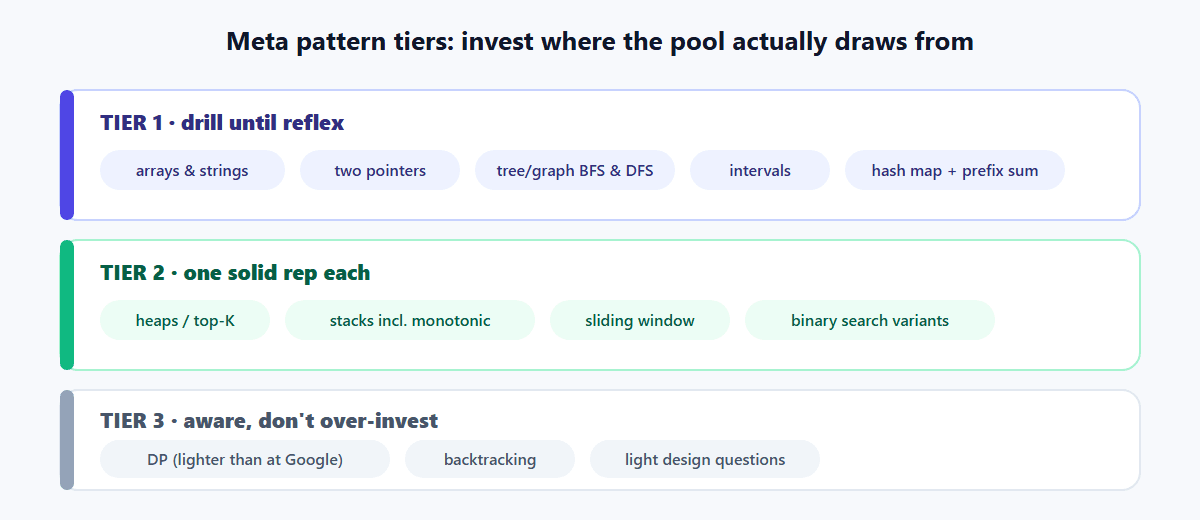
A caveat worth stating plainly: the specific questions above are publicly reported examples, and Meta rotates its pool aggressively, precisely so that memorizing tagged lists fails. The patterns are the stable layer. Prepare the family, treat the famous examples as reps, and a rotated question is just a new costume.
Train the tiers in order: Grokking the Coding Interview covers all 42 patterns (32 common + 10 advanced) with 300+ problems sequenced for exactly this kind of recognition-first prep, for a one-time $79.
The speed bar: how to actually train for 20-minute mediums
- Untimed depth first. Learn patterns in blocks with no clock; speed built on shaky recognition collapses under pressure. Timelines by starting point are in the prep-timeline guide.
- Then timed pairs, Meta-format. Two random mediums, 45 minutes, talking aloud, no pause button. Twice a week in your final month. The first sessions will be humbling; that's the point of doing them before the phone screen rather than during it.
- Kill the silent stretches. Record one session and count your quiet gaps. Every stretch beyond ~30 seconds is a habit to fix, because at Meta the interviewer is scoring the reasoning stream, not just the diff.
- Test without a compiler. Meta's classic rounds don't give you a run button. Practice verifying by tracing an example aloud, checking edge cases (empty, single element, duplicates) by hand. This doubles as training for the AI round's verification pillar.
A 4-week Meta-specific plan (for someone already pattern-fluent)
- Week 1: Tier 1 blocks: arrays/strings, two pointers, BFS/DFS. End each day writing the tell for what you drilled.
- Week 2: intervals + hash/prefix + heaps; start alternating timed single mediums.
- Week 3: Tier 2 sweep (stacks, sliding window, binary search variants) + timed pairs twice.
- Week 4: mixed timed pairs, two full mocks with a human, review your failure list only. No new material.
If you're not yet pattern-fluent, put the 6-week foundation in front of this plan rather than compressing both into four weeks.
The takeaway
Meta's coding interview is a recognition-and-speed exam wearing a difficulty costume. The pool rotates; the patterns don't. Build Tier 1 to reflex, give Tier 2 honest reps, refuse to let DP anxiety consume your calendar, and train the 20-minute-medium-while-talking format explicitly, because that format, not any individual question, is what's actually being tested. And remember the loop now has two different coding formats: the classic round tests recognition with no help, the AI-enabled round tests the same judgment with an assistant watching. Same foundation either way.
Build the foundation the whole loop tests: Grokking the Coding Interview teaches all 42 patterns with 300+ problems in six languages ($79, lifetime). Four weeks out? Grokking 75 is the compressed essential track.
FAQs
How many problems should I solve to pass Meta's coding interviews? Around 100 to 150 pattern-organized problems reaches the bar for most engineers, if they're followed by timed-pair practice and mocks. Meta punishes slow recognition more than small gaps in coverage, so past a point, timed reps beat new problems. The general framework is in How Many LeetCode Problems Should You Actually Solve?
Are Meta's questions really from the LeetCode tagged list? Partially and decreasingly: the pool rotates specifically to defeat tag-memorization, and tagged lists lag reality. Treat tagged questions as pattern reps, not as a syllabus. The pattern distribution is far more stable than any question list.
Is the Meta coding interview harder than Google's? Different bar. Google leans harder on algorithmic depth (more DP, harder graphs); Meta leans on speed and volume (two mediums per round, strict clock). Candidates who've done both usually describe Meta as "easier problems, harsher pacing."
Can I use AI in Meta's coding interviews now? In one designated onsite round, yes: it's a 60-minute session in a multi-file codebase with a built-in chat assistant, and it's graded on the same four pillars as the classic round. The other coding rounds remain AI-free. Full format and prep drills are in our Meta AI-round guide.
What languages can I use, and does the choice matter? Any mainstream language; Meta cares about reasoning, not language choice. Pick whatever you're fastest in, because the clock is the constraint. Python's brevity is a genuine edge at Meta's pacing if you're equally comfortable in it.