TL;DR: Google's coding bar is the depth bar: where Meta grades speed and Amazon grades the person, Google grades how far you can push a problem: optimal complexity, deliberately ambiguous prompts where your clarifying questions are scored, and escalating follow-ups ("now do it for a stream"). Your fate is decided by a hiring committee reading written packets, not by the interviewers themselves, which makes narration doubly valuable: you're dictating your own evidence. The pattern tiers invert the other companies': DP and graphs are Tier 1 here. And the loop is mid-evolution: a Gemini-assisted "code comprehension" round is piloting, the Googleyness round now includes a technical-design conversation about your past work, and early-career loops swap one traditional round for open-ended problem solving.
Completing the triangle with Meta and Amazon: Google, the loop with the longest mythology and the most misunderstood bar. Candidates over-prepare for trick questions (mostly gone) and under-prepare for what actually fails them: mediums that escalate into hards through follow-ups, ambiguity that punishes assumption-makers, and a written-packet evaluation where silent brilliance leaves no evidence. Here's the current shape, the tiers, and the prep adjustments, based on publicly reported interview data and my years across the table at Google's competitors.
The loop at a glance
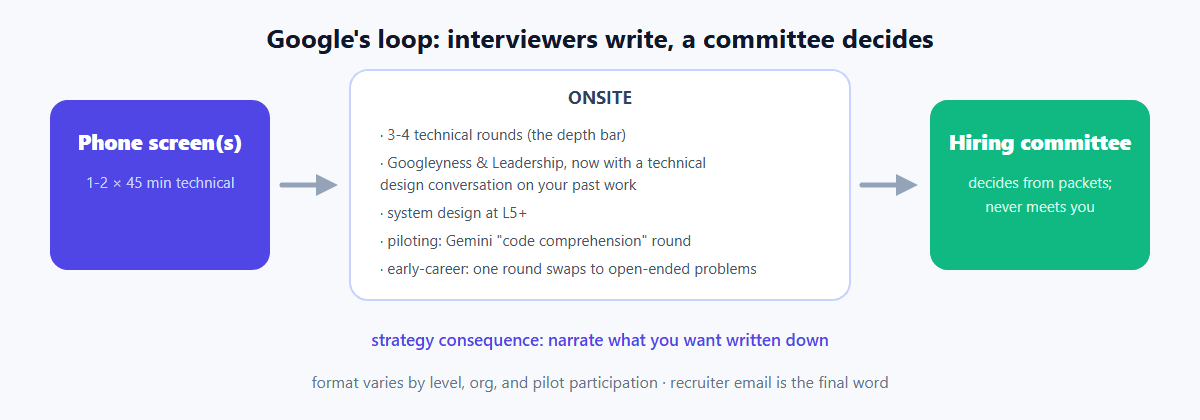
- Phone screen(s): one or two 45-minute technical rounds.
- Onsite: typically three to four technical rounds plus Googleyness & Leadership, which now includes a technical-design conversation grounded in your own past engineering work, not just behavioral questions. System design enters at L5 and above.
- In pilot: a "code comprehension" round with Gemini as an in-environment assistant: 60 minutes in a multi-file codebase, bug-fix through optimize, with AI fluency (prompt quality, output validation, debugging suggestions) explicitly evaluated. We covered it in full here. Early-career loops are also piloting an open-ended engineering-problems session in place of one traditional round.
- The hiring committee: unchanged, and the most distinctive thing about Google. Your interviewers don't decide; they write detailed feedback packets, and a committee that never met you decides from the paper. Two consequences: a single great round can't charm you through (the packet set has to cohere), and everything you say out loud is potential packet material, which is why narration is a scored behavior here in all but name.
Format varies by level, org, and pilot participation; recruiter email is the final word, as always.
What makes Google's coding bar distinct
Optimality is the question. At Amazon, working code wins; at Google, "it works" is the midpoint. Expect "can you do better?" until you've reached (or correctly argued the impossibility of) the optimal bound. This is why complexity fluency, knowing that the sorted structure implies log-something, that the answer space is binary-searchable, that the state space collapses, matters more here than anywhere.
Ambiguity is deliberate. Google prompts famously under-specify: ranges unstated, duplicates unmentioned, "integers" that turn out to be huge. Asking sharp clarifying questions isn't a warm-up nicety; it's a scored behavior, and assuming your way past it is a scored failure. Budget your first two minutes for it, out loud.
Follow-ups escalate by design. The question you solve is the seed, not the exam: "now the input doesn't fit in memory", "now it's a stream", "now make it concurrent". The pattern that solves round one often composes into round two (K-way Merge famously reappears as "merge the logs, but they're on different machines"). Prepare for extension, not completion.
The pool rotates hardest. Google retires leaked questions aggressively, so tagged lists decay fastest here. The patterns are the only stable layer, and Google's loops sample them deeper than anyone's.
The pattern tiers at Google
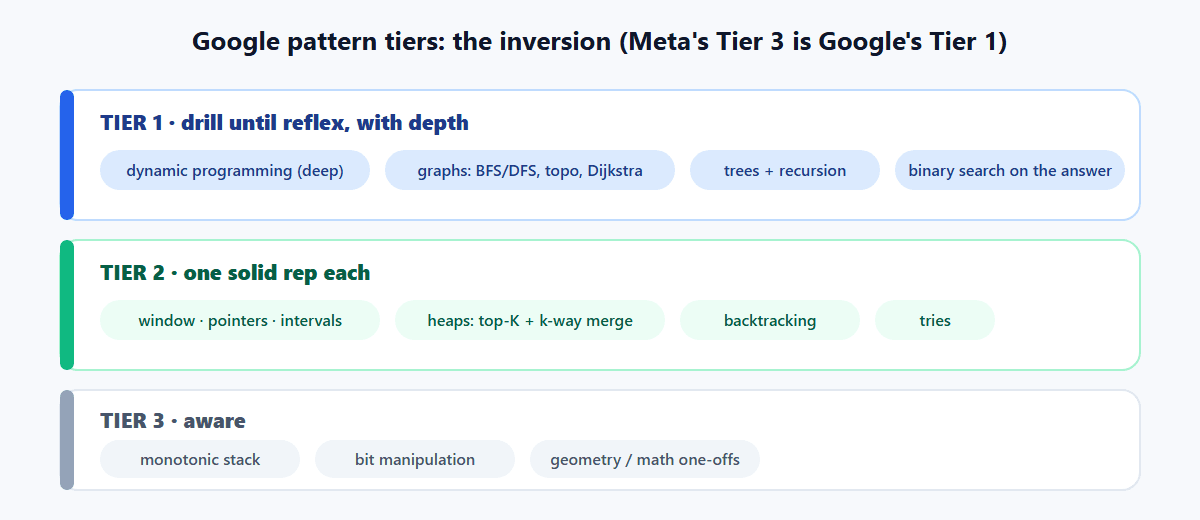
Note the inversion: what's Tier 3 at Meta is Tier 1 here.
Tier 1, drill until reflex:
- Dynamic programming, with real depth: knapsack variants, interval DP, DP-on-grids, LIS-shaped problems. Google is the loop where DP anxiety actually costs offers; both the recognition ("count the ways" + choices) and the state-definition skill need reps.
- Graphs, the full kit: BFS/DFS, topological sort, union find, weighted shortest paths (Dijkstra appears here more than at any peer), and grid-as-graph problems.
- Trees and recursion: deep recursion comfort, tree DP ("value returned vs value updated globally"), serialization.
- Binary search, including on the answer: the minimize-the-maximum family is practically a Google signature.
Tier 2, one solid rep each:
- Sliding window, two pointers, intervals, heaps/Top-K and K-way Merge, backtracking (a real presence at Google: N-Queens-adjacent constraint problems), tries.
Tier 3, aware:
- Monotonic stack (present, less beloved than at Meta/Amazon), bit manipulation, geometry one-offs, segment-tree-flavored problems at the margins.
Train the depth Google actually samples: Grokking the Coding Interview covers all 42 patterns (32 common + 10 advanced) with 300+ problems, including the DP sub-families and graph escalations that decide Google loops, for a one-time $79.
Preparing for Google specifically
- Give DP and graphs double rations. Whatever your baseline plan allocates (the 4-week plan works as the skeleton), Google prep doubles the DP and graph blocks and adds hard variations after the mediums, because the follow-ups will escalate you there anyway.
- Practice the extension game. After solving any practice problem, spend five minutes on self-inflicted follow-ups: stream it, shrink memory, parallelize it, generalize k. This trains the exact muscle Google's rounds exercise, and almost nobody drills it.
- Rehearse clarifying questions as a checklist. Input sizes and ranges, duplicates, sortedness, invalid input, ties. Five questions, fifteen seconds each, out loud, before any approach talk. At Google this reads as maturity; skipping it reads as recklessness.
- Narrate for the packet. Your interviewer is your stenographer: give them clean sentences to write down: the pattern named, the trade-off stated, the complexity argued. The full talk-track method is here, and it matters more at Google than anywhere because the decision-makers only ever meet you on paper.
- If your loop includes the pilot round, the Gemini-assisted guide covers its three extra drills: prompts-as-specs, close-but-wrong debugging reps, and audible validation.
The takeaway
Google's loop is the depth exam: optimal-or-argue-why-not, ambiguity you must dismantle aloud, follow-ups that compose patterns rather than merely testing them, and a committee that knows only what your interviewers could write down. The tier inversion is the practical headline: DP and graphs move to the front of your calendar, binary-search-on-the-answer becomes a named tool, and the extension game becomes a drill. Same foundation as every loop in this series; deepest sampling of it anywhere.
Build the foundation Google samples deepest: Grokking the Coding Interview for the full curriculum ($79, lifetime), or Grokking 75 if your phone screen is weeks away.
FAQs
Is the Google coding interview harder than Meta's or Amazon's? Deeper rather than harder: the seed questions are comparable mediums, but Google escalates them further (optimality demands, follow-up extensions) and samples the heavyweight patterns (DP, graphs) far more. Candidates who've done all three typically rank Google hardest on algorithms, Meta hardest on pacing, and Amazon hardest on breadth of evaluation.
What is the Google hiring committee, and how does it change my strategy? Your interviewers write detailed feedback packets; a separate committee that never met you makes the decision from those packets. The strategic consequence: optimize for what can be written down: clearly named approaches, stated trade-offs, clean complexity arguments. Impressions that live only in the room don't travel to the committee.
How many problems do I need for Google? The usual 100 to 150 pattern-organized problems, but with the mix shifted: proportionally more DP and graph problems, hard variations included, plus the extension-game drill on everything. The general count framework is here; for Google, depth per family beats breadth across families.
Does Google still use whiteboards or Google Docs for coding? The era of coding into a bare Google Doc is essentially over: current loops use an interactive environment (and the pilot round runs in a full multi-file setup with Gemini). The habit the Doc era trained (talking while writing, testing by hand-tracing) is still exactly the right one, since most rounds still have no run button.
Can I use AI in my Google interview? Only in the piloting code-comprehension round, where Gemini is provided in-environment and your fluency with it (prompt quality, validating output, debugging its near-misses) is explicitly evaluated; full guide here. Every other round remains solo, and bringing outside AI tools to any round is not permitted.