TL;DR: A HackerRank coding assessment is a timed test an employer builds on HackerRank's platform and sends before any interview. Most contain one to three coding problems, sometimes with multiple-choice or SQL questions, in 60 to 90 minutes. Your code is scored by hidden test cases, so a correct solution that misses edge cases loses points without warning. Whether the test watches your webcam, your tabs, or your copy and paste depends on settings the employer chooses, and HackerRank's own documentation lists all of them. The questions use the same small set of patterns as other coding tests.
What a HackerRank coding assessment is
HackerRank is a company that sells a technical hiring platform. Employers use it to build timed tests, send them to candidates by email, and receive a scored report for each candidate. The test you receive was written or selected by the employer, so two HackerRank tests from two companies can look quite different.
Many employers send these tests as their online assessment, the automated screening step before any live interview. Amazon's preparation page for SDE II candidates tells them to get comfortable coding within HackerRank, and candidates report HackerRank tests from Oracle, IBM, DocuSign, and many others. The Google online assessment also runs on HackerRank for some candidates, as the Google OA guide describes.
This article covers what the test contains, what the employer can monitor, how scoring works, the patterns the problems draw from, and a plan for the week before.
The format
| What candidates report | |
|---|---|
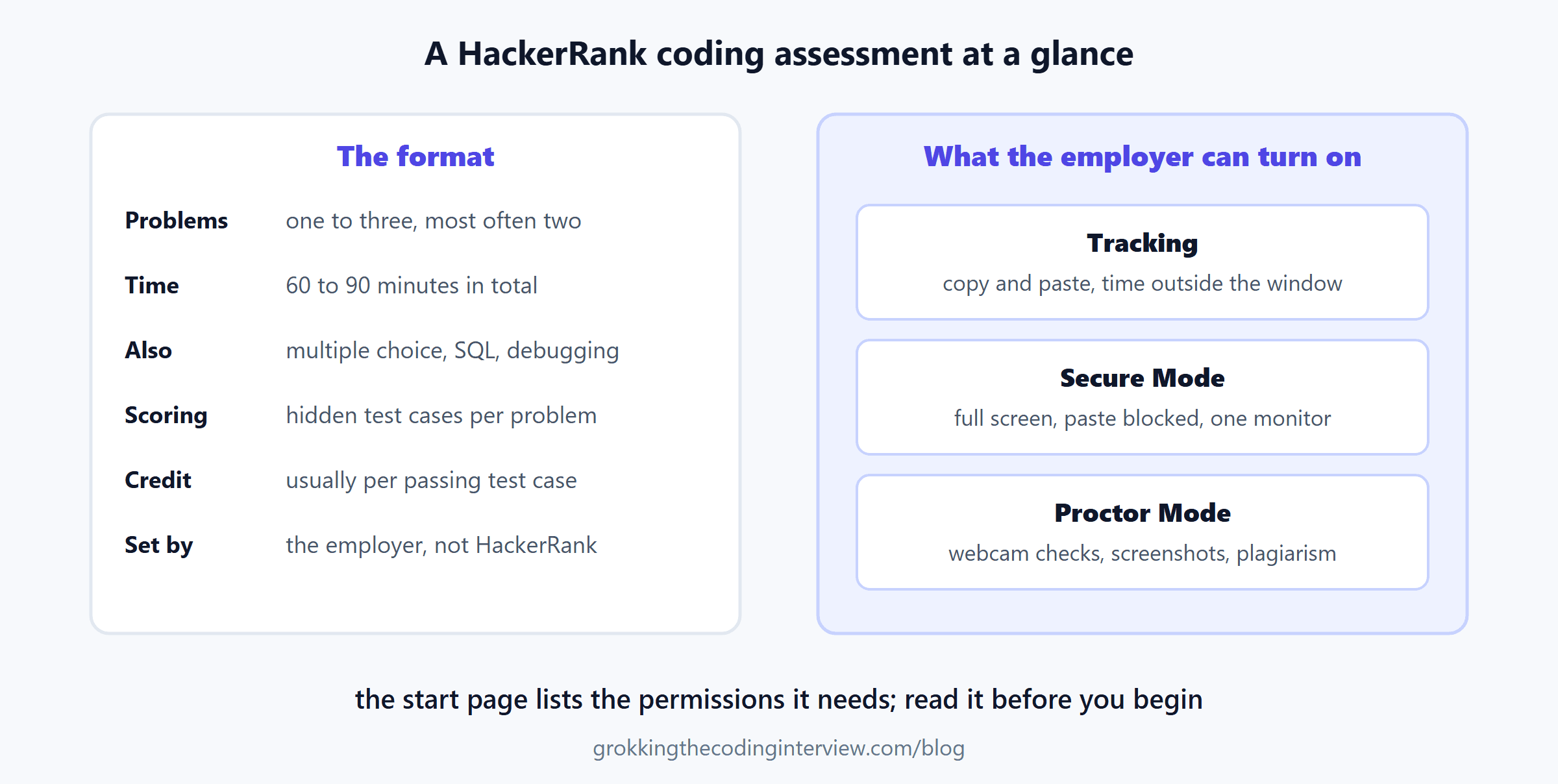
| Coding problems | One to three, most often two |
| Time | 60 to 90 minutes for the whole test |
| Other question types | Multiple choice on language or computer science basics, SQL queries, sometimes a debugging task |
| Languages | Usually the employer's choice from a long list, including Python, Java, C++, C#, JavaScript, and Go |
| Scoring | Hidden test cases for each coding problem |
| Interviewer | None; the test is automated |
| Deadline | Set by the employer, often a few days to a week after the email |
Each language has its own time and memory limit, which HackerRank publishes in its execution environment documentation. A solution that passes in one language can time out in another, so practice in the language you will use on the day.
Is a HackerRank test proctored?
It depends on the employer. HackerRank offers several integrity settings, and the employer chooses which ones to turn on for its test. HackerRank's help center describes them in detail.
Tracking that is common by default. HackerRank records copy and paste actions and tracks how often and for how long a candidate leaves the test window. The employer sees both in its report, even when nothing is blocked.
Secure Mode. When the employer enables it, the test runs in full-screen mode, blocks copy and paste, prevents the use of more than one monitor, and alerts when the candidate switches tabs.
Proctor Mode. This mode adds features driven by AI on top of Secure Mode. It analyzes screenshots taken during the test, checks the webcam for a missing face, a second face, or a phone, and runs plagiarism detection. HackerRank's documentation describes a code similarity check that compares your submission with code submitted by other candidates.
The test's start page tells you which permissions it needs, such as webcam, screen sharing, or full screen. If it asks for those permissions, assume every setting above is active. Either way, the safe approach is the same: type your own code, stay in the test window, and keep your phone away from the desk.
How the test is scored
Each coding problem usually comes with a few sample test cases that you can see and many hidden ones that you cannot. When you submit, HackerRank runs your code against all of them, and the employer's report shows how many passed.
Most tests give credit for each passing test case, so a partial solution still earns points. That has three practical consequences.
A slow correct solution beats an unfinished fast one. If the optimal approach is not clear within ten minutes, write the simple correct version first. It will pass the small hidden cases, and you can improve it if time remains.
Edge cases carry real points. Hidden tests almost always include an empty input, a single element, duplicates, negative numbers where allowed, and the largest input the constraints allow. Write a custom test for each before you submit.
Time limits are part of the score. A solution that is correct but too slow fails the large hidden cases. Read the constraint on the input size before you design anything, and use the Big O cheat sheet to see which complexity that size allows.
How HackerRank differs from LeetCode
The problems are similar, but the environment is not, and the differences cost minutes on the day.
Input handling varies. Most HackerRank problems give you a function to complete, with the input already read for you. Some ask you to read standard input and print the answer yourself, in an exact format. Check which kind you have before writing anything.
The statement is often longer. Employer-written problems tend to describe a business task, such as orders, logs, or schedules, rather than an abstract array. The algorithm inside is usually standard.
Nobody clarifies. There is no interviewer to ask about an unclear rule. Read the statement twice and test your reading against the sample cases before you code.
The patterns the problems draw from
A pattern is a reusable solution shape with a tell, the words in the statement that give it away. Employer tests on HackerRank lean toward easy and medium problems, and these patterns cover most of them.
| Problem type | Pattern | The tell |
|---|---|---|
| Count, group, or deduplicate records | Hash Maps | "how many", "most frequent", "unique" |
| Longest or best run of items | Sliding Window | "contiguous", "consecutive", "at most k" |
| Pairs that meet a target in sorted data | Two Pointers | a sorted array and a target sum or difference |
| Overlapping time ranges or bookings | Merge Intervals | start and end times, "overlap", "free slots" |
| Range totals and running balances | Prefix Sum | "sum between", "running total", "subarray sum" |
| Matching brackets, undo, nearest larger value | Stacks and Monotonic Stack | nesting, "previous", "next greater" |
| Regions and shortest routes in a grid | Matrix Traversal | a grid, "connected", "minimum steps" |
| Ways to reach a total, or the best total | Dynamic programming | "number of ways", "minimum cost", choices that repeat |
For practice problems grouped the same way, the Amazon OA guide and the Google OA guide each list 21 free LeetCode problems by pattern. The full list of tells for every pattern is in the DSA patterns cheat sheet.
How to prepare in the week before
One day on HackerRank itself. Create a free account and solve three problems in its practice section, in the language you will use. Learn how the run and submit buttons differ, how custom input works, and what a problem that reads standard input looks like.
Four days on the patterns. Two or three problems per pattern from the table above, solved against a judge, with the tell written down for each. Spend the most time on hash maps, sliding windows, and two pointers, since easy and medium employer tests use them most.
One timed rehearsal. Two unseen medium problems in 70 minutes, alone, without pasting anything, with your own edge-case tests. Stay in one window for the whole rehearsal, as you will have to on the day.
One check of the setup. Close other applications, charge the laptop, test the webcam if the start page asks for it, and keep a single monitor connected.
A time budget for the day. Read every question first and start with the one you understand fastest. Leave the last five minutes to run every custom test again and to confirm that each solution compiles.
Cover the patterns before the link arrives: Grokking the Coding Interview teaches all 41 patterns with problems ordered so each one builds on the last, for $79 once. If the data structures themselves are shaky, start with Grokking Data Structures for Coding Interviews.
The takeaway
A HackerRank coding assessment is an employer's test on HackerRank's platform: one to three problems in 60 to 90 minutes, scored by hidden test cases, with integrity settings the employer chooses. Partial credit is normal, so a correct simple solution and careful edge-case tests are worth more than an elegant unfinished one. The problems use a small set of patterns, so practice those patterns on the platform itself, type your own code, and stay in the test window from start to finish.
FAQs
Is a HackerRank test proctored? It depends on the employer's settings. HackerRank can track copy and paste and the time you spend outside the test window. The employer can add Secure Mode, which enforces full screen and blocks copy and paste, or Proctor Mode, which adds webcam monitoring, screenshot analysis, and plagiarism detection.
Can HackerRank detect cheating? HackerRank's documentation describes copy and paste tracking, tab tracking, webcam checks for extra faces or phones, and a code similarity check that compares your code with other candidates' submissions. The employer sees the flags in its report and decides what to do with them.
How is a HackerRank coding test scored? Each coding problem runs against hidden test cases, and most tests give credit for each one that passes. The employer sets the passing bar and usually does not share it, so aim to pass every case, including edge cases and the largest inputs.
How many questions are on a HackerRank assessment? Candidates most often report two coding problems, and some tests add multiple-choice, SQL, or debugging questions. The employer builds the test, so the invitation email and the start page are the only reliable description of yours.
What language should I use on HackerRank? Use the language you write fastest, from the ones the employer allows. Python is the most common choice for its short code, but each language has its own time limit, so practice in the language you will use. The language guide compares the main options.
Can I use my own IDE during a HackerRank test? Writing code elsewhere and pasting it in is risky, because copy and paste is recorded and may be blocked. Write and test your code in HackerRank's editor, using its custom input feature for your own test cases.
What are Oracle HackerRank questions like? Candidates report easy to medium problems on arrays, strings, hash maps, and SQL, sometimes with multiple-choice questions on Java or databases. Prepare the patterns in the table above, and add a few SQL join and aggregation problems if the role touches databases.
Related guides
- The Amazon Online Assessment (Amazon OA): Format, Work Simulation, and Practice Questions by Pattern
- The Google Online Assessment (Google OA): What It Is, the Format, and Practice Questions by Pattern
- Big O Cheat Sheet: Time and Space Complexity for Every Coding Pattern
- LeetCode vs Codeforces vs CodeChef vs HackerRank: Difficulty, Contest Format, and Which Employers Use Each
- The 10 Coding Interview Templates on One Page