
TL;DR: The Amazon online assessment is a set of timed tests you take alone, before any interview. The coding part is two questions, with about 70 minutes for new grads and interns and 90 minutes for SDE II candidates. A Workstyles survey follows, and full-time new grads also take a Work Simulation of about an hour. Every section counts, so a perfect coding score cannot rescue a weak Work Simulation. The coding questions are standard patterns written as Amazon stories, and seven patterns cover most of them. The practice list below gives three free LeetCode problems for each of those seven patterns.
What is the Amazon online assessment?
An online assessment (OA) is an automated test sent by email after your application passes the first screening. You open the link on your own schedule, within a deadline, and complete each section in a browser. Nobody interviews you, and nobody asks follow-up questions.
At Amazon, the OA is the first technical step for most software development engineer (SDE) applicants. SDE is Amazon's title for a software engineer, and SDE II is the level above entry. A pass leads to a phone screen or straight to the interview loop, depending on the role and the hiring season.
This article covers the format for each role, the rules Amazon states, the coding question types, the patterns behind them, a practice list grouped by pattern, and how to prepare in the last week.
The format, by role
Amazon publishes the structure of its OA on its own hiring pages. The times below are Amazon's stated averages, and the number of coding questions comes from Amazon's SDE II page and from candidate reports for the other two roles.
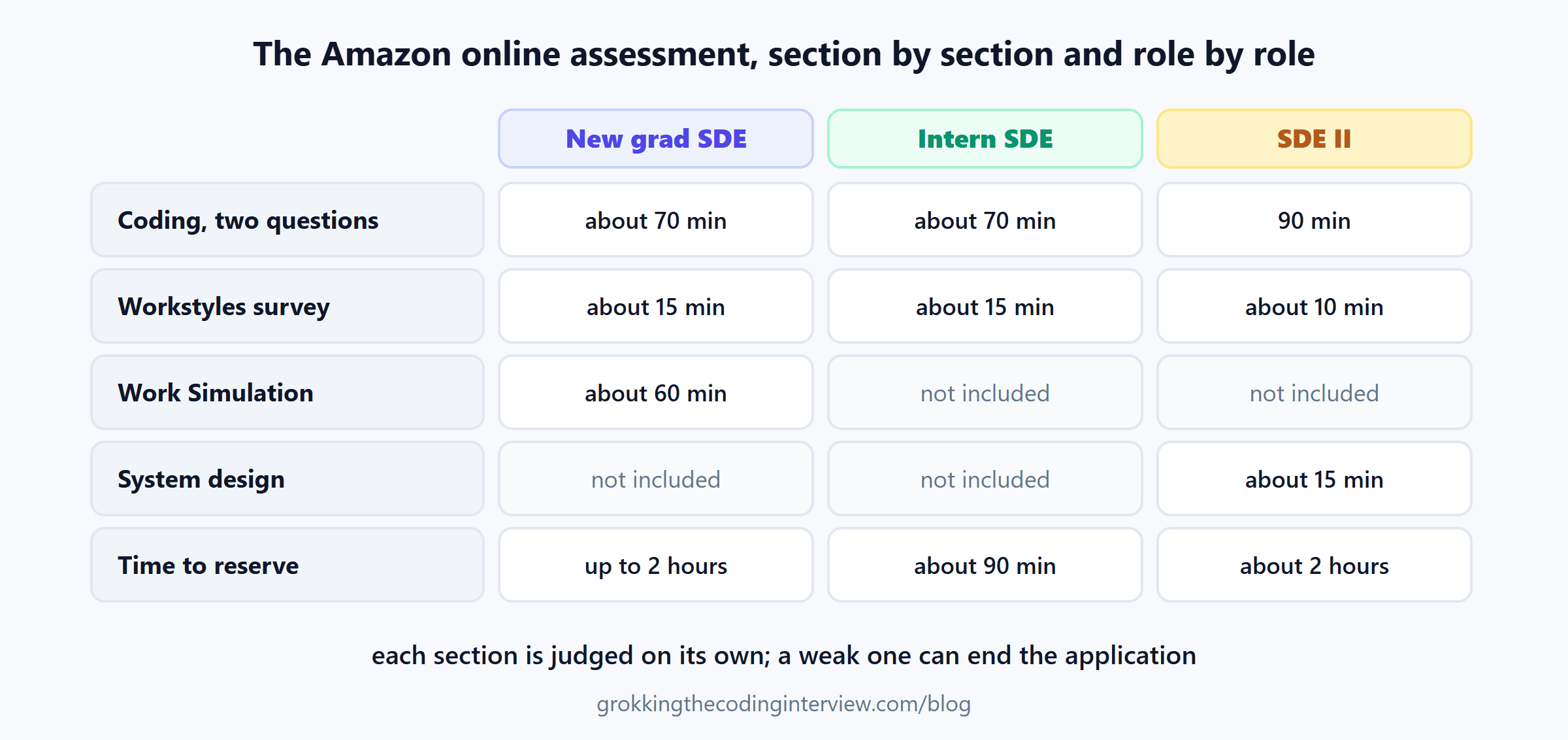
| Section | New grad SDE | Intern SDE | SDE II |
|---|---|---|---|
| Coding, two questions | about 70 minutes | about 70 minutes | 90 minutes |
| Workstyles survey | about 15 minutes | about 15 minutes | about 10 minutes |
| Work Simulation | about 60 minutes | not included | not included |
| System design questions | not included | not included | about 15 minutes |
| Feedback survey | about 5 minutes | about 5 minutes | about 1 minute, optional |
| Total time to reserve | up to two hours | about 90 minutes | about two hours |
Amazon's SDE II page gives seven days to complete the assessment from the date it was sent, and it says candidates hear within about two days whether they are moving forward. The coding section runs on HackerRank, a browser-based platform that compiles your code and runs it against hidden test cases.
The rules Amazon states
Amazon's preparation page for new grads lists the rules for the coding section, and they are stricter than many candidates expect.
Public resources are allowed, with limits. You may use publicly accessible online resources, such as language documentation. You may not use sites that require a login or private repositories, and Amazon states that your browser usage is logged.
Avoid copying and pasting. The page asks candidates to avoid copy and paste in the assessment, so type your own code rather than pasting from an editor or a website.
Never use print screen. The page says that using the print screen function ends your session. A screenshot taken out of habit can cost the whole attempt.
Use a laptop or desktop. The page asks for a laptop or desktop computer, and it addresses webcam use in its FAQ. Check the invitation email for the exact setup your test requires.
If the invitation email describes a different structure or different times, follow the email. Amazon adjusts the OA by role and by season, and the email is the version that applies to you.
The coding question types
The coding questions are standard data structures and algorithms. What makes them feel unfamiliar is the story around them. A question about packages, warehouses, delivery routes, or server logs is usually a plain array, string, or graph question with Amazon nouns.
The types that come up most often, from candidate reports:
Counting and grouping. Count items by category, find the most frequent value, or group records that share a key. The story is about products, orders, or log lines.
Best contiguous range. Find the best run of consecutive days, the longest stretch under a limit, or the maximum total in a window of fixed size.
Pairing and assignment. Load packages into trucks, assign tasks to workers, or pair items under a weight limit, with the fewest resources used.
Grid and route search. Find the shortest route across a warehouse floor, count separate regions, or measure how long a change takes to spread through a grid.
Top k selection. Return the k most popular products, the k closest delivery points, or the k largest values in a stream.
None of these need an advanced algorithm. All of them need the right pattern, typed correctly, inside 35 to 45 minutes per question.
The patterns the questions draw from
A pattern is a reusable solution shape with a tell, the words in the statement that give it away. These seven cover most reported Amazon OA coding questions.
| Question type | Pattern | The tell |
|---|---|---|
| Count, group, or find the most frequent item | Hash Maps | "how many of each", "most common", "group by" |
| Clean and reorder records or text | Arrays and strings | log lines, words, records with a sorting rule |
| Best run of consecutive items | Sliding Window | "consecutive", "contiguous", "at most k", "window of size k" |
| Totals over ranges, or capacity over time | Prefix Sum | "between stop i and stop j", "load at each point", "subarray sum" |
| Fewest trucks, boats, or workers | Greedy with sorting | "minimum number of", a weight or capacity limit |
| k most popular, k closest, k largest | Top 'K' Elements | "top k", "k closest", "k most frequent" |
| Routes, regions, and spreading in a grid | Matrix Traversal | a grid, "shortest path", "regions", "minutes until" |
The full list of tells, for every pattern, is in the DSA patterns cheat sheet. If you can name the pattern within three minutes of reading the story, the remaining time is enough for code and tests.
Amazon online assessment practice questions by pattern
Amazon does not publish its OA questions, and the questions candidates report change from batch to batch. A memorized list of past questions is therefore a weak plan. A stronger plan is to practice public problems that have the same shape as the reported questions, so that a new Amazon story still points you to a pattern you have already used.
The table below gives three LeetCode problems for each of the seven patterns. These are not Amazon's questions. Each one is chosen because its statement and its solution match a question type that candidates report from the OA. All 21 are free on LeetCode.
| Pattern | Practice questions (LeetCode number, difficulty) | What it trains for the OA |
|---|---|---|
| Hash Maps | 1 Two Sum (E), 49 Group Anagrams (M), 128 Longest Consecutive Sequence (M) | Counting and grouping by a key in one pass instead of comparing every pair |
| Arrays and strings | 121 Best Time to Buy and Sell Stock (E), 819 Most Common Word (E), 937 Reorder Data in Log Files (M) | Parsing records, applying a custom sort rule, and keeping a running best value |
| Sliding Window | 643 Maximum Average Subarray I (E), 3 Longest Substring Without Repeating Characters (M), 1423 Maximum Points You Can Obtain from Cards (M) | Finding the best fixed or variable run of consecutive items |
| Prefix Sum | 303 Range Sum Query - Immutable (E), 560 Subarray Sum Equals K (M), 1094 Car Pooling (M) | Answering range totals in constant time and tracking load changes along a route |
| Greedy with sorting | 881 Boats to Save People (M), 1029 Two City Scheduling (M), 56 Merge Intervals (M) | Sorting first, then making the best local choice to use the fewest resources |
| Top 'K' Elements | 1046 Last Stone Weight (E), 215 Kth Largest Element in an Array (M), 973 K Closest Points to Origin (M) | Keeping only the k best items in a heap instead of sorting everything |
| Matrix Traversal | 200 Number of Islands (M), 994 Rotting Oranges (M), 1091 Shortest Path in Binary Matrix (M) | Breadth-first search over a grid for regions, spreading time, and shortest routes |
Work through the table one row at a time. For each problem, set a 35-minute timer, rewrite the statement as one line of input and one line of output, and write your own edge-case tests before you submit. If a problem takes longer than the timer, note the pattern you missed and solve the next problem in the same row the following day.
The three problems in each row run from the most direct example of the pattern to the one closest to an OA story. Boats to Save People, for example, is the same problem as loading packages into the fewest trucks, with people in place of packages.
The Work Simulation and Workstyles sections
Many candidates prepare only for the code and lose the OA in the sections that follow it. Each section is judged on its own, so a weak result in any one of them can end the application.
The Work Simulation is taken by full-time new grads and lasts about an hour. Candidates report short scenarios from an engineer's working day, such as a customer complaint, a missed deadline, or a disagreement over a design. In each one, you choose a response or rank several responses from best to worst.
The scenarios are judged against Amazon's Leadership Principles, the written list of behaviors Amazon expects from every employee. The responses that score well usually share three traits: they ask for data before deciding, they take ownership of a problem even when another team caused it, and they put the customer first. Answer as an engineer who follows those principles, and rank similar scenarios in a consistent way.
The Workstyles survey shows pairs or sets of statements about how you work, and you choose the one that fits you better. It has no right answers in the usual sense, but it does check for consistency, because similar statements appear more than once in different words. Answer honestly and quickly, and pick the same side each time a statement returns.
Read the Leadership Principles once before the OA, since the same principles also decide the behavioral questions in every later interview round.
How to prepare in the week before
Most candidates have about a week between the email and the deadline. Spend it like this.
One day on HackerRank. Solve two problems on HackerRank itself. Learn where the run button is, how custom input works, and whether the question gives you a function to complete or asks you to read the input yourself.
Four days on the seven patterns. Two or three problems per pattern from the practice table, solved against a judge, with the tell written down for each.
One timed rehearsal. Two unseen medium problems in 70 minutes, alone, typed without pasting, with your own test cases. If you are an SDE II candidate, use 90 minutes and add a harder second problem.
One evening on the Leadership Principles. Read them, then write one sentence for each describing what that principle would make you do when a customer reports a bug.
A time budget for the day. Three minutes to read both questions and start with the easier one. About 30 minutes for the first, including tests. About 30 minutes for the second. The last few minutes go to re-running every test and confirming that both solutions compile.
If you are further out than two weeks, treat the OA as the first coding round of the loop. The full preparation for Amazon's interviews is in the Amazon coding interview guide.
Cover the seven patterns before the link arrives: Grokking the Amazon Coding Interview works through the question types Amazon asks most, grouped by pattern. For the full map, Grokking the Coding Interview covers all 41 patterns for $79 once.
How the OA differs from the interviews
Three differences matter.
Nobody hears your reasoning. In a live round, a clear explanation with an imperfect solution can still pass. In the OA, only the hidden test cases count. Write the simple correct solution first, then improve it if time remains.
Code that does not compile scores nothing. Candidates report that the platform checks each solution before moving on. Keep your code in a runnable state at every point, so that running out of time leaves a working answer rather than a broken one.
The behavioral part is graded before you meet anyone. In the loop, an interviewer asks for a story and then follows up. In the OA, the Work Simulation scores your choices directly, with no chance to explain them.
What happens after you pass
A pass leads to the next step, which for most roles is a phone screen with an engineer or the interview loop itself. The loop is a set of four or five interviews, each mixing a coding or design question with Leadership Principle questions. One interviewer, called the Bar Raiser, comes from outside the hiring team and must approve the offer.
The OA and the loop draw on the same patterns, so the practice you did for the OA applies directly to the interviews. The loop adds two things: explaining your approach out loud, which the talk-through guide covers, and the behavioral stories, which the Leadership Principles define.
The takeaway
The Amazon online assessment is two coding questions in about 70 to 90 minutes, followed by a Workstyles survey and, for full-time new grads, a Work Simulation. Every section counts on its own. The coding questions are ordinary patterns written as Amazon stories, so prepare the seven patterns, rehearse on HackerRank without pasting, and read the Leadership Principles before the behavioral sections.
Short on time? Grokking 75 is the 75-problem version of the pattern method, built for a deadline. The complete course is Grokking the Coding Interview, 300+ problems in six languages.
FAQs
What is the Amazon OA? The Amazon OA is the online assessment Amazon sends to most software engineering applicants before any interview. It has a coding section of two questions, a Workstyles survey, and, for full-time new grads, a Work Simulation. Passing every section leads to a phone screen or the interview loop.
How long is the Amazon online assessment? Amazon's pages give about two hours for new grads, about 90 minutes for interns, and about two hours for SDE II candidates. The coding section alone is about 70 minutes for new grads and interns and 90 minutes for SDE II.
How many questions are in the Amazon OA coding section? Two, in Amazon's SDE II page and in most candidate reports for new grad and intern roles. The time limit covers both, so budget about 30 to 35 minutes per question including tests.
How hard are the Amazon OA questions? Candidates report easy to medium difficulty. The difficulty comes from finishing two questions with every hidden test passing, and from reading a story carefully enough to see the plain problem inside it.
Can I use the internet during the Amazon OA? Amazon's new grad page allows publicly accessible online resources but forbids sites that need a login and private repositories, and it states that browser usage is logged. It also asks you to avoid copy and paste and warns that print screen ends the session.
What happens if I fail the Work Simulation? Each section is judged on its own, so a weak Work Simulation can end the application even with strong coding results. Prepare for it as seriously as for the code, using the Leadership Principles as the standard your choices are judged against.
How long do I have to complete the Amazon OA? Amazon's SDE II page gives seven days from the date the invitation was sent. Check your own email for the deadline, since it is the version that applies to you.
Where can I practice Amazon OA questions? Amazon does not publish its questions, so practice public problems with the same shape. The practice table above lists 21 free LeetCode problems, three for each of the seven patterns the OA draws from.
Related guides
- Amazon Coding Interview: The Patterns That Actually Show Up
- The Google Online Assessment (Google OA): What It Is, the Format, and Practice Questions by Pattern
- The DSA Patterns Cheat Sheet: All 41 on One Page
- The 10 Coding Interview Templates on One Page
- LeetCode vs Codeforces vs CodeChef vs HackerRank: Difficulty, Contest Format, and Which Employers Use Each