
TL;DR: The Google online assessment is a timed coding test you take alone, before any interviewer talks to you. Most candidates get two questions and 60 to 90 minutes, on HackerRank or Google's own platform. It goes mainly to direct applicants for intern and new-grad roles. The questions are standard data structures and algorithms with longer statements than a typical LeetCode problem, and about six patterns cover most of them.
An online assessment (OA) is an automated coding test. You receive a link, open it within a set number of days, and write code against hidden test cases with a clock running. Nobody watches, and nobody asks follow-up questions. The result decides whether a recruiter schedules a real interview.
This article covers who receives Google's assessment, the exact format, the question types, the patterns behind them, and how to prepare in the last week.
Who receives the Google online assessment
The assessment goes mostly to candidates who applied directly for intern and new-grad software engineering roles. Candidates who came in through a referral or a recruiter often skip it and go straight to the technical phone screen. Experienced engineers usually skip it too.
The timing varies. Some candidates receive the link within days of applying. Others wait weeks. Once it arrives, there is a short window to complete it. Do not open the link before you have a quiet 90 minutes.
The format
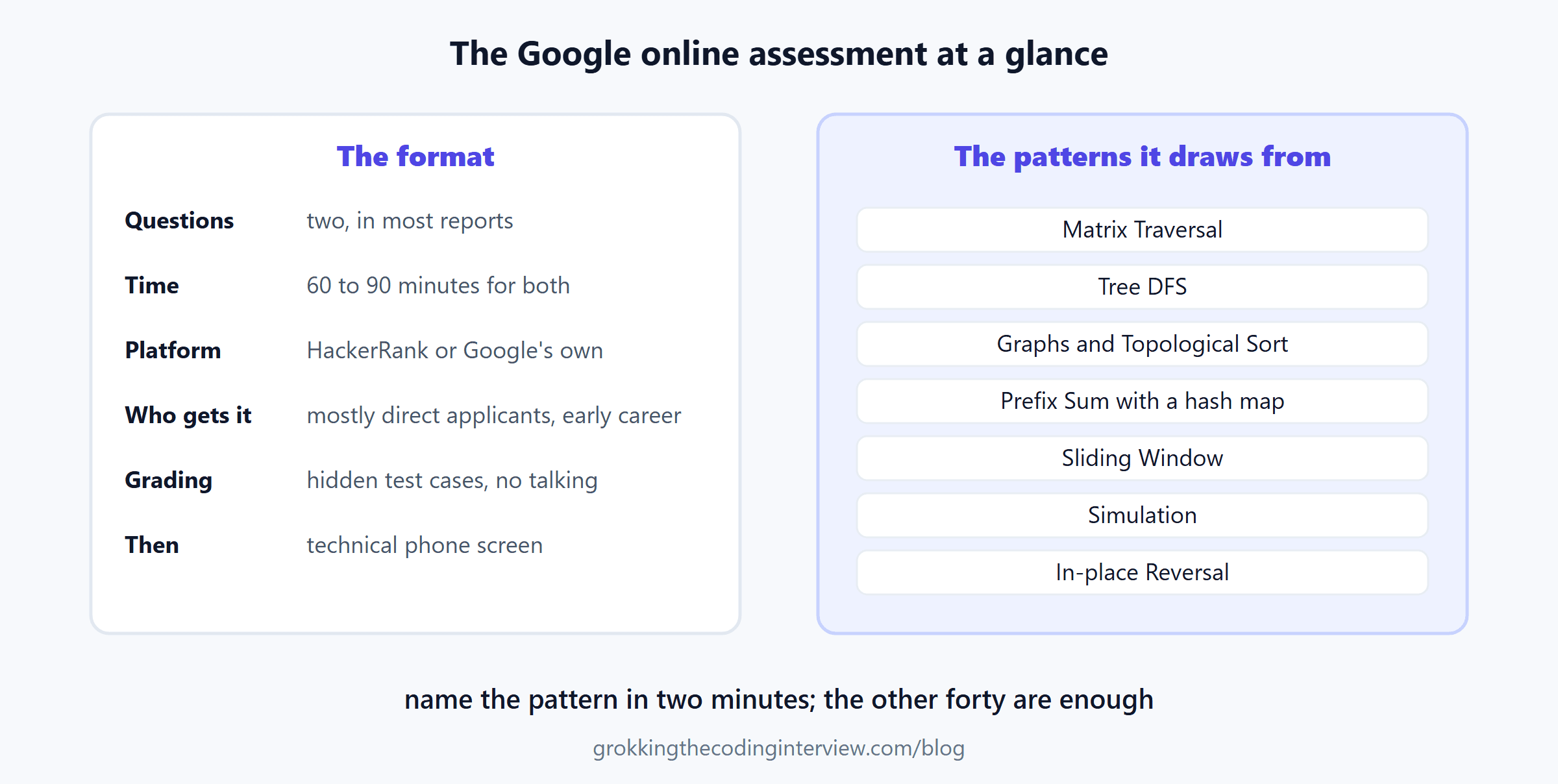
| What to expect | |
|---|---|
| Questions | Two, in most reports |
| Time | 60 to 90 minutes for both, including reading and testing |
| Platform | HackerRank, or Google's own coding platform |
| Languages | Python, Java, C++, Go, and a few others |
| Scoring | Hidden test cases per question; the pass bar is not published |
| Interviewer | None; the test is automated |
| Talking | None; only the code is graded |
Two things in that table change how you should prepare. The time is for both questions together, so 45 minutes each is the budget, and reading a long statement carefully is part of it. And only the code is graded, so a correct idea with a bug in the edge cases scores as a failure.
The question types
Google's assessment questions are standard data structures and algorithms. What makes them feel different from LeetCode is the statement. It is longer, it carries more constraints, and it often describes a small system or a game rather than an abstract array.
The types that come up most often, from candidate reports:
Graph and tree traversal. Find a path, count regions, or check whether something is reachable. The statement describes the graph as rooms, cities, or servers.
Simulation of a rules-based game. The statement gives rules, an initial state, and a sequence of moves, and asks for the final state or a count. The difficulty is reading the rules exactly, not the algorithm.
Arrays and strings with a constraint. Subarrays whose sum is a multiple of k, the longest run that satisfies a rule, or a rearrangement under a limit.
Linked lists and matrices. Reverse a list in place, walk a matrix in a given order, or find a path through it.
None of these need an advanced algorithm. All of them need the right pattern, applied without bugs, inside the time.
The patterns the questions draw from
A pattern is a reusable solution shape with a tell, the words in the statement that give it away. These seven cover most reported Google assessment questions.
| Question type | Pattern | The tell |
|---|---|---|
| Regions, spreading, reaching an edge in a grid | Matrix Traversal | a grid, and "islands", "spread", or "reach the border" |
| Paths, depths, and ancestors in a tree | Tree DFS | a tree and a question about a path or a depth |
| Reachability, shortest steps, dependencies | Graphs and Topological Sort | nodes and edges; "before", "requires", "fewest steps" |
| Subarray sums with a divisor or a target | Prefix Sum with a hash map | "subarray", "sum", "multiple of k" |
| Longest or shortest run under a rule | Sliding Window | "contiguous", "longest", "at most k" |
| Rules, moves, and a final state | Simulation | a list of rules and a sequence of moves |
| Reverse or rearrange a list in place | In-place Reversal | a linked list and O(1) extra space |
The full list of tells, for every pattern, is in the pattern guide. If you can name the pattern within two minutes of reading the statement, the remaining 40 minutes are enough.
How the assessment differs from the onsite
Three differences matter.
Nobody hears your reasoning. In a live round, a good explanation with an imperfect solution can pass. Here, only the test cases count. Write the simple correct solution first, then optimize if time remains.
The statement is the hard part. Live interviewers clarify. The assessment does not. Read the statement twice, write down the constraints, and check the examples against your understanding before you write code.
Edge cases are graded silently. Empty input, a single element, the largest allowed size, negative numbers. A hidden test case for each one is normal. Write your own test for each before you submit.
How to prepare in the week before
Most candidates have a week or two between the email and the deadline. Spend it like this.
Two days on the platform. If the link says HackerRank, practice on HackerRank. Learn where the run button is, how custom test cases work, and how the editor handles input. Interface surprises cost minutes you do not have.
Three days on the seven patterns. One or two problems per pattern from the table above, solved against a judge, with the tell written down for each.
Two timed rehearsals. Two unseen mediums in 90 minutes, alone, with your own test cases. If you finish with time to spare, add a hard one to the second rehearsal.
A time budget for the day. Five minutes to read both questions and pick the easier one first. Forty minutes on it, including tests. Forty minutes on the second. Five minutes to re-read both statements and check the constraints you skipped.
If you are further out than two weeks, treat the assessment as the first coding round of the loop. The full preparation for Google is in the Google coding interview guide.
What happens after you pass
A pass leads to a technical phone screen with an engineer, then a behavioral screen, then the onsite coding rounds. The onsite is where Google's interviews differ most from other companies, and where pattern recognition under a person's questions becomes the test.
Google has also been piloting a changed loop for some roles, with an assistant available and a round that grades reading and improving existing code. The assessment itself has not changed in those reports. The pilot is covered in Google's AI-Assisted Coding Interview.
Cover the seven patterns before the link arrives: Grokking the Google Coding Interview works through the patterns Google asks most. Its problems are grouped so each one stretches the last. For the full map, Grokking the Coding Interview covers all 42 patterns for $79 once.
The takeaway
The Google online assessment is two questions in 60 to 90 minutes, graded by hidden tests, with nobody to talk to. It goes mostly to direct applicants for early-career roles. The questions are ordinary patterns wrapped in long statements. Prepare the seven patterns, rehearse the platform and the clock, and read every statement twice before writing code.
Short on time? Grokking 75 is the 75-problem version of the pattern method, built for a deadline. The complete course is Grokking the Coding Interview, 300+ problems in six languages.
FAQs
What is the Google online assessment? A timed, automated coding test sent before any interview. You solve two questions against hidden test cases in 60 to 90 minutes, usually on HackerRank or Google's own platform. Passing it leads to the technical phone screen.
How many questions are in the Google online assessment? Two, in most reports. The time limit covers both, so budget about 45 minutes per question including reading and testing.
How long is the Google online assessment? 60 to 90 minutes, depending on the role and the batch. The clock starts when you open the test, so open it only when you have the full block free.
Who gets the Google online assessment? Mostly direct applicants for intern and new-grad software engineering roles. Referred candidates and experienced engineers often go straight to the phone screen.
What kind of questions are on the Google online assessment? Data structures and algorithms with long statements: graph and tree traversal, simulating a rules-based game, subarray sums with a constraint, and matrix or linked-list manipulation.
What score do I need to pass the Google online assessment? Google does not publish the bar. Candidate reports suggest that passing most test cases on both questions is expected, so a working solution to only one question is a risk.
Related guides
- Google Coding Interview: The Patterns That Actually Show Up
- Google's AI-Assisted Coding Interview: How It Differs from Meta's
- The 10 Coding Interview Templates on One Page
- LeetCode vs Codeforces vs CodeChef vs HackerRank: Difficulty, Contest Format, and Which Employers Use Each
- The Only 75 LeetCode Problems You Need (Grokking 75)