
TL;DR: Use LeetCode for interview preparation. Use HackerRank when a company has sent you an online assessment, because many companies run their assessments on it. Codeforces and CodeChef are competitive programming sites. They build real algorithmic strength, but they train speed and math depth rather than the skills a hiring loop grades.
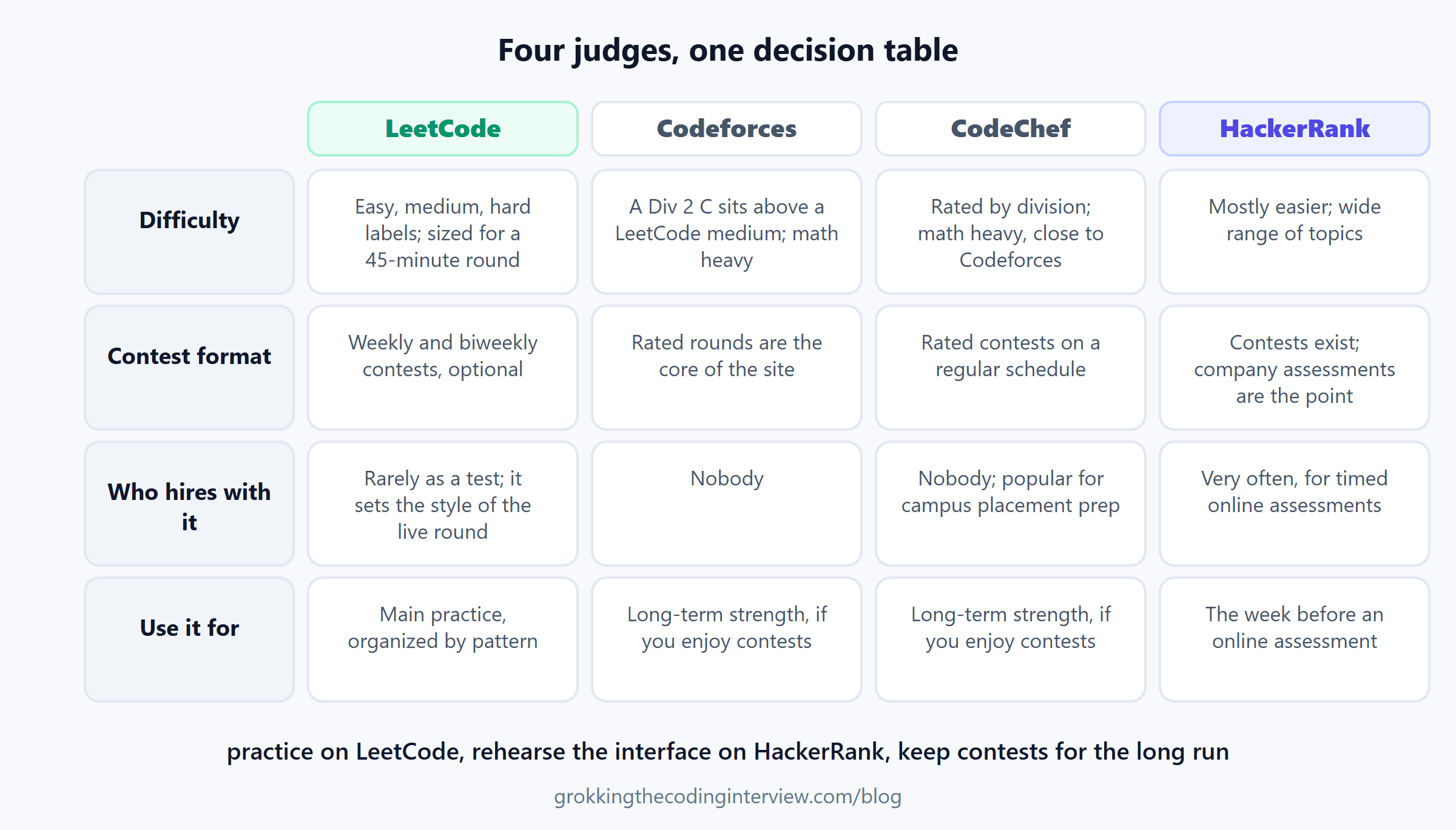
These four sites all show you a problem and run your code against test cases. That surface similarity hides a large difference: each one was built for a different purpose.
Getting this wrong is expensive. Strong competitive programmers fail interviews regularly, and the reason is not ability. They practiced a different skill for years and assumed it transferred.
This article explains what each platform optimizes for. It also covers which one to use at each stage of a job hunt, and why competitive programming can work against you in a live round.
The short comparison
| LeetCode | Codeforces | CodeChef | HackerRank | |
|---|---|---|---|---|
| Built for | Interview preparation | Competitive programming contests | Competitive programming contests | Company assessments and skills testing |
| Problem style | Interview-shaped questions | Contest problems, math heavy | Contest problems, math heavy | Assessment tasks across many domains |
| Difficulty curve | Easy, medium, hard labels | Rated by contest performance | Rated by division | Mostly easier, wide topic range |
| Contest format | Weekly and biweekly contests, optional | Rated rounds, the core of the site | Rated contests on a regular schedule | Contests exist; company assessments are the point |
| Company question tags | Yes, with premium | No | No | Not for candidates |
| Used by employers directly | Rarely | No | No | Yes, very often |
| Best use in a job hunt | Main practice platform | Long term algorithm strength | Long term algorithm strength | Practice before an online assessment |
What each platform actually trains
LeetCode
LeetCode problems are shaped like interview questions because that is what the site is for. The input sizes are small. The expected solution usually fits in 30 lines. The difficulty comes from choosing the right data structure, not from heavy mathematics.
This matches a real interview closely. In a 45 minute round you get one question, and the interviewer expects a working solution plus an explanation of the complexity.
The site also carries company tags on questions, which tell you which companies have asked something similar. That feature sits behind LeetCode Premium.
Codeforces
Codeforces is a contest site. Problems are released in rounds, you compete against a global field, and you get a rating based on results.
The problems are genuinely hard, and often mathematical. A typical Codeforces problem may need number theory, combinatorics, or a clever observation about the structure of the input. Solutions are judged only on whether they pass, so contestants write fast, short, unreadable code.
That last detail matters. Codeforces trains you to write code no interviewer would accept.
CodeChef
CodeChef is also a contest site, with a similar rating system and a large community, particularly in India. Its contests run on a regular schedule, and the problem style sits close to Codeforces.
The same trade-off applies. You will get stronger at algorithms and weaker at the habits an interview grades.
HackerRank
HackerRank is different from the other three, and the difference is the important one. Companies use HackerRank to run online assessments. If a company sends you a timed test link before a phone screen, there is a good chance it runs on HackerRank.
That makes HackerRank worth practicing on for a specific reason: the interface. Knowing where the run button is, how custom test cases work, and how the timer behaves removes a real source of stress on assessment day.
HackerRank also covers domains the others do not, like SQL, regular expressions, and shell scripting. If a role tests those, this is where to practice them.
Why competitive programming does not transfer
I have interviewed candidates with strong Codeforces ratings who failed rounds they should have passed. The pattern repeats often enough to name the causes.
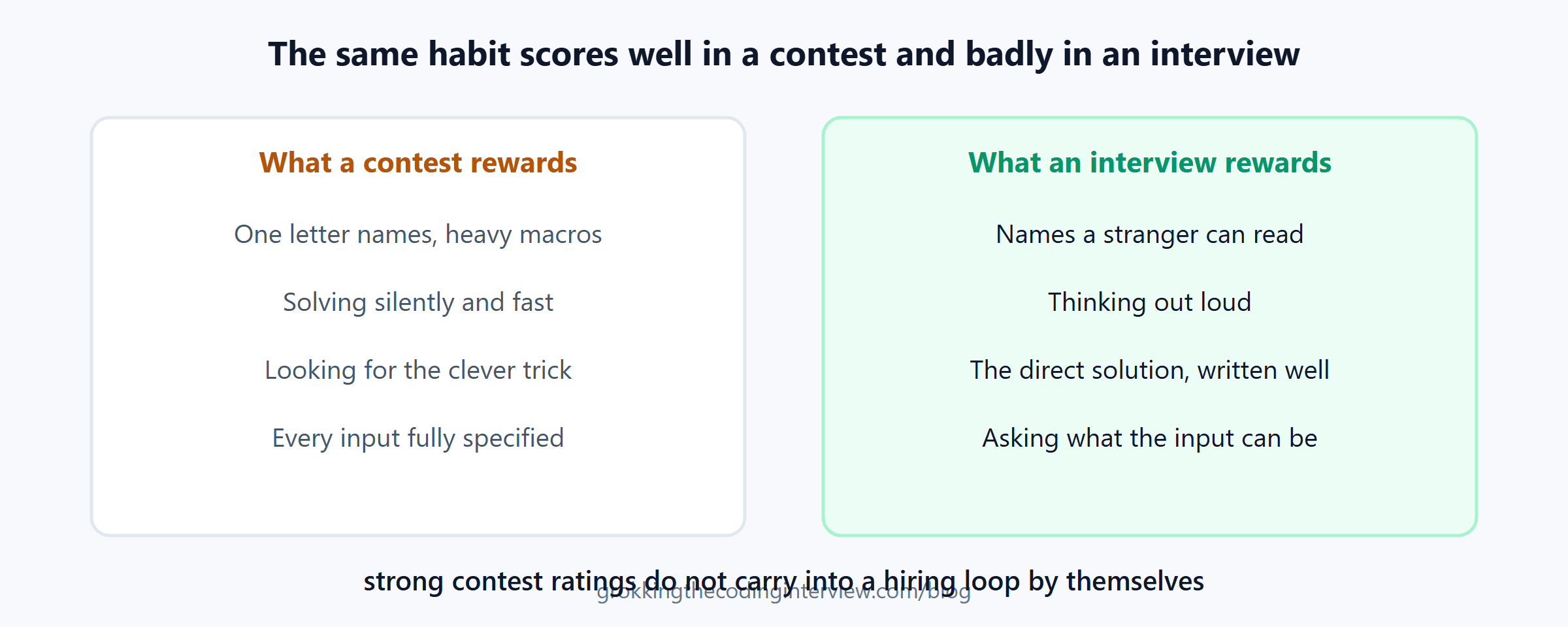
They write for the judge, not for a person. Contest code uses one letter variable names, heavy macros, and no structure, because only the verdict counts. In an interview, a human reads the code while you write it. Naming and structure are part of the grade.
They solve silently. Contests reward thinking fast and alone. Interviews reward thinking out loud. A candidate who goes quiet for ten minutes and then produces a correct answer scores worse than one who explains a slightly weaker approach clearly.
They over-engineer. Contest problems often need a clever trick, so contest programmers look for one. Many interview questions want the direct solution, written well. Reaching for a segment tree when a hash map is enough costs time and signals poor judgment.
They skip the conversation. An interview question is usually underspecified on purpose. The interviewer wants you to ask about input size, duplicates, and empty cases. Contest problems specify everything, so that habit never forms.
None of this means competitive programming is a waste. It builds real strength. It just does not replace interview practice, and treating it as a substitute is the mistake.
Is Codeforces harder than LeetCode?
Yes, for most people, but the comparison is not straightforward.
A Codeforces Division 2 problem C is usually harder than a LeetCode medium. The mathematical content is deeper and the time pressure is higher.
LeetCode hard problems are a different kind of difficulty. They need a specific pattern applied correctly, often dynamic programming or a graph algorithm, and they are usually solvable if you recognize the family.
So a Codeforces regular will find most LeetCode questions easy to solve and may still fail interviews. The difficulty is not the part that is missing.
Which to use, by stage
You are starting out and have months. Learn the patterns first, then practice on LeetCode. Add Codeforces contests if you enjoy them and want deeper algorithmic strength over the long run.
You have an interview in four to eight weeks. LeetCode only, organized by pattern rather than at random. Add mock interviews out loud.
A company just sent you an online assessment. Practice on HackerRank for a few days to learn the interface, then go back to pattern practice.
You are already strong at contests. Spend your time on the habits, not the algorithms. Practice explaining your reasoning out loud, writing readable code, and asking clarifying questions before you start.
The step most people skip
All four sites give you problems. None of them teach you how to recognize which family a problem belongs to, which is the actual skill an interview measures.
That gap is why problem counts stop predicting results after a while. Someone who solves 400 random problems can still freeze on a new one. They learned 400 solutions rather than the small set of patterns that generate them.
Grokking the Coding Interview teaches that recognition step directly. Each pattern comes with the tell that identifies it in a problem statement, the template that solves it, and the ways interviewers disguise it.
Use a judge to practice against. Use a pattern course to know what you are practicing. Our guide on how many LeetCode problems you actually need covers how the two fit together.
Frequently asked questions
Is Codeforces harder than LeetCode? Generally yes. Codeforces problems demand more mathematics and run under contest time pressure. LeetCode problems are shaped to fit a 45 minute interview, so they reward pattern recognition rather than mathematical insight.
Which is better for FAANG interviews, LeetCode or HackerRank? LeetCode for preparation, HackerRank when a company sends you an assessment on it. LeetCode questions match the style of live interview rounds far more closely, and its company tags tell you which questions matter for a given employer.
Should I do competitive programming to get better at interviews? Only if you enjoy it. It builds real algorithmic strength but trains habits that interviews penalize, including silent solving and unreadable code. If your interview is within two months, spend the time on interview practice instead.
Is CodeChef good for placements? It helps with algorithmic ability and is popular for campus placement preparation. For the interview rounds themselves, pattern-organized practice on LeetCode transfers more directly, because the question style and time limits match.
Do I need LeetCode Premium? Premium runs about $35 a month or $159 a year, and it buys company-tagged questions plus official solutions. If you already have a curated problem list organized by pattern, the free tier covers most of what you need. Our comparison of NeetCode and LeetCode covers the free options.
Can I use more than one platform? Yes, but keep one as the main one. Splitting practice across four sites usually means unfinished progress on all of them. Pick LeetCode as the base and add the others for a specific reason.
Related reading
- Coding Interview Patterns: The Complete List
- How Many LeetCode Problems Do You Actually Need?
- NeetCode vs LeetCode
- Why Is LeetCode So Hard?
- The DSA Patterns Cheat Sheet
- The Only 75 LeetCode Problems You Need (Grokking 75)
- The 4-Week Coding Interview Study Plan (Week by Week)
- How to Talk Through a Coding Problem (Without Rambling)
Practice with a map instead of a pile: Grokking the Coding Interview: Patterns for Coding Questions covers all 41 patterns (30 common + 11 advanced), each with its tell, its template, and its variations, plus more than 300 hand-picked problems in Python, Java, JavaScript, C++, C#, and Go. It costs $79 once, with lifetime access.