
TL;DR: For pattern coverage, mostly yes: NeetCode 150 spans the core families that FAANG coding rounds draw from, and it's the best free list available. But "I finished the 150" and "I pass loops" are separated by three gaps the list can't close by design: thin reps per pattern (3 to 5 problems installs a template, not its variation range), no training for the exam itself (mixed-diagnosis under time pressure, narration, mocks), and the parts of modern loops no list contains (speed bars like Meta's two-mediums-in-45, and the AI-enabled rounds now live at Meta and piloting at Google). Whether that makes it "enough" depends on your timeline and target, so the decision grid below is the real answer.
We've said genuinely kind things about NeetCode on this site, and all of them stand: the free tier is the best free resource in interview prep, the videos are the best explanations in the space, and a disciplined candidate can absolutely get hired off it. So this post isn't a takedown. It's the honest answer to the exact question thousands of people type every month, from someone who sat on the grading side: finishing NeetCode 150 is necessary-adjacent, but it is not the same thing as being ready, and the difference is specific enough to name.
What NeetCode 150 covers well
Credit first, because it's real:
- The core pattern space. Arrays, two pointers, sliding window, stacks (including a solid monotonic set: Daily Temperatures, Car Fleet, Largest Rectangle), binary search, linked lists, trees, tries, heaps, backtracking, graphs, intervals, greedy, and a serious DP section. Measured against the full pattern map, the coverage of the core families is genuinely good, far better than the 2018-era Blind 75 it grew from.
- Organization by pattern, which already puts it ahead of random grinding, the failure mode this whole site argues against.
- A video for every problem. When you're stuck, the explanation quality is consistently excellent.
If the question were "is NeetCode 150 a good list," the answer would be an easy yes. But "enough for FAANG" is a different question, and it has three honest complications.
Gap 1: three to five problems installs a template, not a range
Most patterns in the 150 get a handful of problems: enough to learn the canonical form, not enough to meet the variations interviewers actually deploy. And variations are the entire game: FAANG question pools rotate constantly, precisely to punish canonical-form memorization. Your interviewer's version will have a twisted constraint, a flipped optimization target, a different costume, and whether that twist feels like "a small edit" or "a brand new problem" depends on how many variations you've met per pattern, not how many patterns you've met.
This is the quiet reason "I did the 150 but froze in the loop" posts are so common: the list is wide enough but, in several families, not deep enough for the rotation.
Gap 2: the list is content; the interview is a performance
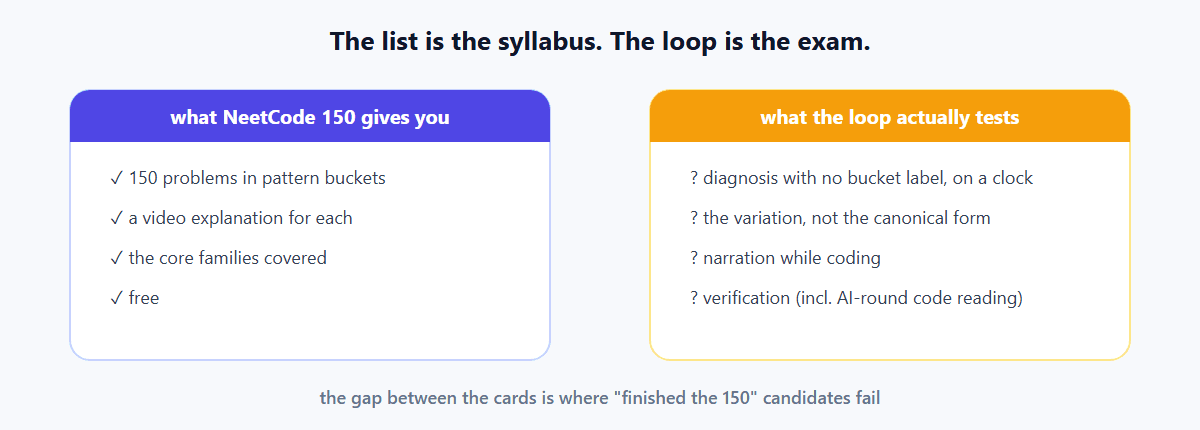
A list, any list, ours included, gives you problems in labeled buckets. The exam is different: an unlabeled problem, a clock, and a human scoring your reasoning stream. Between the two sit skills no list contains:
- Mixed diagnosis: identifying the pattern when nobody tells you the bucket, in the first two minutes. (Training method: the diagnosis drills in the field guide.)
- Pace: Meta's classic rounds run two mediums in ~45 minutes; a correct solution at minute 35 is a failed question.
- Narration: silent-and-right scores below narrated-and-right, everywhere.
- Mocks: the only place all three combine before it counts.
None of this is a flaw in NeetCode; it's a category difference. Finishing the 150 without adding this layer is like reading the driving manual thoroughly and skipping the driving.
Gap 3: modern loops contain rounds no list prepares
The newest gap, and the one prep advice hasn't caught up to: Meta now runs an AI-enabled coding round (multi-file codebase, chat assistant, verification and judgment graded) and Google is piloting its own version with AI fluency explicitly scored. These rounds test code reading, decomposition, and validating code you didn't write, skills orthogonal to any problem list. Your 150 reps still matter there (you can't validate AI output against patterns you don't recognize), but list-completion alone leaves half the new round untrained.
So: when is it actually enough?
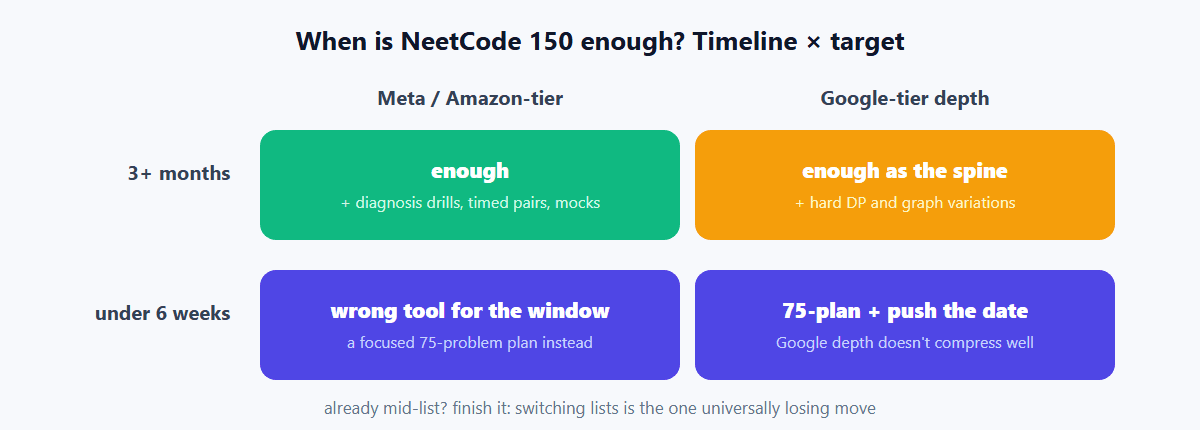
- 3+ months, targeting Meta/Amazon-tier loops: yes, NeetCode 150 plus the missing layer (diagnosis drills, timed pairs, 2-3 mocks) is a legitimately sufficient plan. Add depth reps in whichever families feel thin when you hit mixed practice.
- 3+ months, targeting Google-tier depth: the 150 is the spine, but add hard-variation reps in DP and graphs specifically; that's where Google's loops exceed the list's depth.
- Under 6 weeks: starting a 150-problem list now is a trap; you'll finish coverage and skip the performance layer entirely. A focused 75-problem plan with the exam layer built in fits the window; that's the exact situation Grokking 75 exists for.
- Already halfway through the 150: finish it. Switching lists mid-stream is the one universally losing move, as we said in the list comparison. Just budget your final two weeks for the performance layer instead of more problems.
Want the depth and the training layer in one system? Grokking the Coding Interview teaches all 42 patterns (32 common + 10 advanced) with 300+ problems, so each family gets its variation range, plus graded Test Your Knowledge tiers to catch gaps before an interviewer does, for a one-time $79.
The takeaway
NeetCode 150 is a very good list, and "very good list" is about 70% of readiness. The last 30% (variation depth in the thin families, mixed diagnosis under a clock, narration, mocks, and the new AI-round skills) is where loops are actually decided, and no list, free or paid, contains it, because it isn't content. Finish the 150 if you've started it, respect it if you're choosing it, and then budget real time for the layer between the list and the loop. The candidates who fail after finishing it didn't fail because the list was bad; they failed because they mistook the syllabus for the exam.
Build past the list: Grokking the Coding Interview for the full-depth pattern curriculum ($79, lifetime), or Grokking 75 if your interview is weeks away, not months.
FAQs
Is NeetCode 150 enough to get into Google? For coverage, close; for Google's depth in dynamic programming and graphs, usually not by itself. Finish the 150, then add hard variations in those two families plus timed mock practice. Google's loops are where the "thin reps per pattern" gap bites hardest.
Is NeetCode 150 better than Blind 75? It's a strict superset with meaningfully better coverage (monotonic stack, tries, intervals, more DP), so yes for anyone with 3+ months. With less time, a 75-problem plan you finish beats a 150-problem list you rush; the full three-way comparison covers this by timeline.
How long does NeetCode 150 take to complete? At 1.5 to 2 focused hours a day, most working engineers need 10 to 15 weeks to complete it with real understanding, plus 2 to 3 weeks for the timed-practice-and-mocks layer this post argues you can't skip. Compressing below that trades retention for a finished checkbox.
I finished NeetCode 150 and still failed my loop. Why? Almost always one of three named gaps: the interviewer's variation exceeded your reps in that family, the clock beat you even though your solution was right, or you went silent while thinking. Diagnose which one it was (recruiter feedback usually hints), then train that gap specifically; don't reflexively start another list.
Do I still need NeetCode-style prep now that interviews allow AI? Yes: every loop still contains classic no-AI rounds, and the AI-enabled rounds grade your ability to judge generated code, which runs on the same pattern recognition. What's devalued is memorization; what's promoted is recognition and verification. The list still builds the former's foundation; nothing in it trains the latter.