
Disclosure: Design Gurus is our company, and it sells mock interviews. The comparison below states the price and the format of every option, including the free ones. The numbers are there so you can decide for yourself.
TL;DR: Pramp no longer runs its own sessions. Its free peer practice moved to Exponent, which now calls itself Aced, and it is still free with a monthly allowance. For an interviewer who can grade you the way a hiring loop does, you pay. DesignGurus.io charges $149 to $215 for a 60-minute session with an engineer or hiring manager from a large tech company. interviewing.io charges about $179 to $339 a session with an anonymous senior engineer. Use peers early, for talking practice. Book one or two expert mocks in the last two weeks.
A mock interview is a practice round with someone playing the interviewer, under the real time limit, followed by feedback. It is the only kind of practice that trains the half of the interview LeetCode cannot: thinking out loud, under observation, with follow-up questions.
This article explains what happened to Pramp, compares the four options that remain, and gives a schedule for using them.
What happened to Pramp
Pramp was the free peer-to-peer mock interview site. Exponent, a paid interview-prep company, acquired it, and moved every Pramp session onto its own practice tool. The Pramp site stopped hosting sessions of its own.
Exponent has since renamed itself Aced. Its practice page now says, in its own words, that "Pramp is now Aced (formerly Exponent)". An old Pramp account can be linked to an Aced account. The peer sessions work the same way they did: two candidates, one hour, each interviewing the other for about 30 minutes.
So if you searched for Pramp, the free thing you remember still exists. It lives at Aced, under a free plan with a monthly allowance of sessions.
The comparison
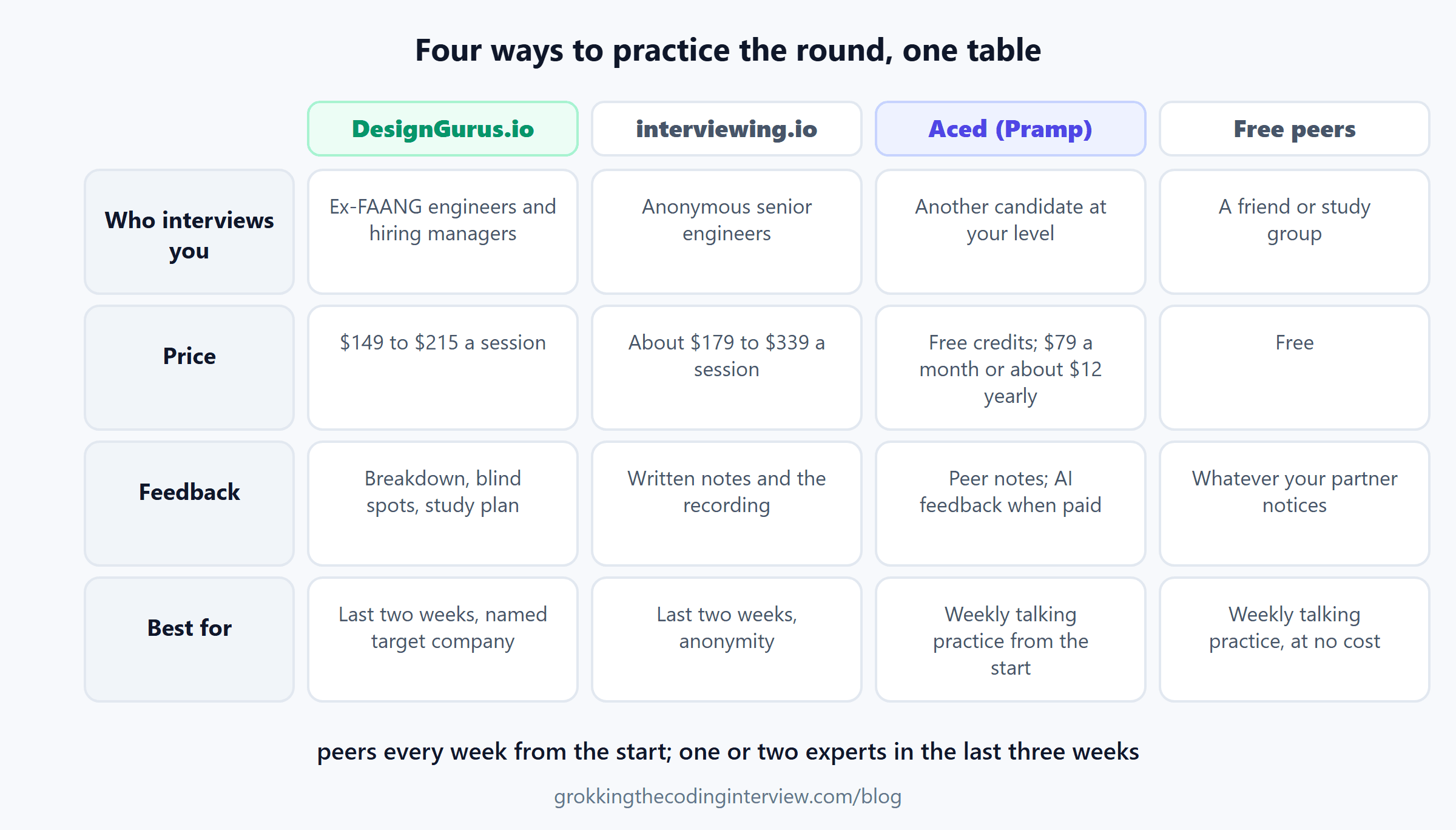
| DesignGurus.io | interviewing.io | Aced (formerly Exponent, absorbed Pramp) | Free peer practice | |
|---|---|---|---|---|
| Who interviews you | Engineers and hiring managers from Meta, Microsoft, Amazon and other large companies | Anonymous senior engineers from large companies | Another candidate, matched by level and schedule; expert coaches sold separately | A friend, a colleague, or a study-group member |
| Session | 60 minutes live, then a debrief | About an hour, recorded | About an hour, 30 minutes in each role | Whatever you agree |
| Price | $149 to $215 a session | About $179 to $339 a session | Free with monthly credits; $79 a month or about $12 a month billed yearly for unlimited | Free |
| Feedback | Performance breakdown, blind-spot analysis, and a study plan | Written feedback and the recording | Peer feedback; AI feedback on the paid plan | Whatever your partner notices |
| Best for | The last two weeks, and a named target company | The last two weeks, when anonymity matters | Weekly talking practice from the start | Weekly talking practice, at no cost |
Prices were read from each platform's own pages at the time of writing. interviewing.io shows its prices after sign-in, so those are from recent third-party reviews. Check before you book.
DesignGurus.io
Design Gurus mock interviews are live 60-minute sessions. The interviewer is an engineer or hiring manager who has run real loops at companies like Meta, Microsoft, Amazon, and Goldman Sachs. The types on offer are coding, system design, behavioral, machine learning, and target-company sessions that copy a specific company's format.
The page prices a system design mock at $159 (list $199) and a target-company session at $215 (list $269). A one-on-one coaching session with a FAANG+ interviewer is $149 (list $186), and it covers coding and system design questions. Coding mock interviews are listed as a session type; pick the round, the level, and the interviewer background when booking.
The feedback is the reason to pay. Each session ends with a debrief. It covers a performance breakdown against what a real loop grades, a blind-spot analysis, and a personalized study plan with specific topics and drills. The point is to find the thing you cannot see yourself doing wrong, before a real interviewer finds it.
Booking is at designgurus.io/mock-interviews.
interviewing.io
interviewing.io pairs you anonymously with a senior engineer from a large company. Sessions run about an hour, they are recorded, and you get written feedback afterwards. The anonymity is the distinctive feature: neither side knows the other's name, so a bad session costs nothing but the fee.
Recent reviews put individual sessions at about $179, with interviewers from a named company at $225 to $339, and a three-session coaching package near $2,000. The site publishes exact prices after you sign in. It is the most expensive option per session, and the closest to a real big-company round in feel.
Aced (formerly Exponent, which absorbed Pramp)
Aced's practice tool is the successor to Pramp. It matches you with another candidate by level, schedule, and interview history. Each session lasts about an hour, and you take turns: 30 minutes as the candidate, 30 minutes as the interviewer.
The free plan gives a monthly allowance of sessions. The membership costs $79 a month, or about $12 a month billed yearly. It removes the limit and adds AI mock interviews with transcripts and feedback, plus Aced's courses. Expert coaching with named coaches is sold separately, priced per coach.
The trade is the interviewer. A peer can tell you that you went quiet for four minutes. A peer usually cannot tell you that your approach was the wrong pattern, or that a hiring committee would have marked the answer incomplete.
Free peer practice
You do not need a platform to practice with a peer. A friend who interviews at a large company works. So does a colleague preparing at the same time, or a study group found through a Discord server or a forum. Aced's free plan is the simplest way to find a stranger at your level.
Four rules make a peer session worth the hour.
Use a rubric. Before you start, write down the four things a real interviewer grades. They are clarifying the question, reasoning out loud toward an approach, clean working code with tests, and adapting when a constraint changes. Score each one.
Run a real clock. 45 minutes, one problem, no pausing.
Talk the whole time. Silence is the most common failure in a live round, and the one a peer can catch.
Swap roles. Interviewing someone else shows you what a rambling explanation looks like from the other side of the table.
One more note for anyone who searched for Hello Interview's mocks: that program has ended, per a notice on its own site.
Peers or experts: what each one trains
Peer mocks train talking. They cost nothing, so you can do one every week from the first month, and the habit of narrating your reasoning becomes automatic.
Expert mocks train grading. A person who has sat on a hiring committee knows what an incomplete answer looks like. They know what a follow-up question is checking for, and which of your habits would cost you the round. That knowledge is what you pay for. One session of it is usually worth more than ten peer sessions in the last two weeks.
The mistake is doing only one kind. Peers only, and you arrive fluent but ungraded. Experts only, and you arrive graded but unpracticed at speaking. The narration skill itself is covered in How to Talk Through a Coding Problem.
Which to use, by weeks left
| Weeks left | Peer sessions | Expert sessions |
|---|---|---|
| 8 or more | One a week, from the start, to build the talking habit | None yet; learn the patterns first |
| 3 to 6 | One a week | One, to find the blind spots while there is time to fix them |
| The last 2 | One or two, on your failure list | One or two, ideally in the target company's format |
The expert session in the middle window matters most. Feedback three weeks out can still change what you practice. Feedback two days out can only change how nervous you are.
The takeaway
Pramp's free peer practice lives on at Aced. Use it, or a friend, every week from the start, with a rubric and a clock. Then buy one or two expert sessions in the last three weeks, from DesignGurus.io or interviewing.io. Have your performance graded by someone who has graded real candidates. Peers make you fluent. Experts tell you whether fluent is enough.
Practice the round with someone who has run it: book a coding, system design, or target-company session at DesignGurus.io mock interviews. Each one is 60 minutes live, with an ex-FAANG engineer or hiring manager, followed by a written debrief and a study plan.
FAQs
Is Pramp still free? The peer sessions Pramp ran are now hosted by Aced, formerly Exponent, and they are still free with a monthly allowance. The paid membership removes the limit and adds AI mock interviews.
What replaced Pramp? Aced. Exponent acquired Pramp, moved its sessions onto the Exponent practice tool, and later renamed the company Aced. Old Pramp accounts can be linked to an Aced account.
How much does interviewing.io cost? About $179 per session for a standard mock, and $225 to $339 for an interviewer from a named company, according to recent reviews. A three-session coaching package is near $2,000. Exact prices appear after sign-in.
Are paid mock interviews worth it? One or two in the last three weeks, yes, if you have already covered the patterns. The value is the grading: an experienced interviewer finds the habit that would cost you the round. Before the patterns are in place, a paid mock mostly confirms that you are not ready.
How many mock interviews should I do before a real one? One peer session a week for the whole preparation period, plus one or two expert sessions in the last three weeks. Two consecutive clean mocks is a reasonable readiness signal.
Where can I do a free mock interview? Aced's free plan, a friend or colleague, or a study group. Bring a rubric and a 45-minute clock, and swap roles so you see the interviewer's side.
Related guides
- How to Talk Through a Coding Problem (Without Rambling)
- The LeetCode Daily Schedule: How Many Problems Per Day at 12, 8, and 4 Weeks Out
- Grokking the Low Level Design Interview: OOD Principles End to End
- Grokking the Object-Oriented Design Interview: What It Is and How to Prepare
- Design Gurus vs Educative: Which Grokking the Coding Interview Should You Buy?