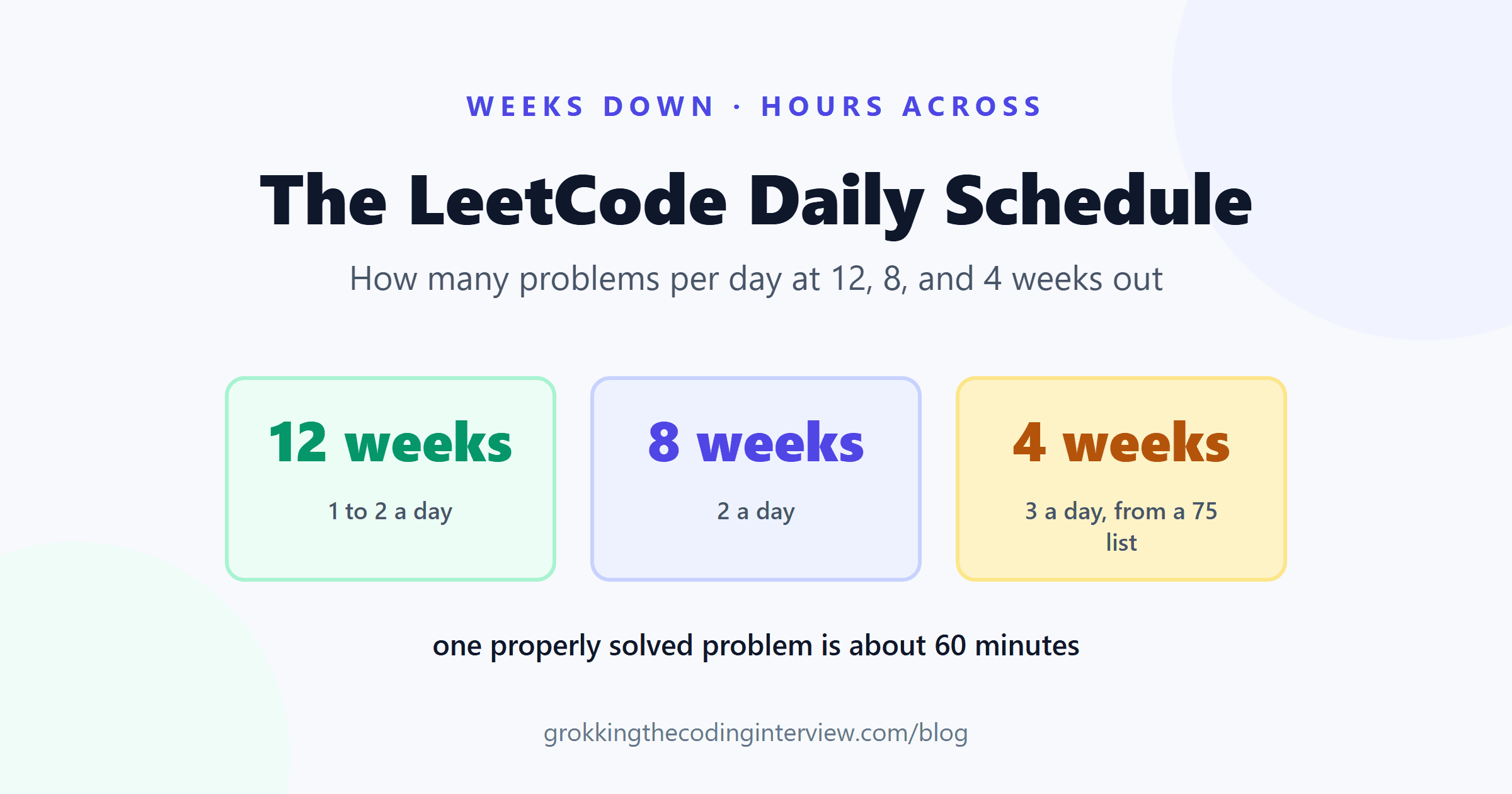
TL;DR: One to two properly solved problems a day is the pace that works for a working engineer. With 12 weeks left, one a day reaches about 70 problems and two a day about 140, which covers the common patterns with variations. With 8 weeks, two a day. With 4 weeks, three a day from a 75-problem list, and no new patterns in the last two weeks. One problem, solved properly, takes about 60 minutes. The table below gives every combination.
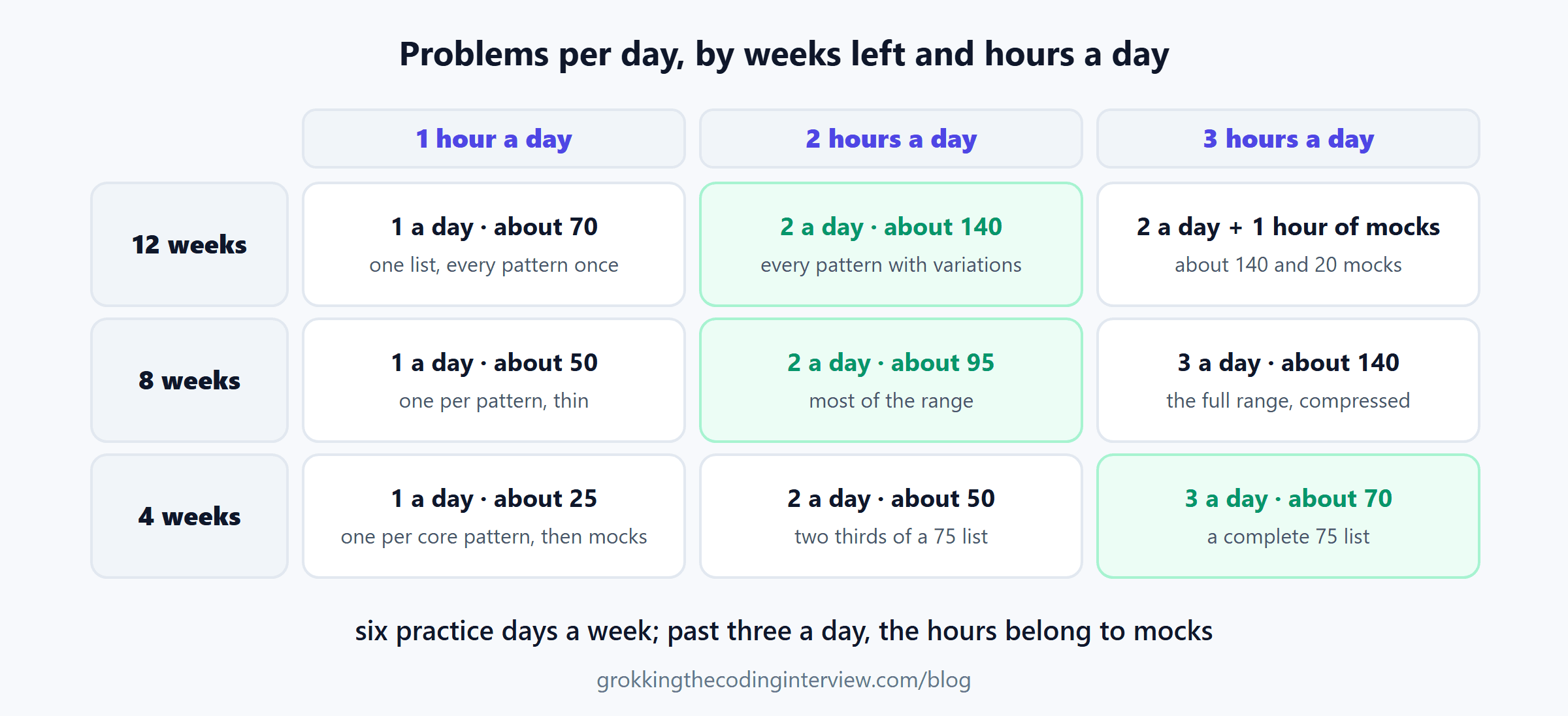
The number of problems per day is set by two things: how many weeks you have, and how many hours a day you can give. Pick your row and your column.
The schedule table
The table assumes six practice days a week, and it counts only problems solved to the quality bar described below. Totals are rounded.
| Weeks left | 1 hour a day | 2 hours a day | 3 hours a day |
|---|---|---|---|
| 12 weeks | 1 a day, about 70 total. One curated list, every common pattern once. | 2 a day, about 140 total. Every common pattern with its variations. This is the target range. | 2 a day plus one hour of mock practice. About 140 problems and 20 mocks. |
| 8 weeks | 1 a day, about 50 total. One problem per common pattern with a few repeats. Thin, but workable with mocks. | 2 a day, about 95 total. Most of the target range. | 3 a day, about 140 total. The full range, compressed. |
| 4 weeks | 1 a day, about 25 total. One problem per core pattern, then mocks in the last week. | 2 a day, about 50 total. Two thirds of a 75-problem list; take it in pattern order and stop at the rare ones. | 3 a day, about 70 total. A complete 75-problem list. |
Two rules sit behind every cell.
More than three a day does not help. Past three, the fourth problem gets solved the way most people solve problems: read, get stuck, read the solution, move on. That teaches reading. The hours past three belong to mock interviews, out loud, with a person.
The total has a ceiling. About 100 to 150 pattern-organized problems is enough for FAANG-level loops, and past 200 the returns collapse. The counts by target company, and the reasons, are in How Many LeetCode Problems. This article is about the pace that reaches them.
What one problem takes
A problem counts when it meets four conditions. You produced the approach yourself or failed for a real 30 minutes first. You can name the pattern and the tell in one sentence. You wrote working code and ran it. You will re-solve it a week later if you failed it.
That takes about 60 minutes, split like this:
- 5 minutes: read the statement twice, write down the constraints, name the likely pattern from the tell.
- 25 minutes: attempt it, in a bare editor, without hints.
- 10 minutes: read the solution or the editorial as a post-mortem, whether you passed or failed.
- 10 minutes: re-code it without looking, cleanly, and run it.
- 10 minutes: write one line in your notes: the pattern, the tell, and the mistake if there was one.
An easy problem can take 30 minutes on this plan. A hard one can take 90. The average settles near 60, which is why one hour gives you one problem and two hours give you two.
Is one LeetCode problem a day enough?
With 12 weeks or more, yes. One a day for 12 weeks is about 70 problems, which is one full curated list. Choose the list by pattern coverage, not by fame, and add mock practice in the final three weeks.
With 8 weeks, one a day is thin. You reach about 50 problems, which covers each common pattern once with no room for variations. It works only if the fundamentals are already solid.
With 4 weeks, one a day is not enough for a FAANG loop. It is enough for a startup or a mid-size company that asks easies and mediums. For anything harder, find the second hour.
How long should a LeetCode medium take?
While you are learning a pattern, 45 minutes for a medium is normal, and 60 is fine. The goal is to reach 25 to 30 minutes for an unseen medium, with tests, while talking. That is the interview pace: two mediums in a 45-minute round, with time to explain.
If a medium still takes more than 45 minutes after six weeks of daily practice, the problem is usually not speed. It is recognition. You are deriving the technique each time instead of recognizing it from the tell. Go back to the pattern, not to more problems.
Hards are different. Budget 60 to 90 minutes, expect to fail the first attempt, and count the post-mortem as the lesson. Most loops ask mediums; hards matter for the toughest loops only.
How long does it take to get good at LeetCode?
For a working engineer with solid fundamentals, 8 to 12 weeks at one to two hours a day. For a new grad, 8 to 12 weeks at two hours. For a career switcher, four to six months, because the data structures come first.
Calendar time is the wrong unit, though. Readiness is four milestones. You can implement hash maps, linked lists, BFS and DFS, binary search, and recursion from memory. You can name the likely pattern within two minutes of reading a question. You can solve two unseen mediums in 45 minutes while talking, most of the time. You have passed two consecutive realistic mock interviews. Hit all four and you are ready, whatever the calendar says.
The weekly shape
The daily count is only half of the schedule. The week needs a shape too.
Weekdays: the daily problems, one or two, at the same time each day. Consistency matters more than the slot.
One weekend day: two problems from your failure list, re-solved cold, plus one timed mock under interview conditions.
One rest day: no problems. Pattern recognition consolidates between sessions, and a week with no rest day usually ends in a skipped week.
That is 8 to 14 quality problems a week. Weekend-only preparation roughly doubles the calendar, because six days apart is long enough to forget what the last session taught.
Want the daily problems chosen and ordered for you? Grokking the Coding Interview sequences 300+ problems by pattern. Each day's problem stretches yesterday's technique instead of repeating it. On a four-week schedule, Grokking 75 is the 75-problem version.
The last two weeks
Whatever the row, the last two weeks are the same, and the daily count goes down.
No new patterns. A pattern learned in the final fortnight will not be automatic on the day, and it displaces one that would have been.
Re-solve the failure list. Every problem you failed and studied, reproduced without notes. This is the highest-yield set you own.
Two or three full mocks with a person. The first one is humbling. That is the point, and it must not be your real first round.
Skim your pattern notes daily. One line per pattern, the tell and the template, read in ten minutes.
When to stop adding problems
Stop near 200. If you have solved 200 pattern-organized problems to the quality bar and still feel unready, the gap is performance, not coverage. Thinking out loud, time pressure, and follow-up questions are the missing parts, and mocks train them, not problem 201.
The takeaway
One to two properly solved problems a day, six days a week, for 8 to 12 weeks. That reaches the 100 to 150 problems that cover the common patterns. Three a day from a 75-problem list covers a four-week deadline. One problem is about 60 minutes: read, attempt, post-mortem, re-code, note. The last two weeks trade new problems for the failure list and mock interviews.
Make every daily problem count: Grokking the Coding Interview teaches all 42 patterns before their problems, in six languages. One-time $79, lifetime access.
FAQs
How many LeetCode problems should I do per day? One or two, solved properly, with the pattern and the tell written down afterwards. Three is the ceiling on a short deadline. Past three, the extra hour is better spent on a timed mock interview.
Is one LeetCode problem a day enough? With 12 weeks or more, yes: one a day reaches about 70 problems, a full curated list. With 4 weeks, no, unless the target is a startup that asks easies and mediums.
How many hours a day should I spend on LeetCode? One to two hours a day, six days a week. One hour gives you one properly solved problem; two hours give you two. A third hour is best spent on mock practice rather than a third problem.
How long should a LeetCode medium take? 45 minutes while you are learning a pattern, and 25 to 30 minutes for an unseen medium by the time you interview. If mediums still take over 45 minutes after six weeks, the gap is pattern recognition, not speed.
How long does it take to get good at LeetCode? 8 to 12 weeks at one to two hours a day, for a working engineer with solid fundamentals. Four to six months for a career switcher. Measure readiness by milestones: fundamentals from memory, the pattern named within two minutes, two mediums in 45 minutes while talking, and two clean mocks.
Should I do LeetCode every day? Six days a week, with one rest day. Daily practice consolidates pattern recognition between sessions. Weekend-only practice roughly doubles the time to the same result.
Related guides
- How Many LeetCode Problems: The Numbers by Target Company, Per Day, and In Total
- The 4-Week Coding Interview Study Plan (Week by Week)
- The NeetCode Roadmap on One Page, With the Pattern Behind Each of the 18 Topics
- Blind 75 Grouped by Pattern: Every Problem Mapped to the Technique That Solves It
- How to Talk Through a Coding Problem (Without Rambling)