
TL;DR: Grokking Data Structures & Algorithms is the foundations course: it builds the core structures (arrays, linked lists, stacks, queues, hash tables, trees, heaps, graphs) and the algorithms on them, from scratch, interview-first. Grokking the Coding Interview is the patterns course: it assumes you know the structures and teaches you to recognize which one a problem wants. Structures are the vocabulary; patterns are the grammar. Take the DSA course first if the self-test below stings; skip straight to patterns if it doesn't.
If you've searched "grokking DSA," you've probably already figured out that Design Gurus has two courses that sound like they might be the same thing, and you want to know which one you need. Fair question, and the answer has a clean shape, so let's give it properly: what the DSA course is, who it's for, who should skip it, and the exact order to do things in.
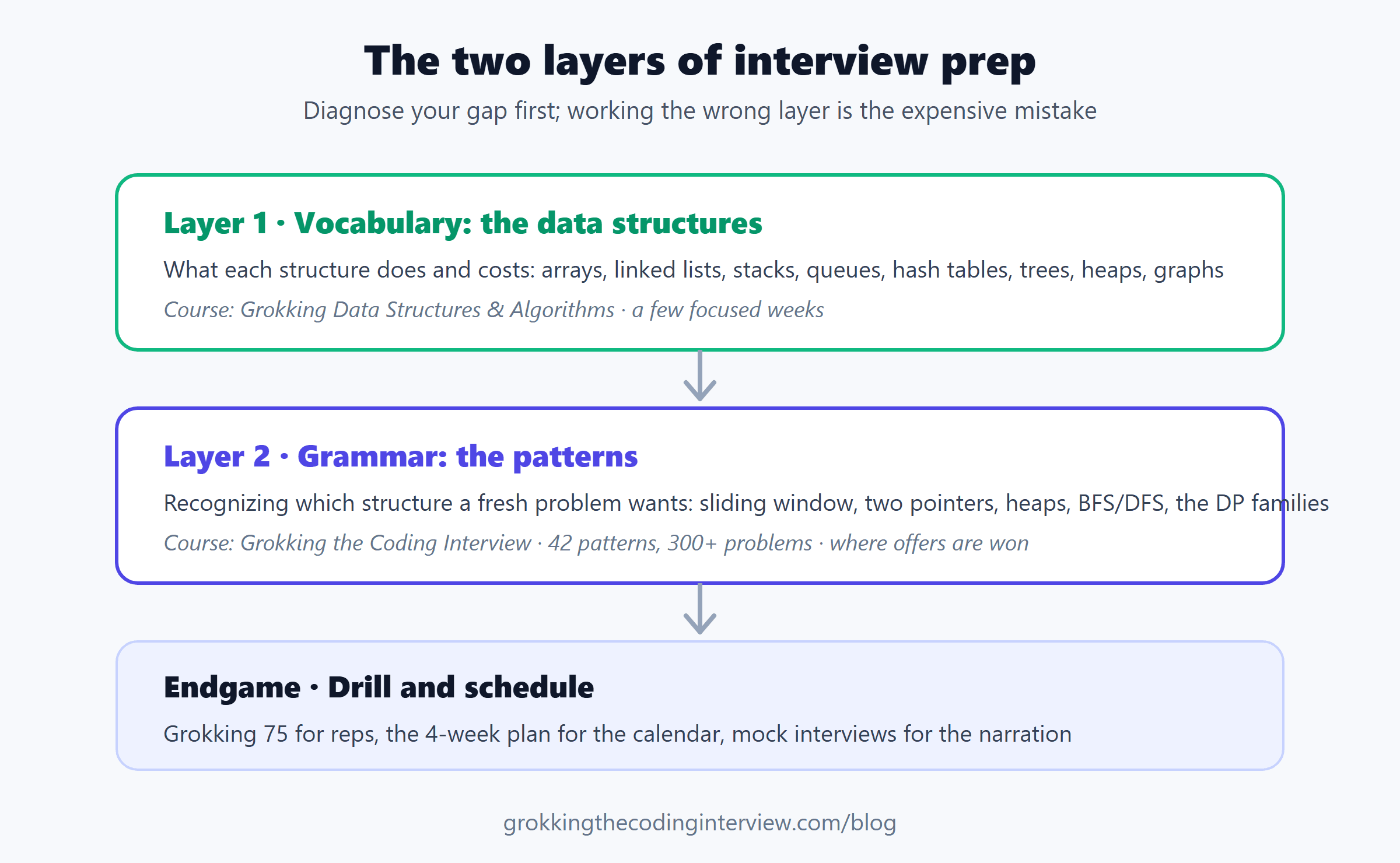
The two layers of interview prep
Every coding interview question exercises two different skills stacked on top of each other.
Layer 1 is vocabulary: the data structures. What a hash table actually does and what it costs. Why a heap gives you the minimum in O(log n). What makes a linked list better than an array in exactly one situation and worse in most others. When BFS visits nodes in a different order than DFS, and why anyone cares.
Layer 2 is grammar: the patterns. Given a fresh problem, recognizing within a couple of minutes that it's a sliding window over a string, or a top-k question that wants a heap, or one of the six dynamic programming shapes.
The mistake that wastes the most prep time is working on the wrong layer. If you grind patterns with shaky structures, every problem feels doubly hard: you're deciphering what a heap is while also learning when to reach for one, and neither sticks. That's a big part of why LeetCode feels so hard to people who skipped fundamentals. And the reverse waste is real too: an engineer with solid fundamentals re-learning what a binary tree is because a course made them, instead of starting on patterns.
So the honest question isn't "is the DSA course good?" It's "which layer is your gap?"
What Grokking Data Structures & Algorithms covers
The course builds each core structure interviews test, from the ground up, with visual explanations and practice problems along the way:
- Linear structures: arrays and strings, linked lists, stacks, and queues, plus the pointer mechanics (traversal, insertion, reversal) that interviews love to hand-check.
- Hash-based structures: hash tables and sets, collisions, and why "just use a hash map" is the answer to half of all easy problems.
- Trees and heaps: binary trees, binary search trees, traversals (the DFS family and BFS), and heaps with their real costs.
- Graphs: representations, BFS/DFS on graphs, and the groundwork for shortest paths and topological ordering.
- The algorithm basics on top: big-O analysis you can actually say out loud, sorting and searching fundamentals, and recursion.
The framing is interview-first throughout: not "here is a red-black tree in full academic glory," but "here is what this structure costs, here is the operation interviewers test, here is a problem that needs it." You're building the working knowledge the patterns course assumes on day one.
Who should start with the DSA course
You, if any of these describes you:
- You're a new grad or student whose DSA course was theory-heavy and a while ago, and "implement it" feels very different from "define it."
- You're a career switcher or bootcamp grad: you ship real code but never formally built a linked list or heap in your life.
- You're returning after a long gap (management detour, different stack, a few years of "the framework did it for me").
- Patterns courses bounce off you. If you tried a patterns course or list and it felt like it assumed a language you don't speak, this is the missing layer, and it's very fixable.
The 60-second self-test: can you skip it?
Answer honestly, out loud, without looking anything up:
- Why is a hash table lookup O(1) on average, and what happens on a collision?
- Reverse a linked list on a whiteboard, in your language, without notes. Comfortable?
- What does a min-heap guarantee, and what do insert and extract-min cost?
- When would you pick BFS over DFS on a tree, and what data structure does BFS need?
- Your function is O(n log n). Where does the log n come from?
Five confident answers: skip the DSA course. Your gap is recognition, not vocabulary; go straight to the patterns and spend your saved weeks there. Two or more misses: do the DSA course first. Patterns learned on top of guesses don't hold, and you'll end up back at the fundamentals anyway, just later and more stressed.
Build the foundation properly: Grokking Data Structures & Algorithms teaches every structure above from scratch, visually, with the interview lens on from the first lesson.
The sequence that works
For an engineer starting from shaky fundamentals, the full path looks like this:
- Grokking Data Structures & Algorithms until the self-test above stops stinging. For most people at 1-2 hours a day, this is a few weeks, not months. Don't aim for mastery; aim for "I can implement and explain each structure."
- Grokking the Coding Interview for the patterns layer: 42 patterns (32 common + 10 advanced) across 300+ problems, which is where interview performance actually gets built.
- Drill and schedule. With less than two months left, switch from coverage to reps: Grokking 75 and the 4-week study plan structure the endgame, and the talk-through guide fixes the communication layer interviews actually grade.
How long the whole path takes for your situation is mapped honestly in How Long Does It Take to Prepare?
One sequencing note: don't run the DSA course and the patterns course in parallel from day one. The patterns course is spaced review of the structures; starting it after the fundamentals click gives you that review free. Interleaving both from scratch just splits your attention while both are still wobbly.
A note on "grokking DSA patterns"
A search that lands people here is "grokking dsa patterns," and it deserves a precise answer: the patterns live in Grokking the Coding Interview, not in the DSA course. The DSA course gives you the structures; the patterns course teaches the 42 recognizable shapes built on them, from sliding window through dynamic programming. If patterns are what you're after and your fundamentals are solid, the free pattern field guide is the place to start reading right now. And if you work in Python, our Python templates guide shows how each structure maps to the standard library you'll actually use in the interview.
The takeaway
Grokking Data Structures & Algorithms is the vocabulary course; Grokking the Coding Interview is the grammar course. Take the self-test, be honest about which layer your gap lives in, and work that layer. Fundamentals first if they're shaky (a few focused weeks), patterns after (that's where offers are won), drilling last. The expensive mistake isn't picking the wrong course; it's spending months on the layer you already had.
Start where your gap is: Grokking Data Structures & Algorithms for foundations, or Grokking the Coding Interview for all 42 patterns with 300+ problems in six languages ($79 one-time, lifetime access, free intro lessons to try first).
FAQs
Is Grokking Data Structures & Algorithms good for complete beginners? Yes, that's exactly who it's built for: it assumes programming basics (variables, loops, functions in some language) but no prior data-structures background. If you can write a for-loop but couldn't build a linked list, you're the target student.
Do I need it before Grokking the Coding Interview? Only if the self-test above stings. The patterns course assumes working knowledge of the core structures; it doesn't re-teach them from scratch. Solid fundamentals: skip straight to patterns. Shaky: foundations first, and the patterns course will feel dramatically easier.
How long does the DSA course take? For most working engineers at 1-2 hours a day, a few weeks to work through the structures with practice, less if you're refreshing rather than learning fresh. It's deliberately a shorter runway than the patterns course, which is the bigger investment.
What language should I learn data structures in? The one you'll interview in. If that's undecided, Python is the pragmatic pick: the least syntax between you and the concept, and the standard library maps beautifully onto interview needs, as we show in Grokking the Coding Interview in Python.
Is this the same as the Grokking Algorithms book? No. Grokking Algorithms is an illustrated Manning book by Aditya Bhargava, a gentle general introduction and unrelated to Design Gurus. The course is interview-focused, practice-driven, and sequenced to feed directly into the patterns curriculum. Similar name, different product and different job.