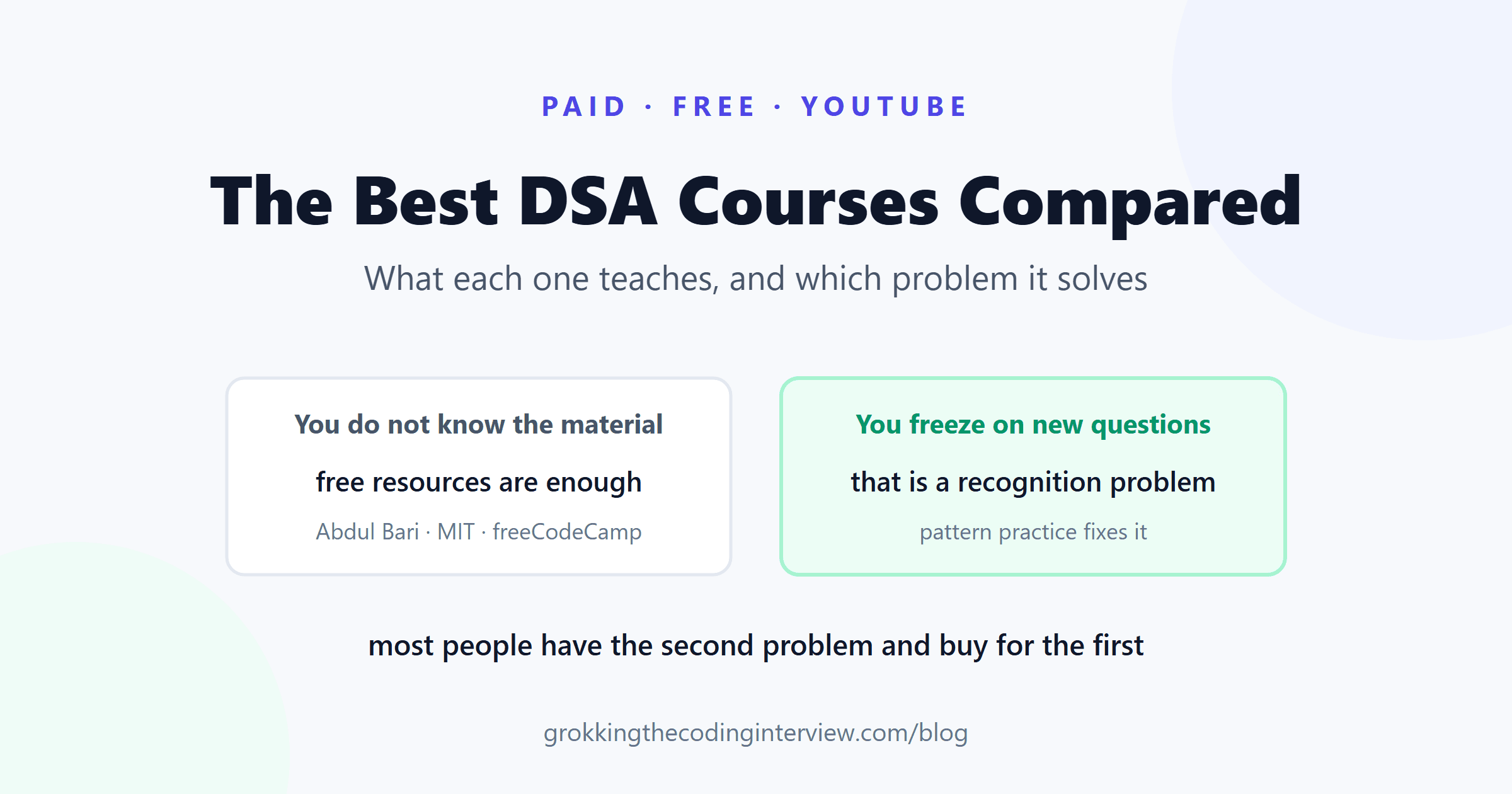
TL;DR: If you are learning data structures for the first time, free resources are genuinely good enough, and Abdul Bari plus a university course will teach you the theory. If you are preparing for interviews with a deadline, a structured pattern-based course saves the most time, because the bottleneck is recognition rather than knowledge. Pick based on which of those two problems you have.
First, the disclosure. I created Grokking the Coding Interview, and Design Gurus is my company. One of the options below is mine. Read this the way you would read any comparison written by someone with a product in it. Every price and feature here is public, so you can check each one yourself.
The reason to write it anyway is that most "best DSA course" lists compare things that are not comparable. A university algorithms course and an interview prep platform are different products solving different problems.
This article splits them by the problem they solve, gives real prices, and says who each one suits.
First, decide which problem you have
There are two, and they need different resources.
Problem one: you do not know the material. You cannot explain what a hash map costs, or how a breadth first search works. You need teaching. Free resources are excellent here, and paying does not help much.
Problem two: you know the material but freeze on new questions. You understand heaps, and you still cannot see that a question is a heap question. This is a recognition problem, and it is the one that fails interviews. Structured pattern-based practice is what fixes it.
Most people preparing for interviews have problem two and buy for problem one. That is the mistake worth avoiding.
The comparison
| Option | Type | Cost | Best for |
|---|---|---|---|
| Abdul Bari (YouTube) | Free video | Free | Learning the theory properly |
| freeCodeCamp (YouTube) | Free video | Free | Long form single-sitting coverage |
| William Fiset (YouTube) | Free video | Free | Graphs and data structure internals |
| MIT OpenCourseWare 6.006 | Free university course | Free | Rigorous foundations |
| Princeton Algorithms (Coursera) | University course | Free to audit | Theory with proofs |
| Tech Interview Handbook | Free written guide | Free | A free interview roadmap |
| Striver's A2Z DSA Sheet (takeUforward) | Free structured sheet | Free | A free step by step roadmap |
| NeetCode | Curated list plus videos | Free tier, Pro about $119 a year | A free problem roadmap |
| AlgoMonster | Pattern course | Free tier, about $99 a year or $189 lifetime | Pattern practice with a free tier |
| takeUforward TUF+ | Subscription platform | From about $89 a year | Roadmaps plus company questions |
| AlgoExpert | Video platform | About $199 a year | Video walkthroughs |
| Educative | Subscription platform | About $59 a month | Text-based courses in a browser |
| Boot.dev | Interactive platform | About $59 a month | Learning by building |
| Udemy (marketplace) | Individual video courses | Varies, heavily discounted most of the time | Buying one teacher's course outright |
| GeeksforGeeks | Self-paced course | Not published, enquiry only | A course that issues a certificate |
| LogicMojo | Live online classes | Not published, enquiry only | Live teaching with a cohort |
| Scaler Academy | Live program with mentorship | About ₹3,99,000 in total | Career change with placement support |
| Grokking the Coding Interview | Pattern course | $79 once, lifetime | Pattern recognition for interviews |
Prices were checked against each vendor's own page, and several were running a discount at the time. Check the current number before you buy, and treat anything described as a limited offer as the normal price.
The free options, and how far they get you
Free resources for data structures are strong. Anyone claiming you must pay to learn the theory is selling something.
Abdul Bari is the most recommended teacher for fundamentals. The explanations focus on why an algorithm works rather than on memorizing it, and the coverage of trees, graphs, and dynamic programming is thorough. Start here if the theory is shaky.
freeCodeCamp publishes multi-hour courses that cover a whole syllabus in one video. Useful if you prefer continuous teaching over short clips.
William Fiset has the clearest free material on graph theory and on how data structures work internally.
MIT OpenCourseWare and Princeton's Algorithms on Coursera are real university courses, free to watch. They go deeper into proofs and analysis than an interview needs, which is useful if you want to understand rather than pass.
NeetCode has a free roadmap of curated problems plus video solutions for most of them. It is the best free interview-focused starting point, and we walk through it in detail in our NeetCode roadmap guide.
Tech Interview Handbook is a free written guide covering the whole process, not just algorithms.
Striver's A2Z DSA Sheet from takeUforward is the most widely used free data structures and algorithms roadmap among Indian learners. It sequences the whole subject from basics to advanced as a checklist you work through in order, which fixes the one thing most free material lacks.
How far does free get you? Most of the way, if you are disciplined. What free resources do not give you is sequencing and grouping. You get a pile of good explanations and a list of problems, and you have to build the study plan yourself.
The paid options, and what you are paying for
Paid platforms are not selling information. They are selling structure, sequencing, and time saved.
NeetCode Pro adds paid features on top of the free roadmap. It runs at about $119 a year or roughly $297 for lifetime access. Good value if the free roadmap already suits you.
AlgoExpert sells video walkthroughs of a curated problem set at about $199 a year, with no lifetime option. The video production is strong. You are paying for someone explaining each problem well.
Educative sells a subscription to a large library of text-based, in-browser courses at roughly $59 a month. Broad, and access ends when you stop paying.
Boot.dev teaches through interactive projects at about $59 a month. It suits people who learn by building rather than by watching.
AlgoMonster is the closest comparison to this course, because it also teaches by pattern rather than problem by problem. There is a free tier, and Pro runs about $99 a year or $189 for lifetime access, both currently listed at half price.
takeUforward TUF+ is the paid tier above Striver's free sheet, starting around $89 a year, adding premium roadmaps, company-tagged questions and planning tools.
Udemy is a marketplace rather than a course. Quality depends entirely on the instructor, and prices swing widely because something is almost always on sale. You buy one teacher's course outright instead of a subscription.
Grokking the Coding Interview is ours. It costs $79 once, with lifetime access. It teaches 41 patterns: 30 common and 11 advanced. Each one comes as a tell, a template, and a set of variations, with more than 300 problems grouped so recognition builds. Solutions come in Python, Java, JavaScript, C++, C#, and Go.
The honest comparison: if you want someone to explain individual problems well, AlgoExpert and NeetCode do that. If your issue is that you solve a problem, understand the solution, and still cannot see the next one, a pattern course targets that directly. That is the gap it was built for, and it is why the format exists.
For a direct head to head against the closest alternatives, see Grokking vs NeetCode and Design Gurus vs Educative.
What to pick, by situation
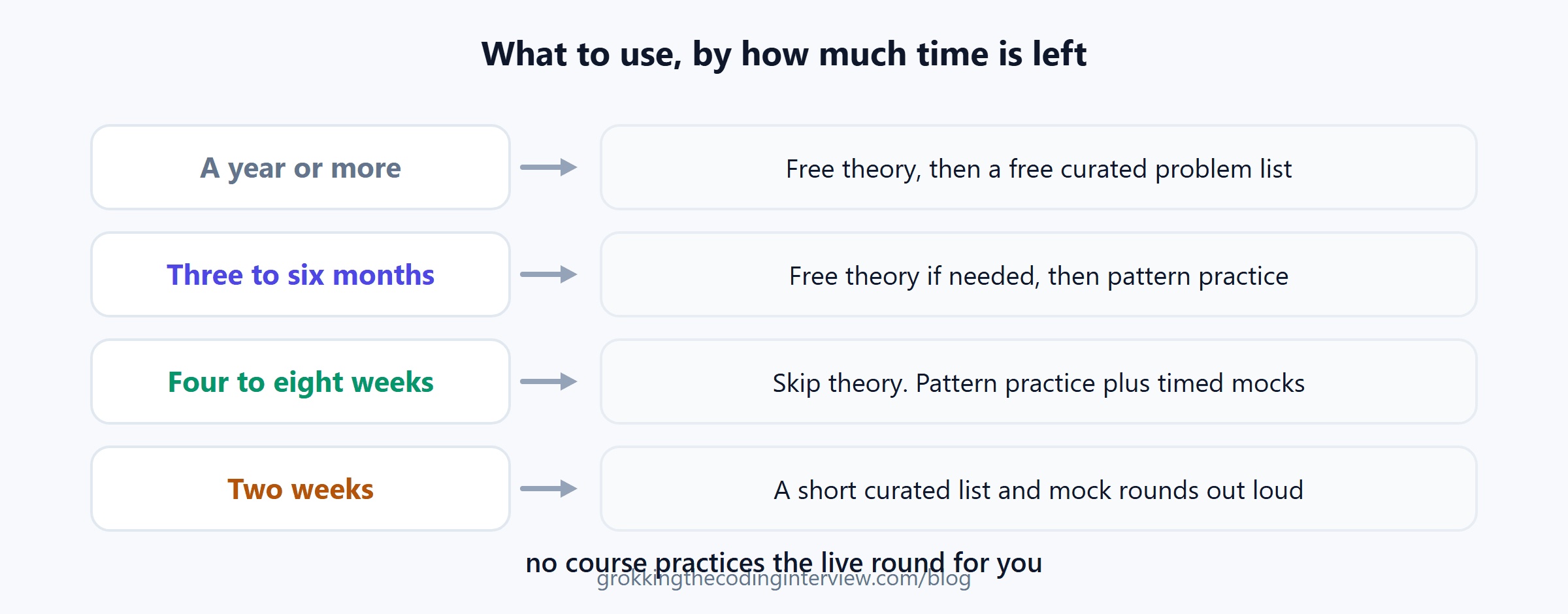
You are a student with a year or more. Free, all of it. Abdul Bari or a university course for theory, then NeetCode's free roadmap for practice. Add a pattern course only in your final few months.
You have three to six months and a target company. Free theory if you need it, then a pattern-based course for the practice phase. Spending money on video walkthroughs of individual problems is the least efficient choice at this stage.
You have four to eight weeks. Skip the theory courses entirely. You do not have time to relearn material you half know. Go straight to pattern practice with a curated list, and add timed mock rounds.
You have two weeks. No course will help much. Use a curated short list, review the core patterns, and spend most of your time on mock rounds out loud. Our four week study plan compresses reasonably to two if you cut the advanced patterns.
You keep failing interviews despite solving hundreds of problems. This is a recognition problem, not a knowledge one. More problems will not fix it. Reorganize your practice by pattern and add explaining out loud.
Grokking the Coding Interview is built for that last case specifically.
The best data structures and algorithms courses online
Everything above is online, so the real question behind this search is usually narrower: do you want recordings you work through at your own pace, or live classes with a cohort and a mentor?
Self-paced online covers every option in the table except the last three. You trade accountability for price and flexibility, and for most people preparing for interviews that is the right trade.
Live online classes are a different product at a very different price.
Scaler Academy runs a twelve month live program with 1:1 mentorship, placement support and a certificate. Its page lists about ₹3,99,000 in total, or roughly ₹9,791 a month. That is a career-change product rather than an interview-prep purchase, and it should be judged against a bootcamp, not against a course.
LogicMojo teaches data structures and algorithms through live online classes with a fixed schedule. It does not publish a price; you request a call.
GeeksforGeeks sells self-paced data structures and algorithms courses that issue a completion certificate. It does not publish a price on the course page either.
One thing worth saying plainly: the options that cost the most are the ones that do not publish a number. If a price is only available after a sales call, treat that as information about the price.
Which data structures and algorithms courses give a certificate
Scaler, GeeksforGeeks and Coursera issue one. Most interview-focused courses, including ours, do not.
That is a deliberate choice rather than a gap. Engineering interviewers at product companies do not ask to see a data structures and algorithms certificate. What gets tested is whether you can solve an unfamiliar problem while explaining your thinking, and a certificate is not evidence of that.
Certificates do carry weight in two narrower cases. Some service companies and campus placement processes treat them as a screening signal, and some employers will reimburse a course that issues one. If neither applies to you, choose on teaching quality and ignore the certificate entirely.
What no course gives you
Every option above teaches content. None of them can practice the interview for you.
The round is a live performance. You talk while you think, you handle interruptions, you take a hint without losing your place, and you write code someone reads as it appears. Watching videos does not train any of that.
So whichever option you pick, add two things: solve problems out loud with a timer, and do real mock interviews with a person. Candidates who skip this reliably underperform their practice results.
Frequently asked questions
What is the best DSA course for beginners? For learning the theory, free resources are as good as paid ones. Abdul Bari on YouTube and MIT OpenCourseWare 6.006 both teach the fundamentals thoroughly, and neither costs anything.
What is the best YouTube channel for DSA? Abdul Bari for fundamentals and intuition, William Fiset for graphs and data structure internals, freeCodeCamp for long single-sitting coverage, and NeetCode for interview-focused problem walkthroughs. Most people benefit from one concept channel plus one problem channel.
Are free DSA courses good enough for interviews? For the material, yes. What free resources lack is sequencing, which means you build the study plan yourself. If you have plenty of time that is fine, and if you have a deadline it is the expensive part.
Is NeetCode or AlgoExpert better? NeetCode has a strong free tier and costs less, with a lifetime option. AlgoExpert has higher production quality video walkthroughs and costs about $199 a year with no lifetime option. If you are choosing on value, NeetCode is the better deal for most people.
Should I pay for a DSA course at all? Only if it solves a problem free resources do not. If you cannot explain a hash map, use free material. If you understand the material but freeze on unfamiliar questions, a structured pattern-based course targets that directly and saves real time.
Which is the best DSA course in India? For free, Striver's A2Z sheet from takeUforward is the most used roadmap and costs nothing. For live classes with placement support, Scaler is the best known and by far the most expensive, at about ₹3,99,000. For interview preparation specifically, a pattern-based course is the most time-efficient option, and the price gap between the paid courses is small next to the time any of them save.
How long does a DSA course take? A theory course runs 20 to 40 hours of video. An interview-focused pattern course takes most people 6 to 10 weeks alongside a job, since the time goes into solving problems rather than watching. The watching is the small part.
Related reading
- The DSA Patterns Cheat Sheet: All 41 on One Page
- The NeetCode Roadmap, Walked Through
- Grokking the Coding Interview vs NeetCode
- How Many LeetCode Problems Do You Actually Need?
- LeetCode vs Codeforces vs CodeChef vs HackerRank
Related guides
- Grokking Data Structures and Algorithms: The Complete Guide
- Is Grokking the Coding Interview Worth It? (An Honest Review)
- Is There a Grokking the Coding Interview PDF or Book? What's Free and What Isn't
- Grokking LeetCode: How the 25-Pattern Method Became 42
- Coding Interview Patterns: The Complete List of All 42 (LeetCode Cheat Sheet)
If your problem is recognition, not knowledge: Grokking the Coding Interview: Patterns for Coding Questions teaches all 41 patterns as a tell, a template, and a set of variations, with more than 300 hand-picked problems in six languages. It costs $79 once, with lifetime access.