
TL;DR: Beyond Cracking the Coding Interview is a real successor, not a reprint. It fixes the biggest weakness of the original. Its technical chapters are organized around named techniques like sliding window, prefix sums, and topological sort. It adds more than 150 walked-through problems. Its career half, on getting interviews, recruiters, and negotiation, is the best in print and is material no course teaches. What it cannot fix is being a book: no judge, no playgrounds, and fewer reps than interview prep needs. Read it for the career half and the orientation. Do your problem practice somewhere interactive and pattern-first.
A quick disclosure before the review. I run Design Gurus, which sells a competing prep resource. This review will still tell you to buy the book, because for two of its three jobs it is genuinely the best option. Apply skepticism where my interest shows, and check the facts, which are all public.
What the book is
Beyond Cracking the Coding Interview is the sequel to the most famous interview book ever written. Gayle Laakmann McDowell wrote it with three people from interviewing.io: Mike Mroczka, Aline Lerner, and Nil Mamano. Interviewing.io is a mock-interview platform, and the authors state the book draws on its data from about 100,000 real and mock interviews. It was published in early 2025, runs 644 pages, and nine of its chapters are free to read online at the book's site.
The book has three jobs. It orients you on how hiring actually works. It teaches technical topics with worked problems. And it covers the parts before and after the interview: getting noticed without a referral, handling recruiters, and negotiating the offer.
What is new compared with the original
The original Cracking the Coding Interview stopped updating a decade ago, and its age shows hardest in the problem half. We reviewed that in detail before this sequel appeared, and the short version is: the people-and-process chapters aged well, the problem organization did not.
The sequel fixes exactly that. The 13 new technical chapters are organized by technique, not by data structure. Sliding window, prefix sums, heaps, greedy, topological sort: these are pattern names, the same taxonomy the prep world settled on after the original's last edition. Each chapter comes with new problems, more than 150 in total, each walked through step by step.
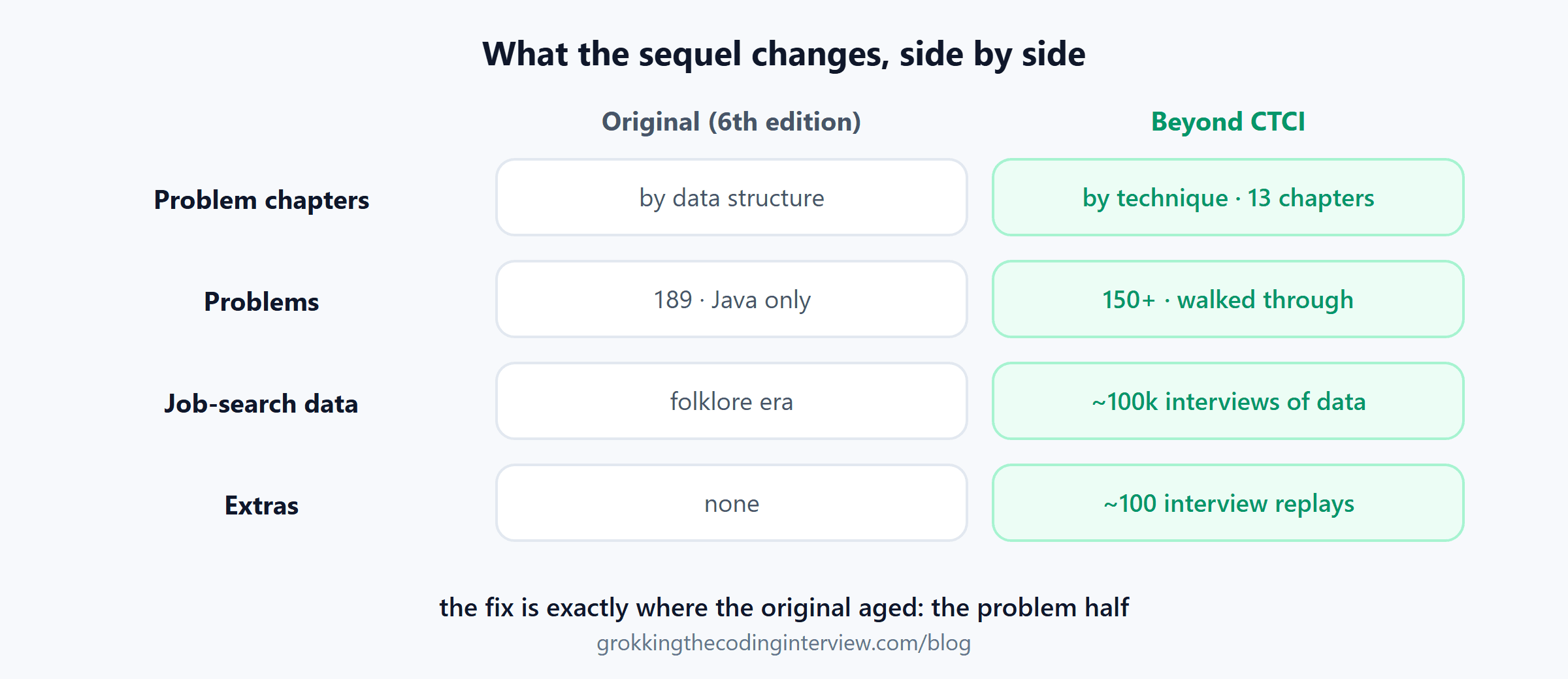
Two more additions matter. Buyers get access to about 100 recorded interview replays from interviewing.io's mock interviews, so you can watch real candidates struggle and recover. And the job-search chapters are grounded in recruiter-side data rather than folklore. They cover what recruiters actually filter on, why referrals are overrated, and how to contact companies cold without being ignored.
Where the book is genuinely the best option
The career half has no real competitor. Negotiation, recruiter handling, and getting interviews where you know nobody: no course, list, or video series covers this properly. The book's treatment is specific, down to the exact scripts. If the offer stage scares you, this half alone repays the cover price many times.
The orientation is current. The original taught a whole generation what interviews are. The sequel does the same job with today's process, informed by a dataset none of its rivals have.
The free chapters are a real trial. Nine chapters online, free, before you spend anything. Few paid resources are that confident.
What a book still cannot do
No judge, no reps. You cannot run code on paper. Reading a walkthrough feels like learning and mostly is not; the skill forms when your code fails against test cases and you fix it. Any book, this one included, needs a practice layer beside it: a judge and a problem list, or a course with built-in playgrounds.
150 problems is a starting set. It is a well-chosen set, but full pattern coverage takes more volume and more escalation per technique. Our free guide to all 42 patterns shows the size of the space. The counts that matter are in How Many LeetCode Problems Do You Actually Need?
Paper does not sequence your practice. The book teaches a technique, shows problems, and then you are on your own to find more, order them, and check your work. A curriculum does that scheduling for you. That difference is the core of the book-versus-course decision below.
Book, course, or list?
| Beyond CTCI | Pattern course | Free list + videos | |
|---|---|---|---|
| Format | 644-page book | Interactive text | Problem list + videos |
| Technical unit | 13 technique chapters | 42 patterns, sequenced | 18 topics |
| Problems | 150+, on paper | 300+, with playgrounds | 150, on a judge |
| Career + negotiation | Best available | No | No |
| Practice environment | No | Yes | Yes |
| Price | ~$35-40 | $79 one-time | Free |
The honest reading of that table: the book wins the first and last rows, and a practice resource wins the middle. They are complements. Two combinations make sense. Pair the book with a free list solved on a judge. Or pair its career half with Grokking the Coding Interview as the technical spine.
Is the original still worth reading?
Mostly no, now that the sequel exists. The original's lasting value was its orientation, behavioral, and big-O chapters, and the sequel covers that ground with current information. Buy the original only if you find a used copy for a few dollars and want the classic. Its 189 problems are organized by data structure and solved in Java only. They should not be anyone's syllabus anymore. If you own it already, keep it for the behavioral grid and skip its problem half.
The takeaway
Beyond Cracking the Coding Interview is what a sequel should be. It keeps the original's strength, replaces the dated problem half with a technique-first one, and adds the best career-stage material in print. Buy it for orientation and for everything around the interview, especially negotiation. Then be honest about what a book is: the reading layer of your prep, not the practice layer. Pair it with a judge and a pattern-first problem sequence, and the combination covers every stage of the process.
The practice layer to pair with it: Grokking the Coding Interview teaches all 42 patterns before their problems. It includes 300+ problems and playgrounds in six languages, for a one-time $79. Interview in six weeks or less? Grokking 75 is the compressed plan.
FAQs
Is Beyond Cracking the Coding Interview worth it? Yes, for its career-stage chapters and orientation, which nothing else covers as well. Treat its technical chapters as a well-taught introduction to each technique, then do your actual practice on a judge or in an interactive course. It is the best book in the category; it is not a complete prep plan by itself.
Is it a new edition of Cracking the Coding Interview? No. It is a separate sequel with three new co-authors from interviewing.io. The original remains at its 6th edition. The sequel stands alone; you do not need to read the original first.
Where can I read Beyond CTCI for free? Nine chapters are free on the book's official site, beyondctci.com. That includes career material, so you can judge the writing and the advice before buying.
Beyond CTCI or NeetCode? Different jobs. The book teaches process, techniques on paper, and the career stage. NeetCode gives you a free curated problem list with video walkthroughs and a judge. A serious candidate on a budget uses both: the book to understand the game, the list for reps. The comparison of practice options is in NeetCode vs LeetCode.
Is Beyond CTCI enough to pass FAANG interviews? Not alone, and the authors would likely agree. Its 150 problems on paper cannot build the speed and recognition the coding rounds test. Add timed practice against a judge, a pattern-first problem sequence, and mock interviews in the final weeks.