Grokking the Coding Interview logo
HomeCoursesBlog
← Back to Blog
Article

Which Grokking Coding Course Should You Take?

Which Grokking Coding Course Should You Take?

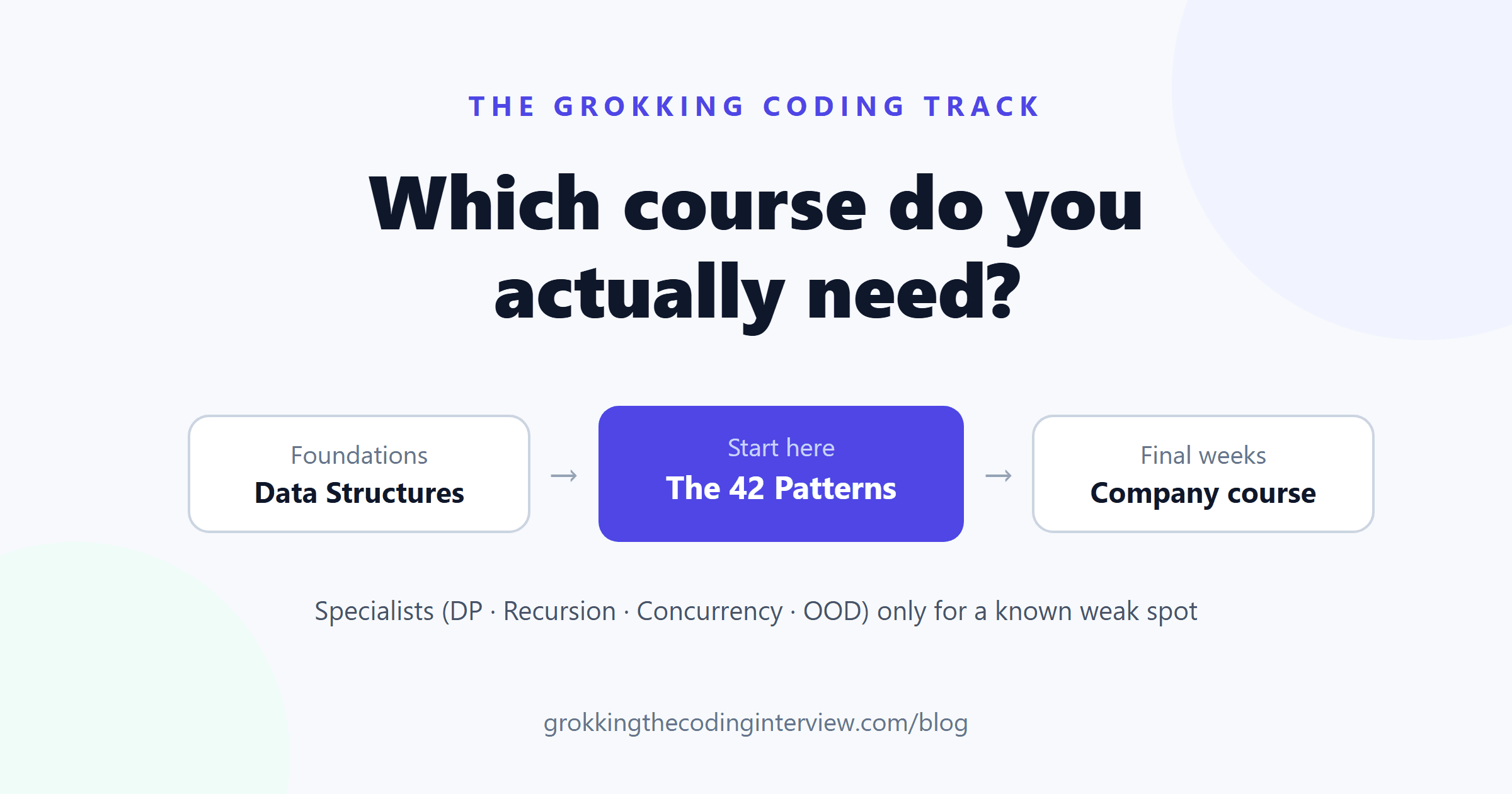
TL;DR: for almost everyone, the answer is Grokking the Coding Interview. It is the flagship, it covers all 42 patterns, and it is the only one of these courses that is a complete preparation on its own. The other six exist for specific situations: you are rusty on data structures themselves, you have two weeks instead of two months, or you have one identified weak spot such as dynamic programming or concurrency. If you are not sure which situation you are in, the decision table below will tell you in about thirty seconds.

I wrote these courses, so let me say the uncomfortable part first: the names are confusing. Seven of them have "Grokking" in the title and several have overlapping subject matter, which means the most common question I get is not "is it good" but "which one do I actually need?"

This page answers that directly, including the cases where the answer is "none of them yet" or "not the one you were about to buy."

The thirty-second version

Where you are right nowStart with
You can code, but LeetCode feels like 3,000 unrelated puzzlesGrokking the Coding Interview
You freeze because you don't really know heaps, graphs, or triesGrokking Data Structures, then the patterns course
Your onsite is in two or three weeksGrokking 75
You are fine everywhere except dynamic programmingGrokking Dynamic Programming
Recursion itself is the thing that breaks youGrokking the Art of Recursion
Your loop includes a concurrency or threading roundGrokking Multithreading and Concurrency
You have a "design a parking lot" style roundGrokking the Object Oriented Design Interview
You have an onsite at one specific companyThe patterns course, then that company's course

If two rows describe you, take the one that is higher in the table. They are ordered roughly by how much they change your outcome.

Decision table matching each starting point to a Grokking coding course: random-feeling LeetCode goes to the 42 patterns course, fuzzy data structures go to Grokking Data Structures first, a two-week timeline goes to Grokking 75, a dynamic programming weak spot goes to the DP course, broken recursion goes to the Art of Recursion, a threading round goes to Multithreading and Concurrency, an object oriented design round goes to the OOD course, and a booked company onsite goes to patterns followed by that company's course

The one course most people need

Grokking the Coding Interview: Patterns for Coding Questions

This is the original and still the one I would pick if I could only keep one. It teaches 42 patterns (32 common plus 10 advanced) across 50 chapters and 300-plus problems, with solutions in six languages and in-browser playgrounds, at a one-time $79.

The premise is that interview problems are not 3,000 distinct puzzles. They are a few dozen recurring shapes wearing different costumes, and once you can name the shape from the problem statement, the solution follows. That is the whole argument for patterns over volume, and it is why 100 to 150 pattern-organized problems beats 500 random ones.

Take it if: you can already write working code and your problem is that unfamiliar problems leave you with no idea where to start. That is the majority of people preparing.

Skip it if: you genuinely do not know what a hash map or a heap is yet. Patterns are built on data structures, and learning both at once is miserable. Do the next course first.

The prerequisite, if you need one

Grokking Data Structures for Coding Interviews

The honest test for whether you need this: can you explain, without looking anything up, why a hash map lookup is O(1) on average, what a heap gives you that a sorted array does not, and when a trie beats a hash map? If any of those made you hesitate, start here.

This course covers the structures themselves, arrays through graphs and tries, at the level interviews actually demand. It is the lower of two layers: data structures are the vocabulary, patterns are the sentences. People who skip straight to patterns while missing the vocabulary tend to stall around the heap and graph chapters and conclude the patterns course is too hard, when the real gap is underneath it.

Take it if: you are a bootcamp graduate, a self-taught developer who never did a formal algorithms class, or someone returning after several years away from this material.

Skip it if: you took a data structures course and still remember it. Go straight to patterns.

The short-timeline option

Grokking 75: Top Coding Interview Questions

Seventy-five problems, chosen for coverage rather than popularity, organized by pattern rather than by topic. It is the triage option.

Take it if: your onsite is inside about three weeks. At that range, breadth of exposure beats depth of understanding, and finishing a curated 75 is worth more than getting a third of the way through a 300-problem course.

Skip it if: you have more than a month. You will end up wanting the full patterns course anyway, and the 75 is a subset of that territory rather than a different subject. If you are weighing it against the well-known community lists, I compared them directly in Blind 75 vs NeetCode 150 vs Grokking 75.

The three specialists

These exist because a specific topic defeats a specific kind of candidate. None of them is a substitute for the patterns course; each one goes deeper on a slice of it.

Grokking Dynamic Programming is the most commonly needed of the three, because DP is the topic people most often decide they are simply bad at. They usually are not; they have just never been shown that DP is six recurring patterns rather than one intimidating technique. Take it if you can solve most non-DP mediums but DP problems still feel like guessing.

Grokking the Art of Recursion sits one level below that. If tree problems, backtracking, and DP all feel hard, the common factor is usually recursion itself rather than any of those three topics. Fix the root and the branches get easier.

Grokking Multithreading and Concurrency is the narrowest of the three and the easiest to skip by mistake. Most loops never test concurrency. Some do, particularly for backend and infrastructure roles at companies that care about it, and candidates who are excellent at algorithms are routinely caught flat by a producer-consumer question. If your recruiter mentions a concurrency round, this is not optional.

The adjacent round

Grokking the Object Oriented Design Interview

Strictly speaking this is not a coding-patterns course. It covers the round where you are asked to design a parking lot, an elevator system, or a library, using classes and relationships rather than algorithms. It is sometimes called low-level design or LLD.

Take it if: your interview loop lists an OOD or LLD round, which is common at Amazon and increasingly common elsewhere for mid-level and senior roles. More on what that round actually asks in the OOD interview guide.

Skip it if: your loop is purely algorithmic. Nothing in it helps you on a LeetCode-style question.

The company-specific courses

There is a course for each of Meta, Amazon, Google, Microsoft, and LinkedIn.

These are targeting, not teaching. They narrow the same pattern material down to what a given company actually asks and how that company runs its loop, which is a real difference: Meta optimizes for speed, Google for depth on one hard problem, Amazon for the leadership-principles wrapper around the code.

Take one if: you already have the patterns and you have a specific onsite booked. They are a final-weeks tool.

Do not take one instead of the patterns course. A company-specific course assumes you can already solve the problems and shows you which ones to expect. Without the foundation, it is a list of topics you cannot yet do. Our free written guides for Meta, Amazon, and Google cover the loop structure if you just want the lay of the land.

Sequences that actually work

Three realistic stacks, depending on where you start:

Rusty engineer, two to three months. Data Structures, then the patterns course, then a company course in the final two weeks. This is the most common path and the one with the highest success rate.

Working engineer, six weeks, foundations intact. Straight into the patterns course, following a structured plan, adding the DP specialist only if DP is the thing that keeps failing.

Onsite in two weeks. Grokking 75, then the company-specific course for the last few days. Accept that this is triage and that you are trading depth for coverage.

The mistake I see most often is buying three courses at once and finishing none. Every one of these is a real time commitment. Buy the next one when the current one stops being the constraint.

If you were not looking for a coding course

Several courses share the Grokking name without sharing the subject. If you landed here wanting the system design track, the behavioral course, or the machine learning material, those are a different ladder entirely, mapped in the full catalog guide. The short version: Grokking the System Design Interview for the design round, System Design Fundamentals if you need the concepts underneath it first, and Grokking the Behavioral Interview for the behavioral round.

And if you searched "grokking" expecting the machine learning phenomenon of the same name, or Manning's Grokking Algorithms book, neither is related to these courses. The name collision is real and I am sorry about it.

The takeaway

Most people overthink this. If you can code and LeetCode feels random, take the patterns course; that single decision covers the large majority of cases. Add the data structures course underneath it if the vocabulary is missing, swap to Grokking 75 if the calendar has already run out, and add exactly one specialist if you have exactly one identified weak spot.

The failure mode is not picking the wrong course. It is picking four.

Start here: Grokking the Coding Interview teaches all 42 patterns across 300-plus problems, in six languages with in-browser playgrounds, for a one-time $79. There is a free intro tier if you want to see the teaching style before deciding.

FAQs

What is the difference between Grokking the Coding Interview and Grokking 75? Scope and timeline. The patterns course teaches all 42 patterns across 300-plus problems and is a complete preparation. Grokking 75 is a curated 75-problem sprint for people whose interview is a few weeks away. The 75 is a subset of the same territory, not a different subject.

Do I need Grokking Data Structures before Grokking the Coding Interview? Only if you cannot comfortably explain what a heap, a hash map, and a graph traversal each do. If you took a data structures class and remember it, go straight to patterns. If you are self-taught or several years removed from the material, the extra step saves you frustration later.

Which Grokking course is best for FAANG? Grokking the Coding Interview, for the coding rounds. Add the company-specific course for your target in the final two weeks, and the system design course if your level includes a design round, which it will at mid-level and above.

Is there one course that covers everything? No, and deliberately so. The coding interview, the system design round, and the behavioral round are genuinely different skills with different preparation. The patterns course is complete for the coding round specifically.

Are the Grokking courses a subscription? Each course is a one-time purchase with lifetime access rather than a recurring subscription. Check the individual course page for the current price, and note that the flagship course has a free intro tier.

Is Grokking the Coding Interview worth it? I am obviously not a neutral party, so I wrote out the full case including the criticisms and who should not buy it in this honest review.

One-Stop Portal For Coding Interviews.
Follow us:
Copyright © 2025 Coding Interview All rights reserved.